Creative-LAB. Phase 3 Program Report #3
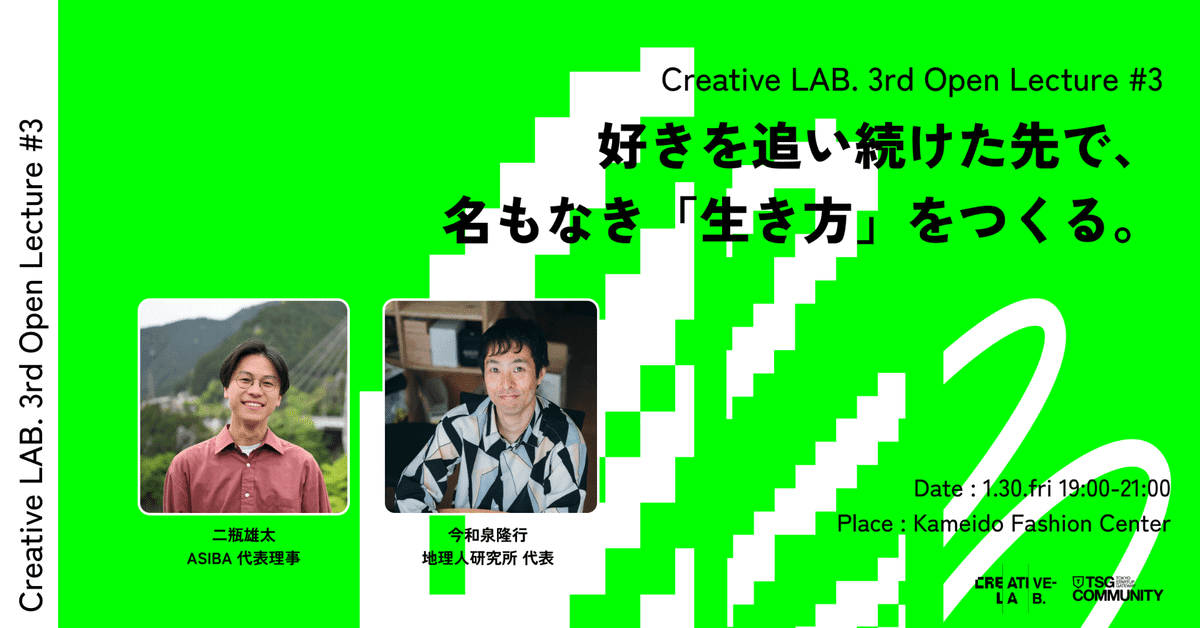
FIG.1
That night, Takayuki Imaizumi—known as “the Geographer”—began by saying, “Since I have no pride, I’m generally fine with being asked just about anything.”
The third installment of Creative-LAB. was held as an open event, featuring Mr. Imaizumi as a guest under the theme “Creating Is Living.” Known as a creator of imaginary maps, he didn’t talk about maps at all—instead, he spoke about what came before that: how he made ends meet and how he built his career.
First, Mr. Imaizumi presented a breakdown of his income. Commissioned fantasy maps and art exhibitions accounted for 19.6% of his total income from 2011 to 2023. In other words, his pure income as a “fantasy map artist” amounts to less than 20% of the total.
So what about the remaining 80 percent? Writing, lectures and workshops, participation in projects related to maps and geography, map design for real-world regions… When you list them out, almost all of it is related to maps and geography. “It’s true that almost all of my work originated from Imaginary Maps. So it’s not a lie to say that ‘creating Imaginary Maps led to work.’”
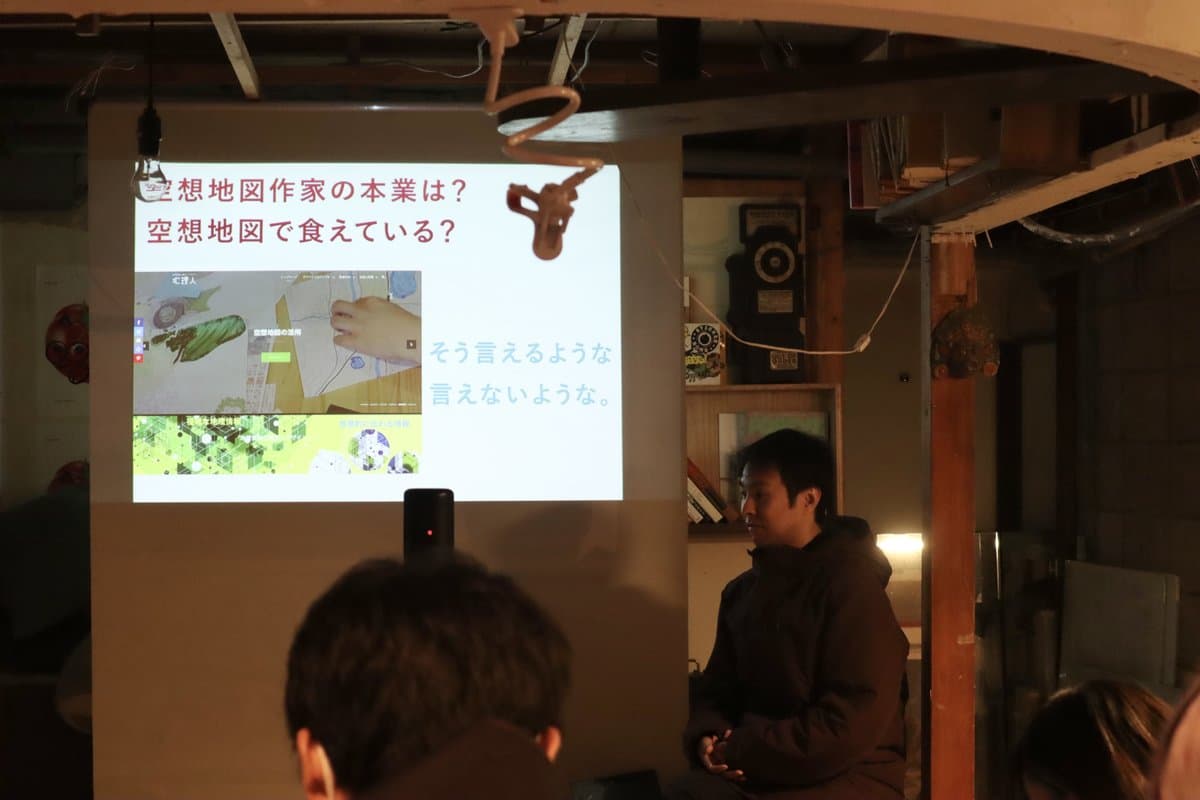
FIG.2
I quit my job in 2011, when I was 26 years old.I failed my high school physics course and was forced to switch to the humanities. Although I enrolled in a geography program, I couldn’t see a clear career path, so I transferred to another university. I took a part-time job at an urban design consulting firm but gave up on that career path due to the industry’s harsh realities. Realizing that “you can’t choose the perfect career path on the first try,” I joined an IT company with many clients, but I left after two years.
After quitting, the rule Mr. Imaizumi set for himself was simple: “If my income as a self-employed person doesn’t increase within two years, I’ll find a new job; if it does, I’ll go into business for myself.” The idea was to first test whether he was suited for self-employment or if being an employee was a better fit. His initial work could be categorized into four areas.DTP design, information and map design, geographic information editing, and imaginary map-related work. The higher up the list, the greater the demand and competition—a “red ocean” where one can make a living; the lower down, the less demand and competition—a “blue ocean” where it’s hard to make a living.“At first, I had no choice but to scrape by with DTP design. It wasn’t until 2015—four years after I quit my job—that I started getting work related to fictional maps.”
Immediately after quitting his job, Mr. Imaizumi got by on part-time work for a while. Although he had some savings, he was fundamentally driven by the anxiety that “I need a monthly income no matter what,” so two years later, he took a certain step. “First, I decided to reduce my resistance to seeing my savings dwindle.Instead of getting a job, I trained myself to simply watch my bank balance dwindle and get used to it.”
“The first month was nerve-wracking. I was still anxious in the second month. By the third month, I’d grown accustomed to seeing the balance drop, and the realization that ‘if this keeps up, I’ll be dead in eight months’ began to feel like a realistic possibility,” he says.“If you accidentally skip this training and stay scared, you’ll either put on a brave face and pretend you have a job, or take on a random part-time gig that prevents you from doing what you really want to do. If you allow yourself to acknowledge that things aren’t okay in the short term, they’ll start to work out in the long run.”
Three months later, just as I’d gotten used to the decline, I started a part-time job and a temporary position to restore my income. It was a night shift job designing flyers, paying about 2,000 yen an hour. While establishing a situation where I could just about make ends meet by working three days a week, I gradually built up my work related to “Imaginary Maps.”
In the latter half of 2013, the proportion of my self-employed work surpassed that of my part-time and temp jobs, and I officially became self-employed for the first time.
However, the work for “Kusō Chizu” didn’t increase immediately after that. The numbers listed on the slide honestly reflected that progression.From 2011 to 2013, DTP design accounted for 45% of my income, while Kuso Chizu-related work made up 36%—though this was due to “two book commissions coming in by chance”; without them, it would have been nearly zero.By 2019–23, Kuso Chizu-related work exceeded 50%, while DTP design had dropped to 1.6%. “The truth is, the center of gravity gradually shifted from 1 to 4. We didn’t jump into a blue ocean right from the start.”
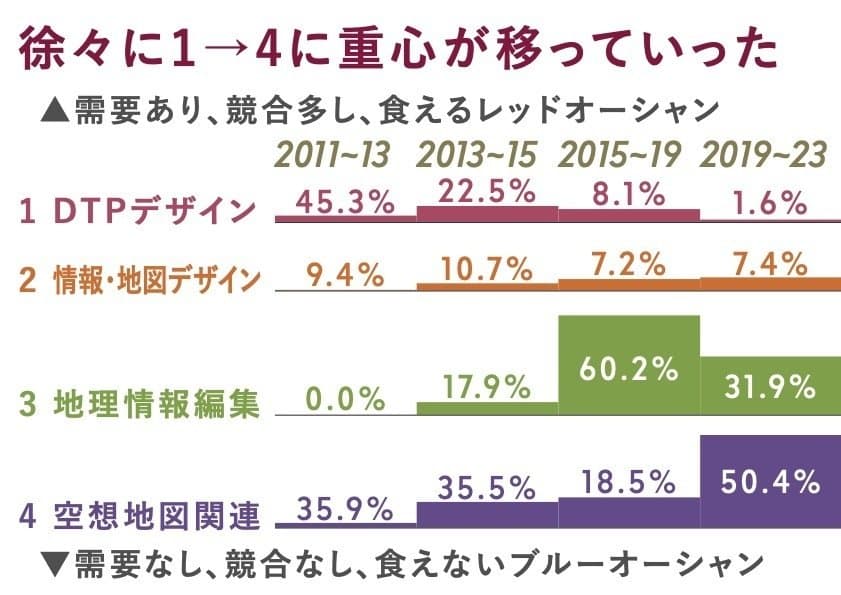
FIG.3
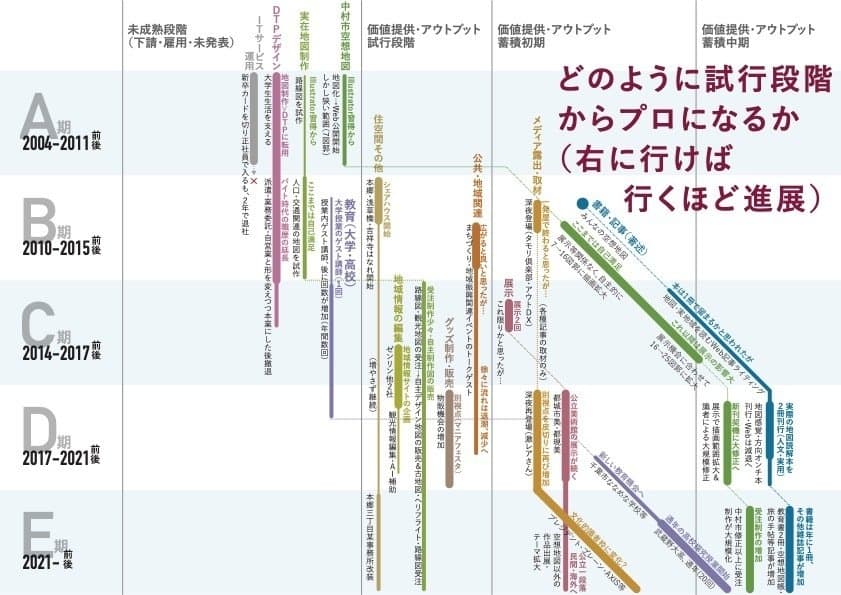
FIG.4
This shift wasn’t driven by his own sales efforts. Mr. Imaizumi describes himself as “someone who doesn’t apply for jobs or make proposals—an extremely passive person.” Yet he says his work expanded because, armed with “fictional maps” as his “secret weapon,” he continued to make appearances in various circles whenever he was invited.Community development, venture media, design, architecture, art—he says that, before he knew it, the field of maps and geography was the very last one he ended up in.
How does Mr. Izumi view what is needed in today’s world? “During the Showa era, society functioned because there were many people who were competent at an average level. But now, AI has taken over the tasks of following rules at an average level. We’re in an era where people who may have some shortcomings but excel in a particular area are preferred.”
However, he also notes that this “edge” isn’t necessarily a “subject you excel at.” “It’s something that isn’t particularly difficult for you compared to others—an unconscious habit you don’t even realize you have. Surprisingly, those are the things that give you an edge. It’s about whether you can recognize that while others seem to be struggling, you don’t find it particularly difficult at all.”
He also says there are three ways to deal with weaknesses: accept them, accepting the consequences; overcome them to the minimum necessary extent; or compensate for them with other strengths. “You don’t have to force yourself to eliminate your weaknesses. If things go well, trying to compensate for a weakness can sometimes lead to the emergence of a unique strength.”
Mr. Imaizumi himself admits that he isn’t number one in maps or geography. However, when he combines his knowledge of maps and design with his ability to explain things to people who aren’t interested in maps, he becomes one-of-a-kind. “Especially in the field of geography, there aren’t many people who are strong in both design and communication. It seems that’s where I tend to land my work.”
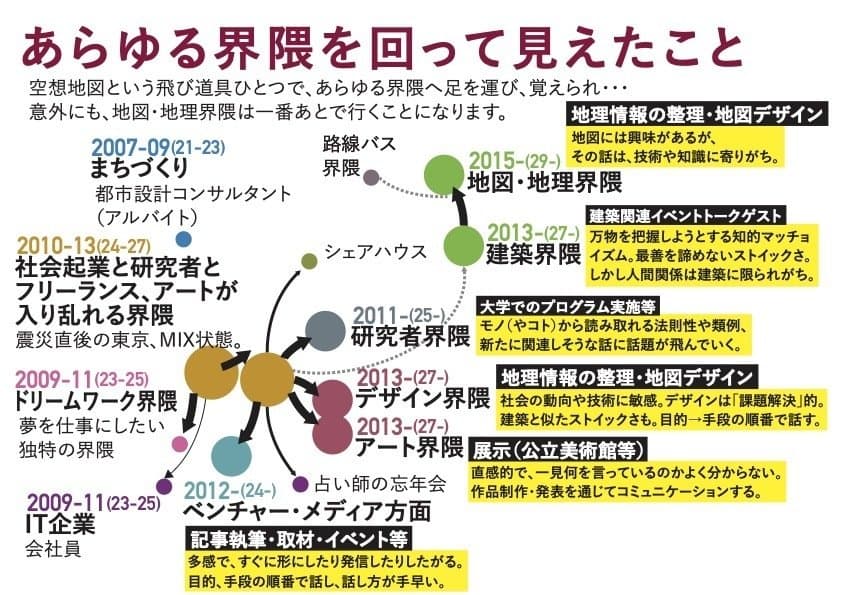
FIG.5
“I’m doing the work of a map company even though I don’t work for one. I’m involved in community development projects even though I’m not employed by city hall. I teach at a high school even though I don’t have a teaching license or a master’s degree. ‘In the Showa era, work was contained entirely within an organization.But now, we’ve entered an era where organizations bring in outside specialists to start new initiatives. Even without getting a traditional job, there are paths to get involved from the outside.”
It’s not the title that comes first—it’s the work itself. Even the name “Fantasy Map Artist” came later, as a result of my continued drawing. “I didn’t set out to become anything in particular. It’s more like I kept going, and before I knew it, it had taken shape.”
After the lecture ended, casual conversation continued in the venue for a while. When asked, “Did you have a goal?” Chiri-jin paused for a moment before answering, “No.”
He hasn’t been guided by a North Star to aim for, but rather by the compass right in his hands. Even so, he says the one direction that has never wavered is “heading toward a blue ocean with no competition.” Just because you love something doesn’t mean you can make a living from it right away. But there’s no need to give it up in a rush either.
(Written by Yoshihiko Kanda)
Creating the Intersection of Creation and Life / TSG Creative-LAB. Phase 3 DAY 1 Lab Joint Kickoff
Creative-LAB. Phase 3 Program Report #1
REPORT
2026.02.25.