Practice of Unsettlement #2
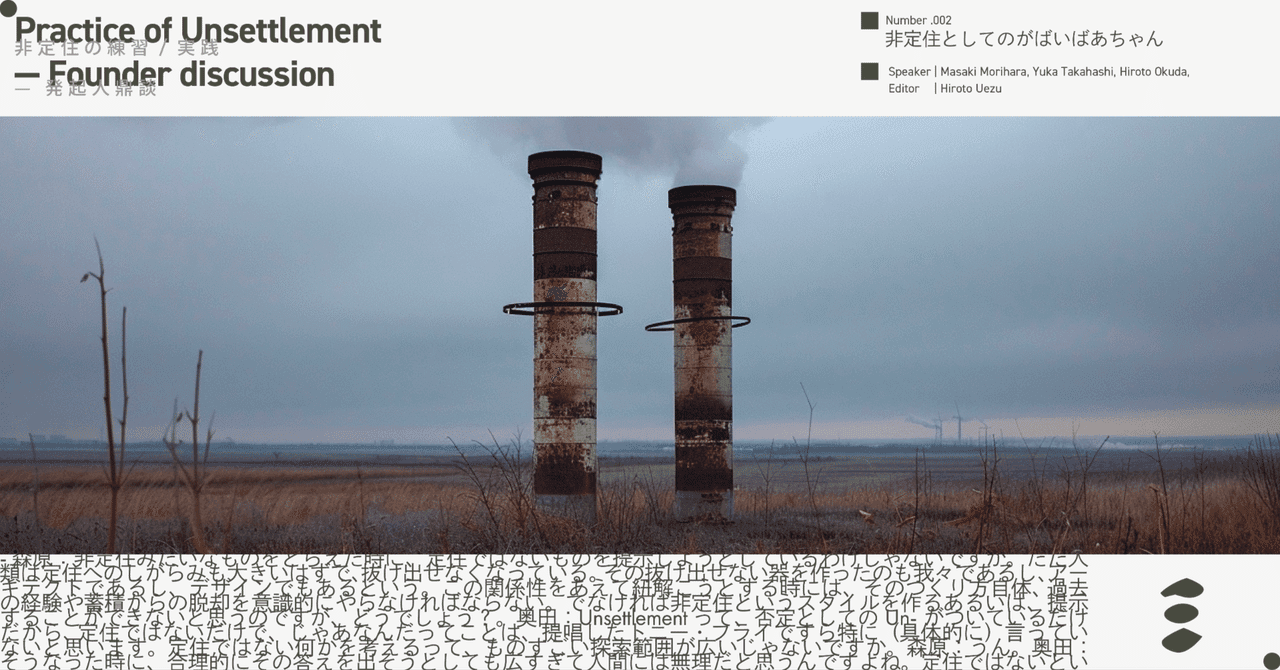
FIG.1
The “Practice of Unsettlement” (hereinafter PoU) project champions the concept of “non-residence” to challenge the unsustainability of current urban and residential forms and explore new possibilities for living that transcend them.In this installment, we present a roundtable discussion exploring the contours of “Practice of Unsettlement,” featuring Okuda of Poietica, Morihara of ASIBA Architecture Design Studio, and Takahashi, a design curator—all of whom are driving the PoU initiative.
Takahashi: The reason we started this roundtable discussion was that I wanted to reflect on the theme of “non-residence.” I imagine there’s a line of thought that questions current issues like nuclear power generation, the infrastructure we live in, and even our lifestyle itself. Could you tell me, Okuda, why you want to think about this right now?
Okuda: Yes. First, regarding this project, the term “unsettlement”—which forms the basis of the Japanese term “non-residence”—is a concept developed by Tony Fry, a design researcher. He has established a base in Australia called the “Studio at the Edge of the World,” where he devotes himself entirely to writing books; I think he can be described as a design philosopher. His term “unsettlement” is believed to have first appeared in *Remaking Cities* (2011). Essentially, it argues that in a situation where sea levels are rising due to the climate crisis and agriculture is inevitably taking on new forms, if our traditional way of living—based on “settlement”—is creating unsustainability, then we have no future unless we break away from it.
What I mean by using the term “non-settlement” is not simply to advocate for a nomadic way of living, but to rethink whether our very approach to inhabiting the Earth has been fundamentally flawed from the start. The underlying context is that we must move away from the “humans versus nature” framework and consider forms of habitation that go beyond a gatherer-based model.
Morihara: I share a similar sense of urgency. The background behind the emergence of today’s sedentary forms of settlement involves factors like energy, labor, and social structures—the need to build densely on flat land or construct large-scale energy facilities lies at the root of architecture.Another point is that architecture is fundamentally slow to change—it’s even called the “last of the comprehensive arts”—and it probably evolves the slowest of all, haha. I also resonate with Okuda’s ironic proposal for architecture from the perspective of the humanities-oriented design side.
Okuda: Yes, design is much like architecture. Looking back now after finishing graduate school, where I saw a mountain of design examples from overseas, I generally feel that Japanese design is, by any measure, far too commercially driven.In case studies and theses from overseas design schools, discussions about the political nature of design and the ideology behind making things are unavoidable, but I strongly feel that these aspects have been obscured in Japan. I believe this proposal—which asks, “Shouldn’t we rethink our way of life, starting with the very concept of settled living?”—has sprung from those experiences and sensibilities.
Morihara: Now that we’re getting to the main topic, I’d like to start by discussing the first theme: how do design and architectural practices relate to non-sedentary living? What are your thoughts on this, Okuda?
Okuda: Yes. I’ll jump right in here, but I think Arturo Escobar’s *Design for a Pluralistic World* offers a clue for connecting architecture and design. Chapter 2 of this book discusses human living spaces, and it introduces dwellings in a region of Colombia called Maloka as an example.These dwellings are designed as large, single-family homes where everyone sleeps on mats laid out on the floor. He suggests that people raised in a Maloca would clearly have a different relationship with man-made objects and their environment compared to those raised in the car-centric suburbs of the United States. The book discusses how such designs shape people’s living environments, and how those living environments in turn alter people’s very perception of the world—a concept described as “design redesigning itself.” I believe this is a topic relevant to both architecture and design.
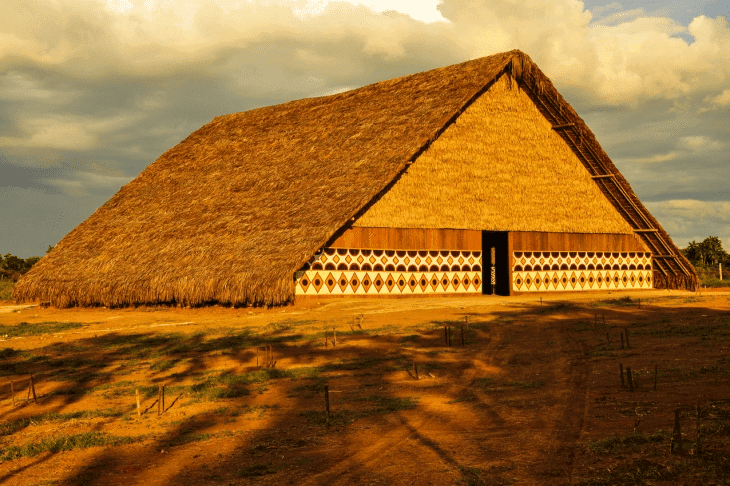
FIG.2
Morihara: That’s interesting. When architecture considers living spaces, there’s a tendency to start from a “should” perspective—like “how should people live?”—but I think anyone involved in design would understand that the original landscapes of the places we’ve lived, the forms we’ve always seen, and our everyday experiences all unconsciously influence our work.I don’t think we can deny that the constraints we face from spatial experiences and memories are mutually interdependent with the spaces and places we ourselves create.
Morihara’s concept of “non-sedentary living” seeks to present a form of dwelling that is not rooted in sedentariness, doesn’t it? However, humanity is deeply entangled in the constraints of sedentariness and has become unable to break free. It is we—as architects and designers—who created this inescapable framework.When we deliberately attempt to unravel this relationship, we must consciously break away from past experiences and accumulated practices in the very process of creating it. Otherwise, I don’t think we can create or present a style of “non-settlement”—what do you think?
Okuda: “Unsettlement” just has the “un-” prefix, which implies negation—it simply means “not settled.” But as for what it actually is, I don’t think even Tony Fry, who proposed the term, has specified that in any concrete way. Thinking about something that isn’t settled opens up an incredibly broad scope for exploration, doesn’t it?
Okuda: In that case, I think it’s impossible for humans to arrive at a rational answer—the scope is simply too vast. I believe it would be quite groundbreaking if, through this exhibition project, we could demonstrate that “not being settled” isn’t a separate thesis but rather one of several possible realities.
Takahashi: So, rather than stating, “Non-residency is this,” it would be better to demonstrate through practice that “this might be one form of something that isn’t residency.”
Takahashi: When comparing design and architecture, the research itself becomes the design in design, doesn’t it? On the other hand, since the purpose of architecture is to construct a building, I think the major difference is that the research process is merely a means to an end. In design, it’s often the case that what exactly is being designed isn’t decided until the project begins.
Morihara: In architecture, once you have a site, a client, and a general number of staff members, you design with the goal of quickly producing a plan within three months—so what you’re going to build is already determined. I’d say the essence of the architectural profession lies in this state where both what you’re building and where you’re building it are already fixed.I wonder if the term “non-sedentary” is fundamentally meant to upend the very foundations—as if to say, “The site is unknown.” Moreover, architecture has always existed on the basis of sedentariness; if that foundation is dismantled, what will we be able to do? I feel like we’re being confronted with this profound question.
Okuda: I just had a completely out-of-the-blue idea, so I’d like to share it as one perspective. There’s a man named Masana Izawa who goes by the mysterious title of “Fecal Soil Specialist,” and he has been consistently defecating in the wild.He bought a mountain himself, uses it as his toilet, and goes there whenever he feels the urge. He’s been doing this relentlessly for about 20 years, and as a result, when they conducted a soil survey of the mountain, they discovered extremely rare microorganisms or fungi, as he explained.
What I’m trying to say is that whether you view owning a mountain as a resource, a restroom, or an asset makes a decisive difference. In other words, architecture—which was supposed to be a design process aligned with the purpose of having a site, a client, and building a structure accordingly—is nearing its limits.Given this premise, one possible approach might be to question, within the act of architecture itself, the very notion of treating that site as real estate.
Morihara, that’s great. You’re deconstructing and dismantling the very concept of a “mountain”—the idea that a mountain is a place for defecation. It doesn’t have to be just a mountain; it could be a “poop path” or even “poop manholes”—and then every spot would become a toilet.Surprisingly, places and land are often thought of as immovable—hence the term “real estate”—but perhaps that’s not actually the case. There may be quite a few things that are bound by language.
Okuda: That’s right. In the sense of “building a toilet without actually building it,” I thought this might be a kind of “unsettlement” approach.
Takahashi: As we mentioned at the beginning—like how Morihara-kun’s architecture generates new designs based on empirical rules, or how Okuda-kun’s designs “redesign”—practicing non-settlement might begin with reframing one’s own experiences into different words or actions.
Morihara: Another theme I’d like to explore is the question: “Is it possible to create and build something together with non-human beings?”
Okuda: I think this is a major point of common interest between Morihara and me. To cut to the chase, I believe it’s possible. However, the question of “What does it mean to create together?” always follows, and since delving into that debate seems like it would be a struggle, I feel it’s healthier and more positive to simply say, “For now, I believe it’s possible” (laughs). Specifically, there’s an example from the 21_21 Design Sight exhibition “Material, or,” which we did in collaboration with Actant Forest: a material that promotes the growth of microorganisms and fungi that live in symbiosis with plant roots.
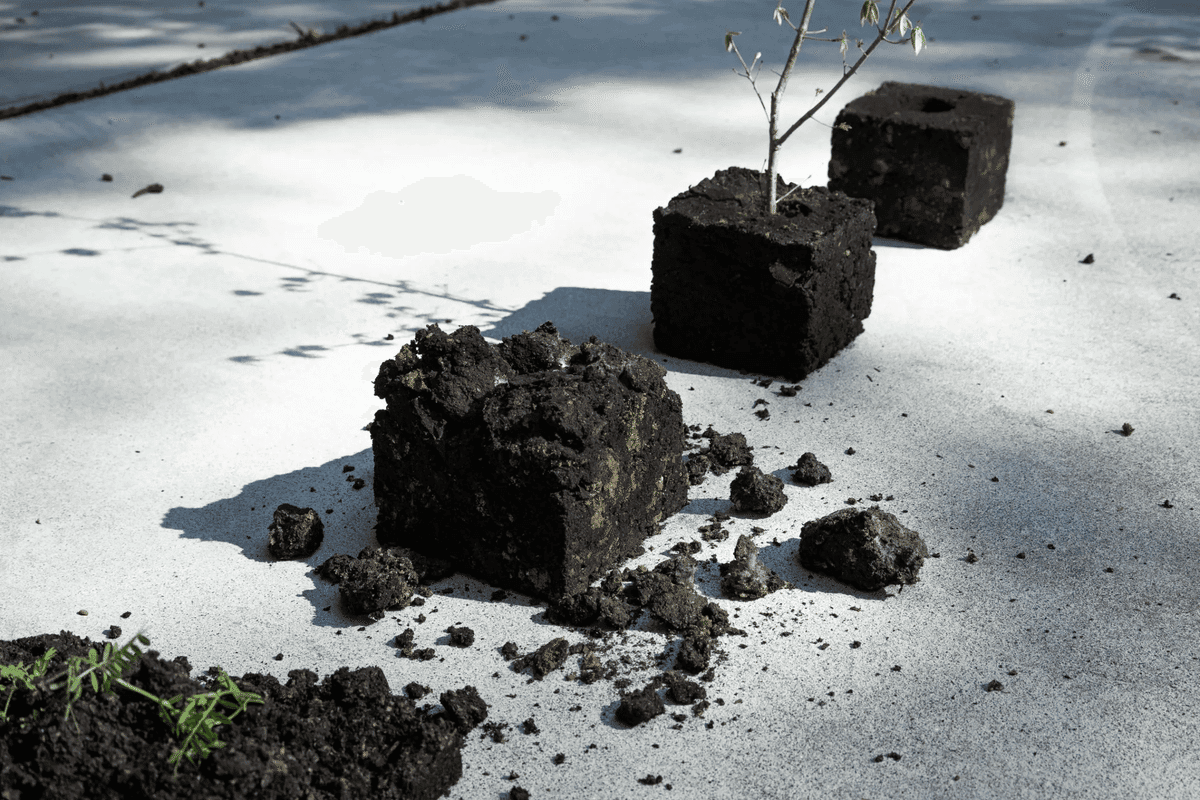
FIG.3
The reason I think it’s possible is that when we were taking down the exhibition and broke up the blocks in the deepest, dampest part—where drainage was poor—an insane number of cockroaches came pouring out (laughs). In other words, there are many things that show up unintentionally once you’ve created something. It’s unpredictable, uncertain, and emergent; depending on how you look at it, you could say the insects reinterpreted the artwork, and I think it’s fair to say we created it together. This is the experiential background that leads me to believe it’s not impossible to create something together with non-human living beings.
I think this premise involves a shift in attitude—acknowledging that we can’t design everything and that there will be unforeseeable consequences.
Morihara, this is really fascinating. I have a mountain of things I want to talk about. (laughs) The fact that cockroaches recognized that place as a habitable environment—living creatures’ instincts for survival environments are truly remarkable.
I’m also conducting research on whether we can view animal nests as architecture. I’ve been approaching this with questions like whether we can create things—including architecture—together with living creatures, and why animal nests aren’t even considered part of architectural history in the first place. The reason is that while architecture known as “vernacular architecture” is often cited as historically significant, I wonder if the same isn’t true for living creatures.As I observe the forms created by various creatures, I’m thinking about how to interpret their meanings and whether we can say they possess technical skills comparable to those of humans.
To build on what Okuda-kun said, I believe that a discovery-oriented perspective for survival—that is, the act of interpreting things—precedes the emergence of architecture. Even though Okuda-kun didn’t provide it as a dwelling, the cockroaches interpreted it as one.If we assume that the emergence of space and architecture stems from this kind of interpretation—such as thinking, “This hole looks like it could work”—then since we are living creatures too, I think it’s probably the same for us. And when considering non-sedentary ways of living, I feel this exploratory perspective is incredibly important; rather than planning or stabilizing a settled life, I see potential in the cockroach-like approach of thinking, “This hole could work.”Rather than “creating together,” perhaps we need to “become one with them”—that is, become cockroaches ourselves—and actively learn from the way they build their nests.
Okuda: Moving away from the idea of “creating with living things” for a moment and returning to the topic of settlement, there’s a project by Michael Rakowitz called *FROM PARASITE, ONGOING PROJECT*.It’s a project that designs spaces where homeless people can keep warm by attaching large plastic bags to outdoor air conditioning units in the city, turning them into tent-like structures.
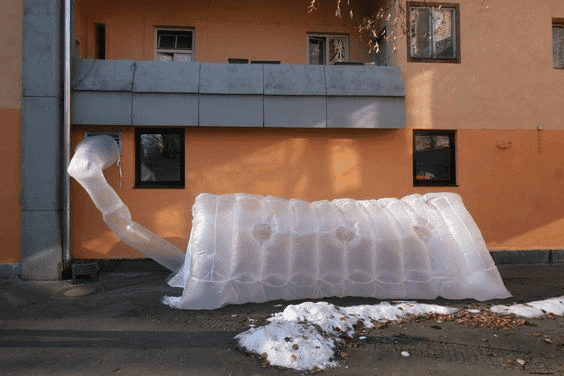
FIG.4
The reason I thought of this now is that I felt the act of “imagining something” in an environment saturated with artificial objects—rather than in a so-called natural environment—is closer to a cockroach’s perspective. Designing architecture and creating objects on the premise that they will constantly be reinterpreted—designs that assume incompleteness—are not often sought after or accepted in social contexts, so I hope to achieve this using the format of an exhibition.
Even so, Takahashi, I can’t help but feel that design premised on incompleteness isn’t really design at all—it’s simply everyday life.In what Morihara and Okuda said earlier—creating alongside the unexpected and actively reinterpreting man-made objects—is less about design and more like the ingenuity of daily life, where we sense our environment and adapt our bodies accordingly. I thought that might be the appropriate scale for this.
Ezio Manzini, a design researcher, says that designing is like singing. Singing is something everyone is fundamentally capable of, but because we don’t sing every day, we feel self-conscious or can’t do it well.However, Manzini believes that if we start singing little by little—or if we sing together so that even those who aren’t good at it can join in—and these experiences accumulate, it might open up ways of creating that differ from how our current society is structured. In that sense, the idea that there is no difference from daily life aligns with Manzini’s observation.
I deeply resonate with Moriwara Takahashi’s statement, “Isn’t it just life?” To put it another way, I often find myself wondering if living beings aren’t actually designing at all. (The way living beings create things) might not be “design” but rather “adaptation.” This raises the question of why humanity needs design, as well as why other living beings don’t engage in it.
Considering nomadic living in light of how, since the modern era, architects have—somehow—engaged in a form of “designing daily life” that has emerged outside the conventional mindset of creating for society, it seems less about planned, social design and more about each individual’s way of living. Perhaps it’s about evoking a mindset where each person must adapt—and where adapting is seen as a positive thing.
Okuda: That’s right. So, it ranges from “life hacks”—or rather, how to work efficiently using ordinary household tools, at the level of the “Matsui Stick”—to the nest-like structures homeless people build to survive, and even the wisdom of our grandmothers for getting by in times of scarcity.
You couldn’t exactly call it “technology,” but these things—which are essential for sustaining daily life—exist even without using the term “design,” and they form part of what sustains distinct economic and social spheres. When we deliberately treat these as design or architecture, questioning their meaning leads to a practice that critiques the political nature of design and architecture—in other words, a practice that sheds light on how contemporary design relies on the ideology of sedentarism.One such issue might be how we coexist with non-human beings, or how we best handle the wisdom and knowledge derived from that coexistence.
I, Moriwara, realized I lacked the wisdom of those “tough old grannies,” and when I wondered why that might be, I concluded that perhaps we have knowledge but lack wisdom—in other words, even though we possess knowledge and the technical skills to create forms, we lack wisdom. What is actually necessary when considering non-sedentary living may not be knowledge or intellect, but rather the depth of wisdom.
Takahashi: So, to wrap up today, the key point is how we can increase our wisdom through design-based practices, right?
Credit
ANNOUNCEMENT
2024.04.23.