Tokyo Futurescape Studio Event Report #1
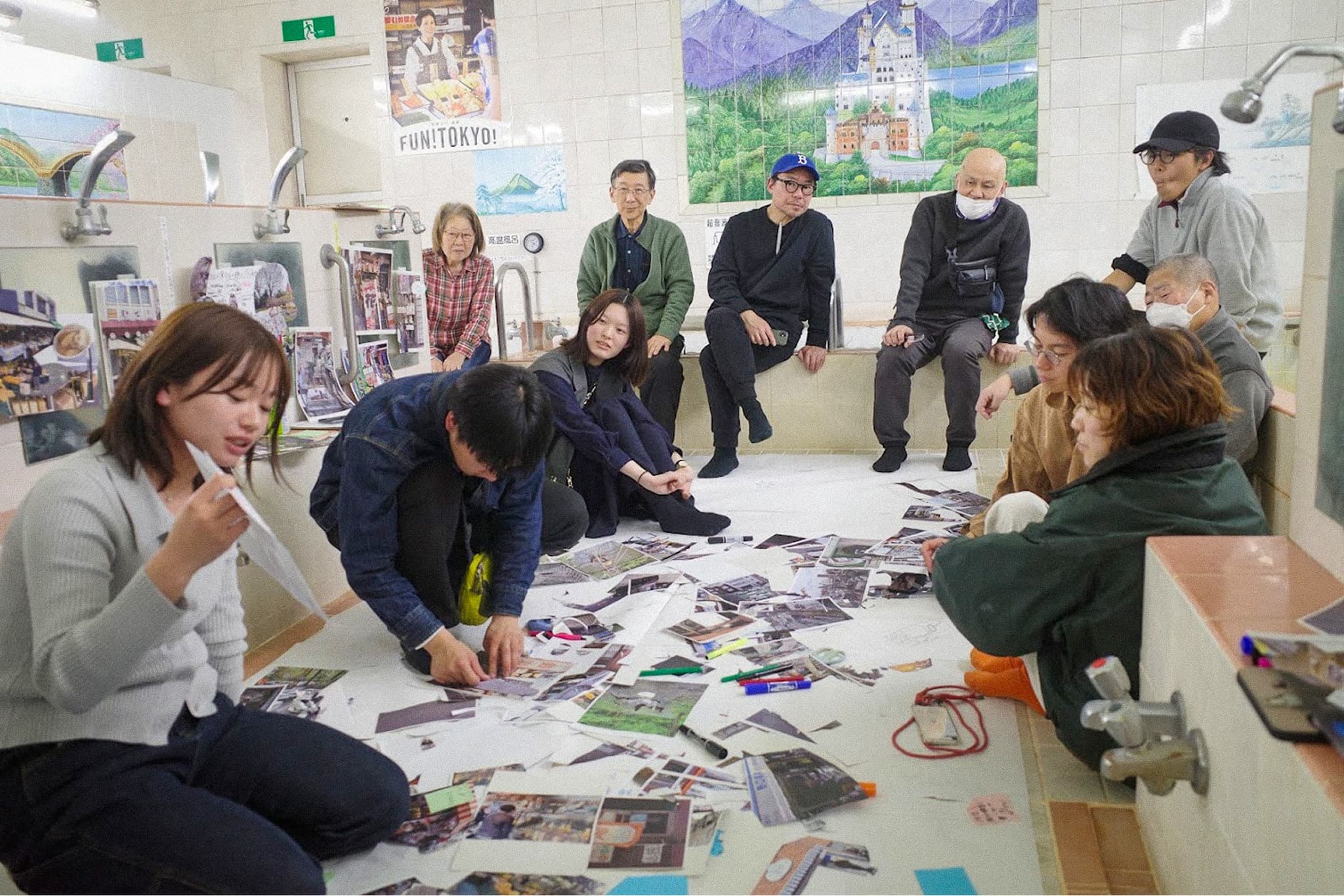
FIG.1
On March 31, 2025, we held Tokyo Futurescape Studio #01, “Covered Channel Shopping District × Landscape Collage,” at “Matsu-no-Yu,” a public bathhouse in the Tabata Ginza Shopping District.A total of about 20 people, including architecture students and local residents, participated. They spread out maps and photographs in the public bathhouse and created collages depicting future landscapes.
Workshop Overview
Date and Time:March 31, 2025, 10:00 a.m.–6:00 p.m.
Venue: Matsu-no-Yu (4-3-9 Tabata, Kita Ward, Tokyo), Tabata Ginza Shopping Street
Organizer: ASIBA (General Incorporated Association)
Event Support: Matsu-no-Yu
Collaborators: Volunteer local residents, local ward assembly members
This workshop was held as a prototype for “Tokyo Futurescape Studio,” a workshop series designed to positively and creatively envision Tokyo’s landscape 50 and 100 years from now.
In an era dominated by private-sector urban development, the importance of the public sector—which can take a long-term view and take action purely to enrich citizens’ lives—is only increasing. However, the capacity of the public sector will inevitably shrink.In this context, how can we address issues that are (deemed) low-priority and for which funding cannot be allocated? Furthermore, given that the public sector is constrained by projects with 1- to 3-year timeframes, how is it possible to take action with a 10- to 20-year outlook?
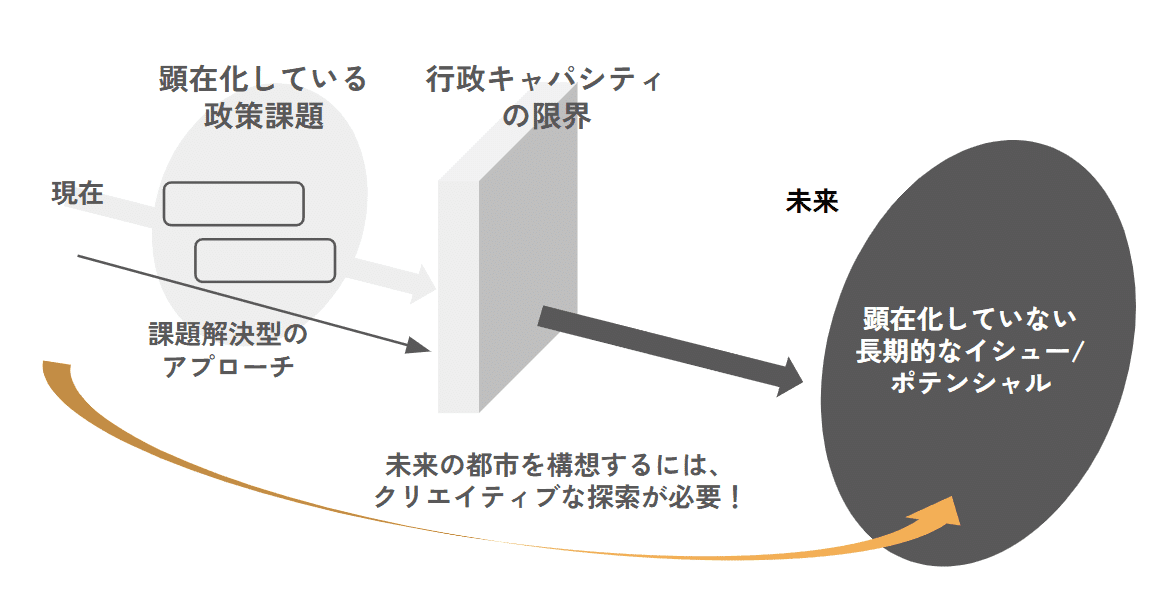
FIG.2
Based on this awareness of the issues, we believe that in modern cities where challenges are intricately intertwined, discovery through a “bricolage”-like process—and the “projects*”* based on that discovery—are more important than a problem-solving approach.Rather than prioritizing challenges in a zero-sum manner, might a more positive city emerge from the accumulation of actions—actions in which we discover fragments of a positive future on our own, envision future possibilities, and give shape to something to realize them? And it is precisely these actions—these “projects”—that constitute the creative entrepreneurship ASIBA strives to achieve.
In this workshop series, we aim to gain discoveries and insights that lead to such “projects” while exploratively sketching future landscapes in various areas of Tokyo.
*The term “project” used here is based on the concept proposed by Ezio Manzini, a leading figure in social innovation and design research. In strongly advocating for the role of design in social transformation, he defined a “project” as the process of reexamining existing circumstances, envisioning a desirable future, and bringing about concrete changes to achieve it.He further characterizes a society shaped by such pragmatic practices as “project-based democracy.” For more details, please read *Creative Democracy*!
In the past, Edo was crisscrossed by canals, and its waterfronts served as hubs for logistics and bustling activity; however, beginning in the Meiji period, many canals and waterways were covered over due to issues such as foul odors.In the Komagome area—which spans Kita, Bunkyo, and Toshima wards in Tokyo—several shopping districts stretch continuously for about 1.5 kilometers along the former courses of the Yatagawa and Aizome rivers. Traces of this history remain vividly in the topography, and the valley running from Oji to Shinobazu Pond is clearly visible.Amid the fully developed areas along the Yamanote Line, the presence of a continuous stretch of low- to mid-rise mixed-use residential and commercial districts is somewhat unusual; however, in recent years, the area has increasingly seen the construction of single-family homes and condominiums, as well as a growing number of shuttered storefronts.
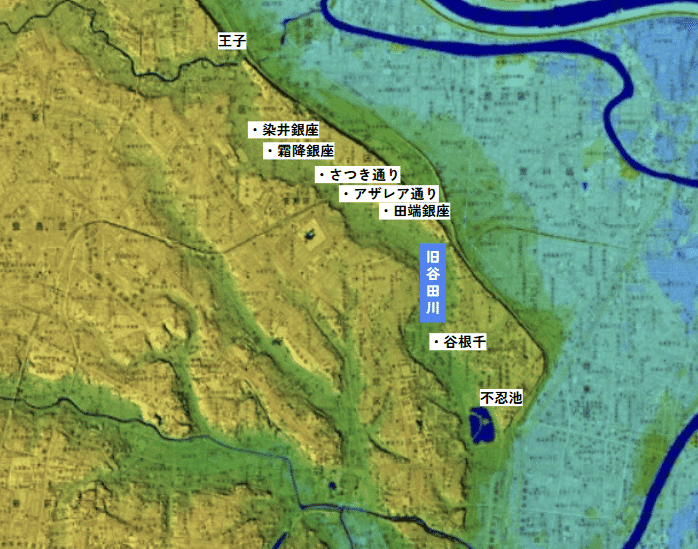
FIG.3
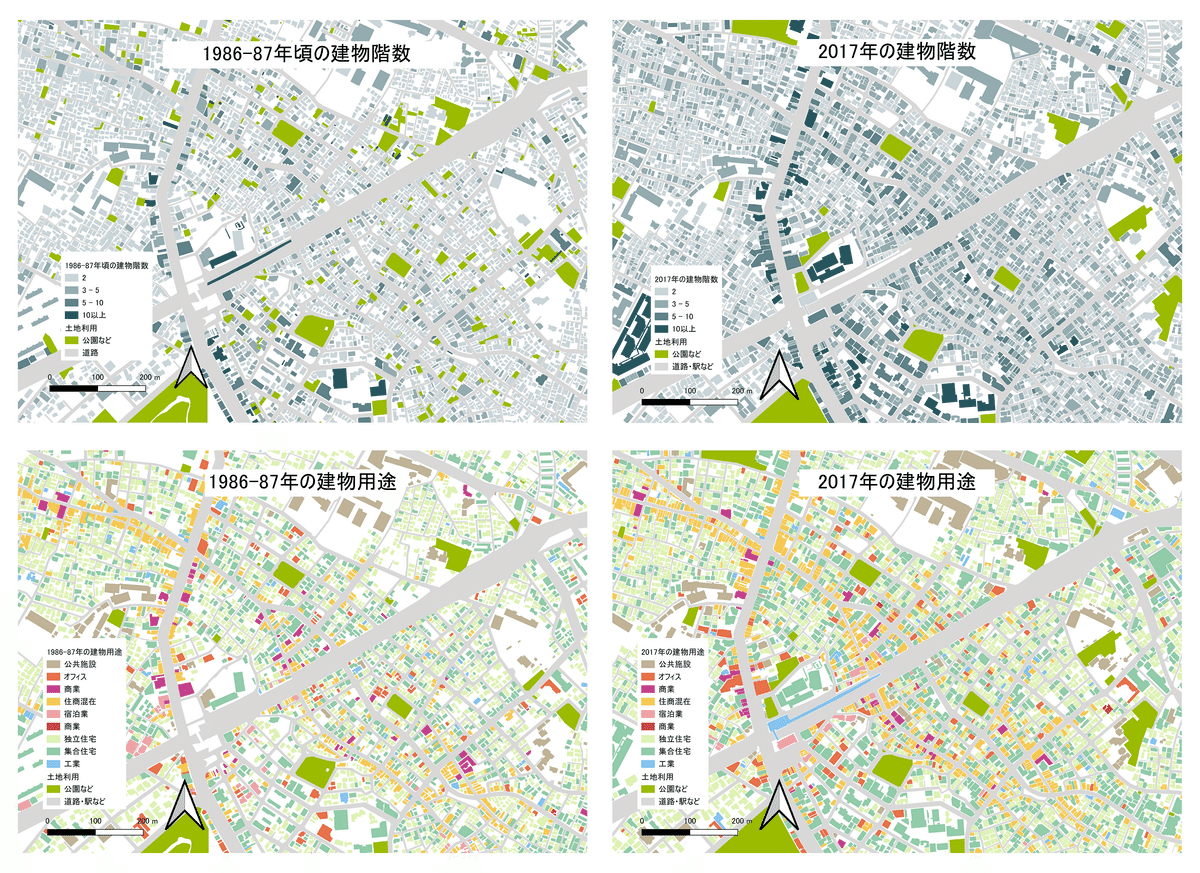
FIG.4
The close connection between topography and urban layout in Edo and Tokyo is a point frequently highlighted in studies on Edo and Tokyo—including the seminal work *The Spatial Anthropology of Tokyo*—and has continued to attract significant attention from both experts and the general public alike.
While “culvert shopping districts”—where low- to mid-rise shopping streets run along the course of a former valley that has been covered over—are rare in this sense, they can also be considered a typical everyday sight in Tokyo in that they are urban areas formed by interpreting the rich topography of the land. Focusing on these aspects, we held a workshop on the theme of “culvert shopping districts” at the Tabata Ginza Shopping District.
Located 250 meters north of Komagome Station, at the intersection of Hongo-dori and Yatagawa-dori, is“Shimogori Bridge Intersection.” On rainy days, when walking along Yatagawa-dori, a faint, fishy odor drifts in from somewhere. The shopping street, which runs from northwest to southeast through this area, is not straight but curves gently in places, giving it a warm, human touch. At JR Komagome Station, you can see the tracks below on the Sugamo side, but before you know it, the tracks have gone elevated, and at the East Exit, you find yourself passing under them. Yes, this is a shopping district that emerged where the former Yatagawa River was channelized—a so-called “culvert shopping district.”Low- to mid-rise shops stretch for about 1.5 kilometers, interspersed with gaps and branching off here and there. It is a curious everyday scene—one that exists quite naturally, without drawing attention, even in the global metropolis of Tokyo. However, by the time the children who have moved into the apartment buildings being constructed one after another in this area in recent years reach adulthood, how will this landscape have changed?
In preparation for this workshop, we prototypically developed two workshop methodologies to explore the future of the community.
For the Future Adventure Workshop, we created two types of cards to provide a framework for imagining future landscapes. The first type is “Verb Cards,” and the second is “Time Cards.” Each Verb Card features a different verb, while each Time Card lists various time periods ranging from 3 years from now to 100 years from now.
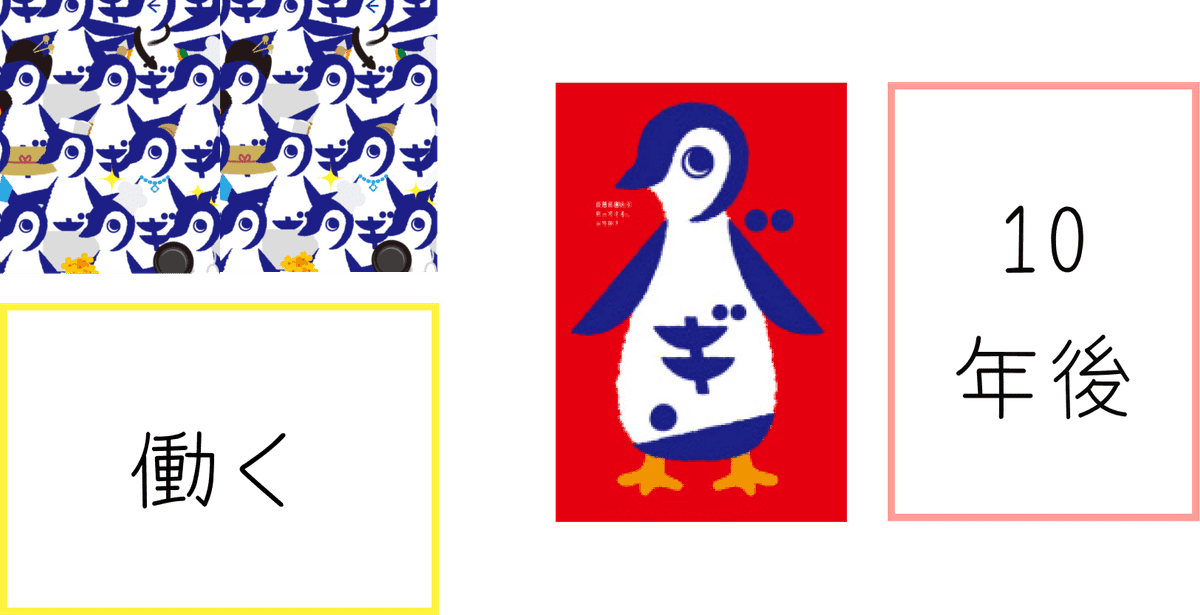
FIG.5
Participants first select three Verb Cards and one Time Card. Next, they form groups of three, and within each group, each person assigns one Verb Card to their Time Card, creating three new sets consisting of three Verb Cards and one Time Card.
They then use the 5W1H framework to develop a story based on their set, and by placing sticky notes on a map spread out across the entire public bath, they bring their story to life in the physical space.
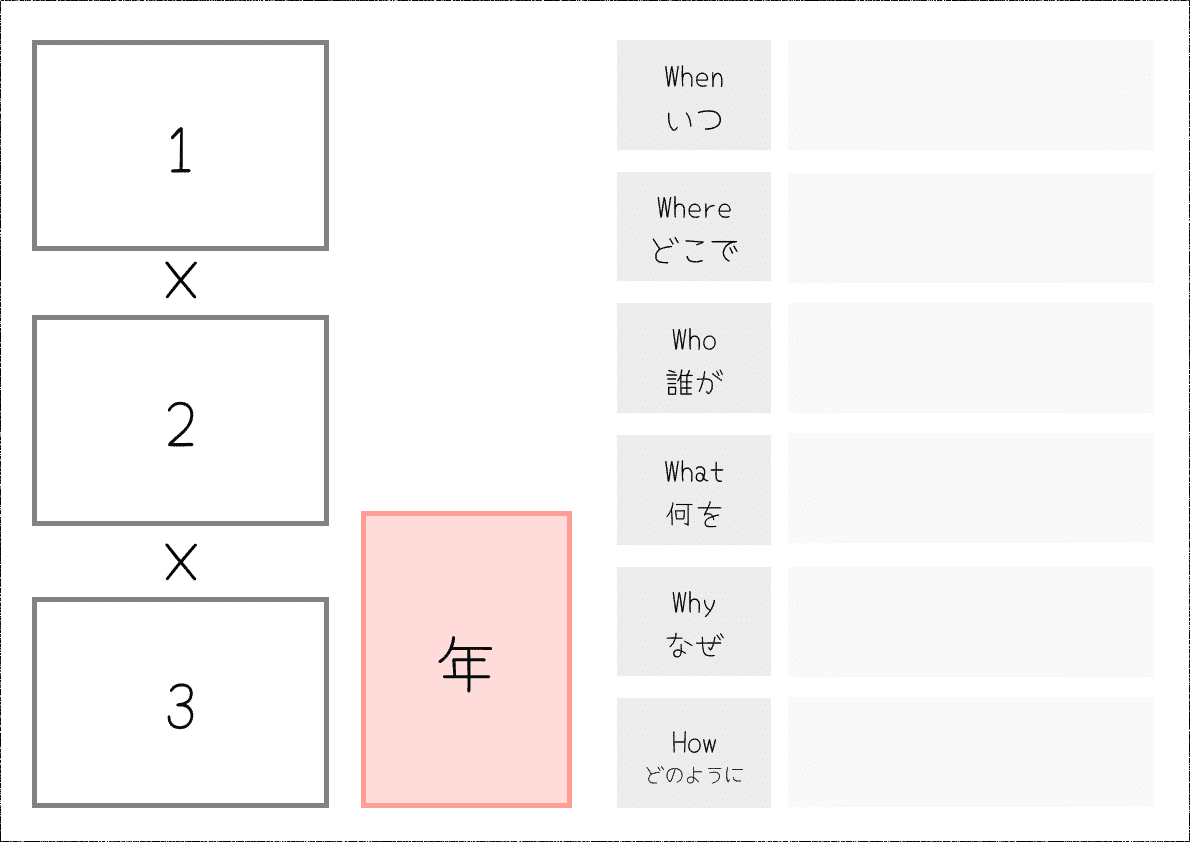
FIG.6
What effect did these two types of cards have? First, rather than simply envisioning the future of the town, providing three verbs within a defined timeline gave participants a starting point for constructing a story around a vague future, making it easier to imagine the scenery they hoped to see.The very aim of this workshop was to draw out participants’ feelings and discoveries about the city—the thoughts that follow phrases like “maybe,” “what if,” and “if only”—and we actually heard many such expressions during the event.
Furthermore, having the three verbs encouraged participants to view the town from a dynamic perspective different from their usual one, allowing them to engage in fieldwork in a more physical way, using all five senses.
In the Bathhouse Garden Workshop, held inside a public bathhouse covered entirely with maps, participants cut and pasted photos taken during their fieldwork to express the stories they had conceived in the Future Adventure Workshop through collages. These days, image-generating AI is often used to visualize stories. Among the participants in this workshop were members of NESS, who aim to update community-building workshops using image-generating AI.
On the other hand, the process of actually selecting the desired photos from a large collection, cutting them out, arranging them, and pasting them—this series of tasks—exposes participants to far richer information than simply entering prompts into AI. Examples include chance encounters with unexpected photos and discoveries made through trial and error regarding which parts of a photo to crop and how to arrange them.Precisely because it is a hands-on activity, it opens the door to various possibilities—such as feeling a sense of dissonance with something that seemed convincing in text form, or seeing new ideas take root.
I believe collage is not an engineering method for solving problems, but rather a discovery-driven process of assembling limited “existing elements” “right here and now”—and it is precisely in these discoveries that its value lies. Furthermore, I believe these discoveries possess the power to draw attention to possibilities that might be overlooked by conventional problem-solving approaches, to envision a positive future, and to work backward to make it a reality.
To start as an icebreaker, we began by piecing together a giant 1/250-scale map of the Komagome area in the Matsunoyu bathhouse.Originally, the organizing team was supposed to do this, but faced with a massive map consisting of 25 A1-sized sheets, they became confused about the layout, so we decided at the last minute to have all participants work together on it as part of the icebreaker.
Although this was unplanned, the process of assembling the map provided an opportunity to examine the layout of the city and its topography, sparking numerous conversations between students and local residents about the area’s geography and history.
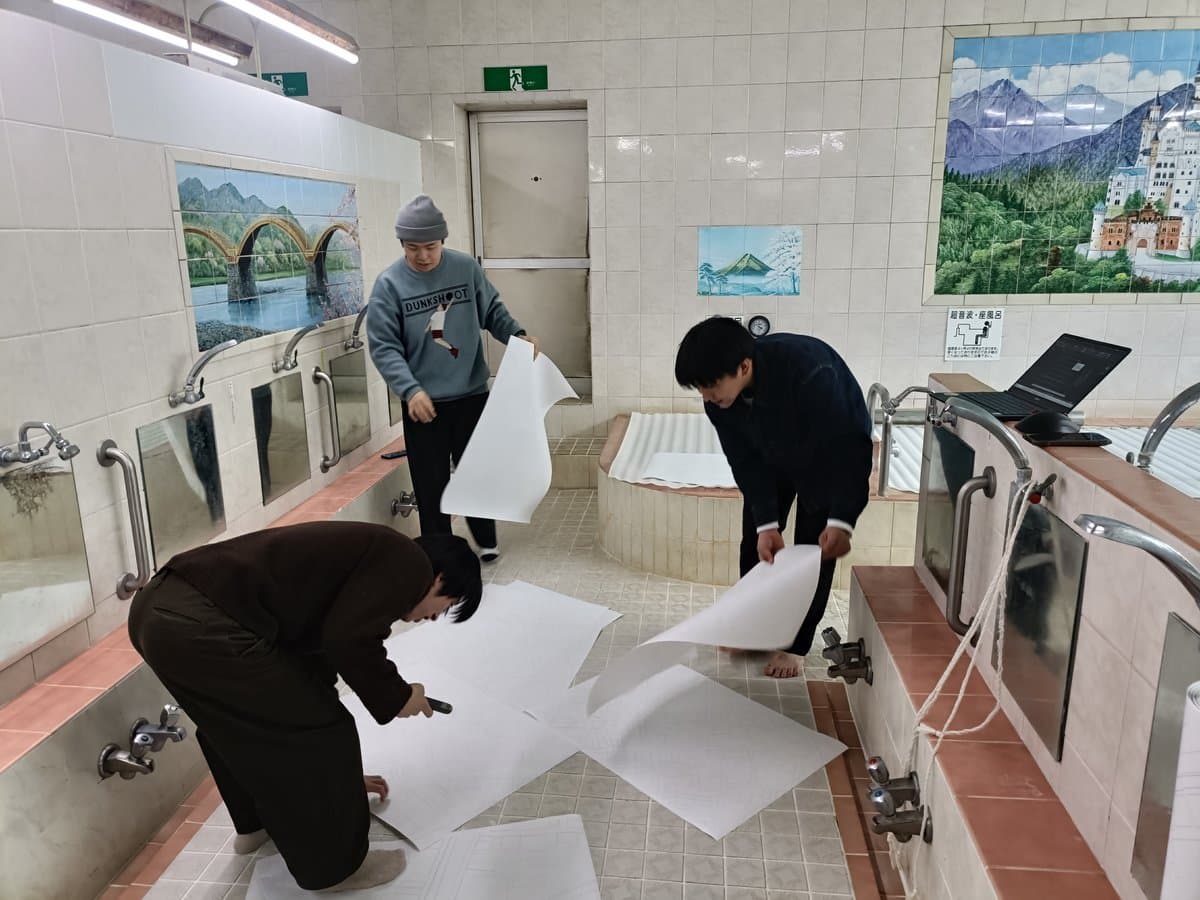
FIG.7
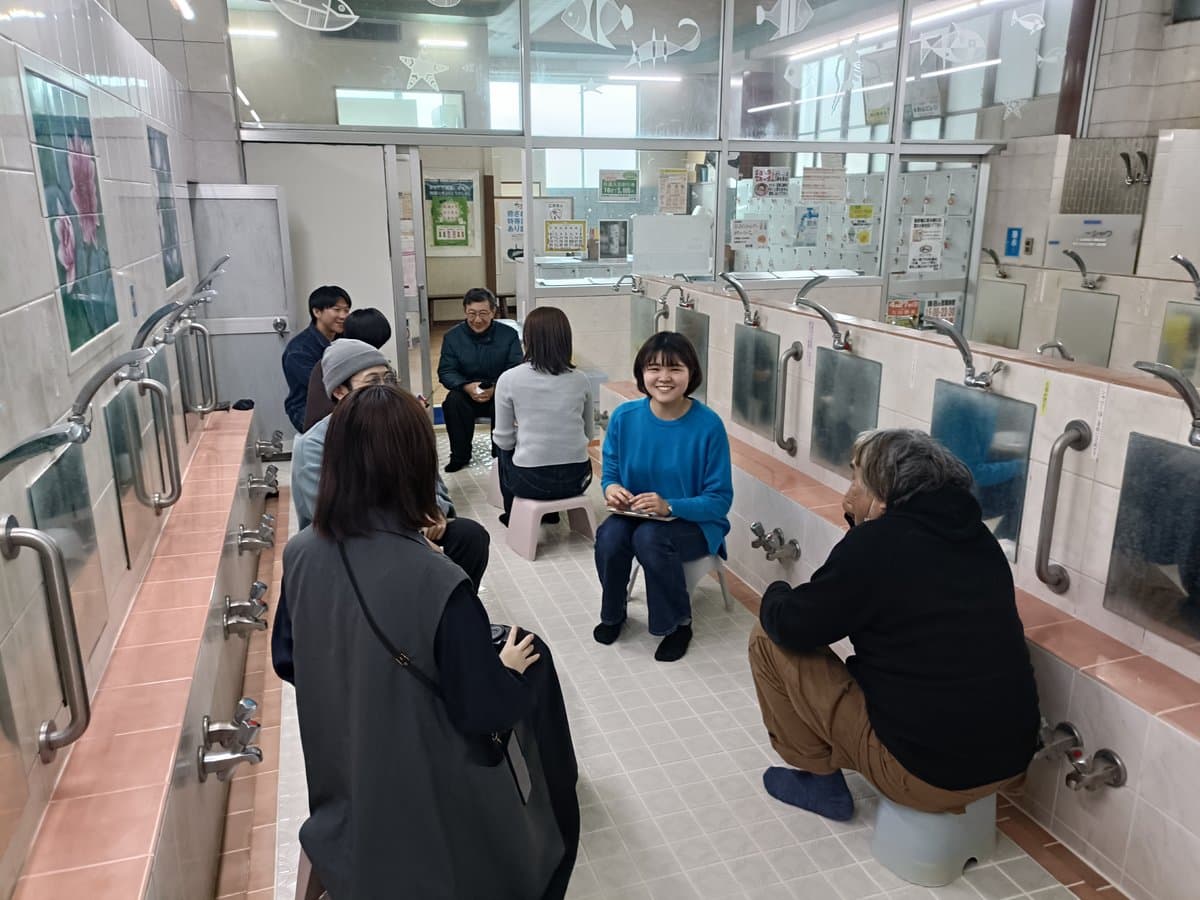
FIG.8
Mr. Honda, who has served as a local ward council member for over 30 years, gave a lecture on the Tabata Ginza Shopping Street and the Komagome area—the focus of this field trip—and then personally guided the participants through the neighborhood. In particular, he shared stories about the history embedded in the streets—such as the details of postwar land readjustment—that cannot be discovered through desk research alone.
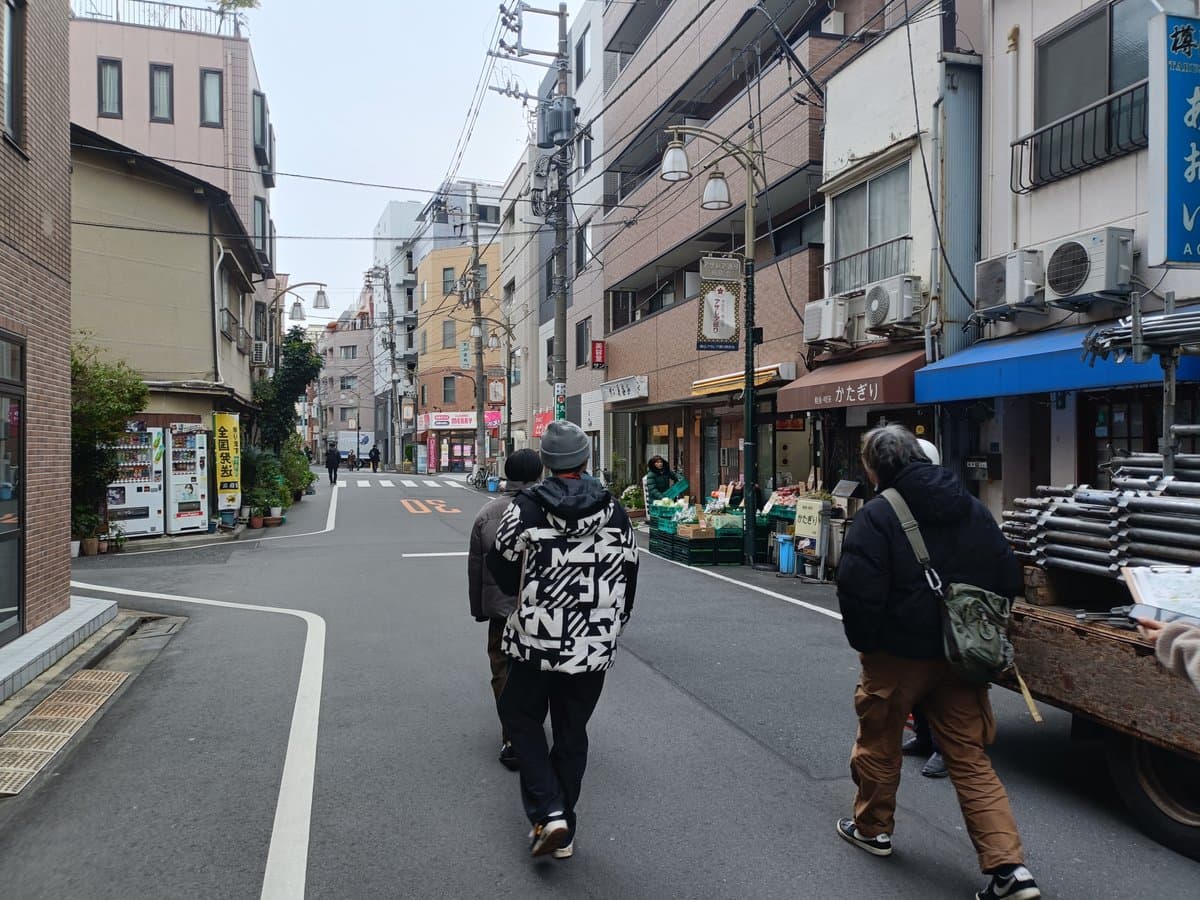
FIG.9
For the Future Adventure Workshop, we took advantage of the venue’s unique setting—a public bathhouse—by placing one verb card and one time card into each locker in the changing room and locking them. Participants selected four locker keys to secure three verb cards and one time card.
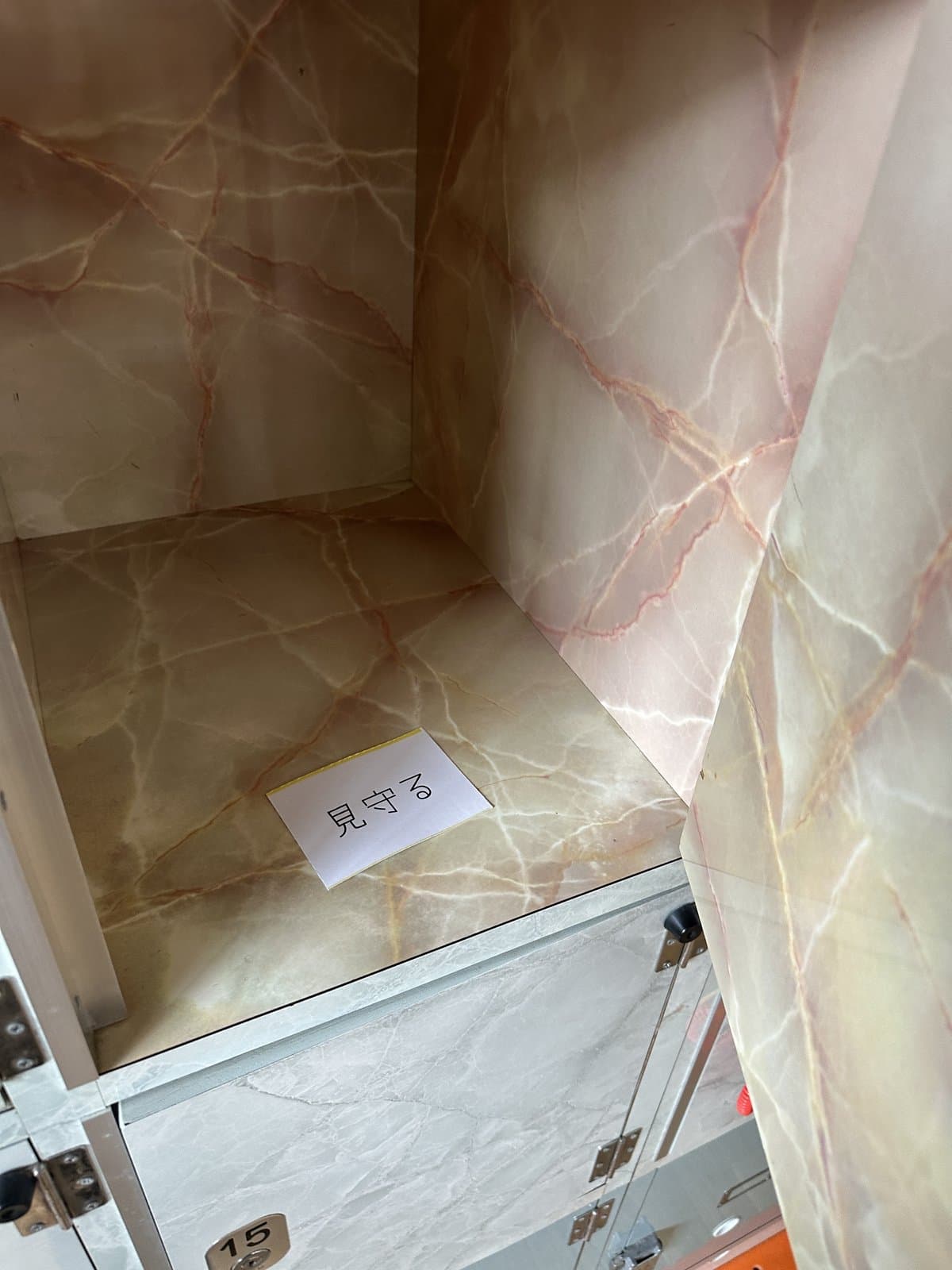
FIG.10
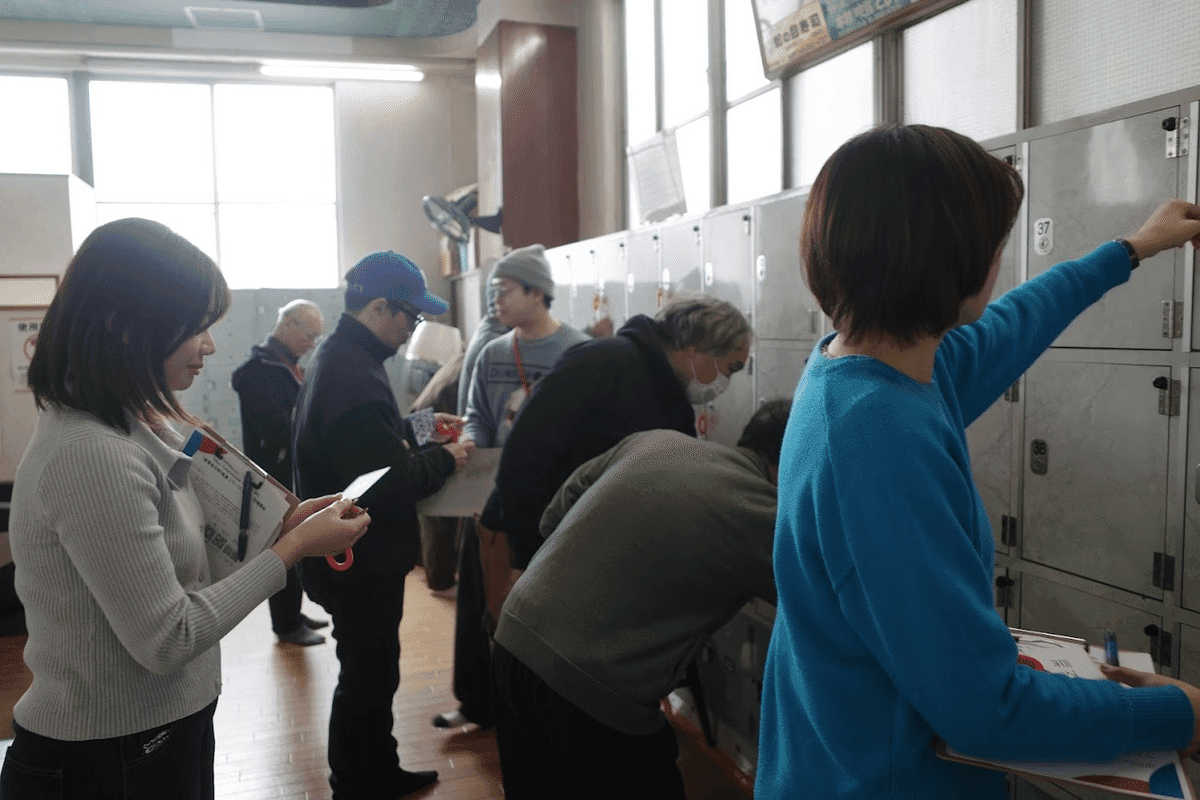
FIG.11
Next, participants formed groups of three, exchanged cards with one another to reassemble sets of three verb cards and one time card, and then worked together to fill out the “Future Scenario Worksheet.”
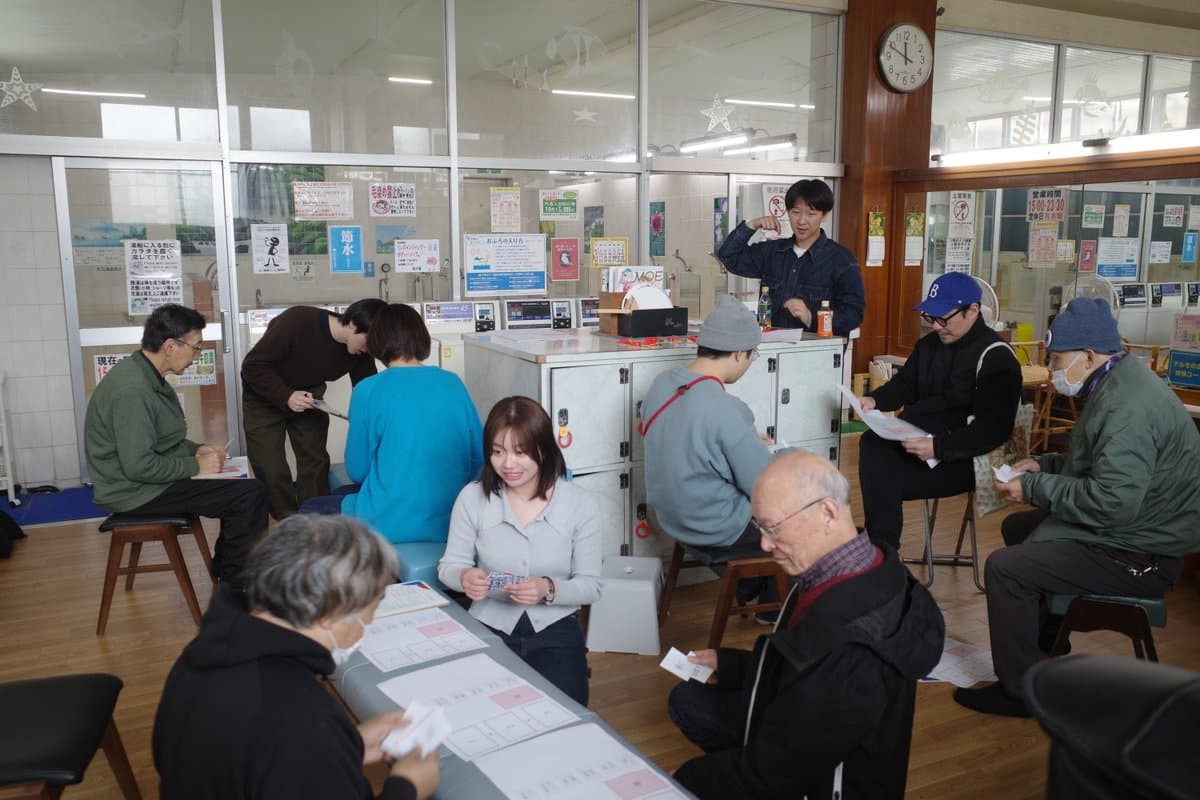
FIG.12
Once they had filled out the Future Scenario Sheet to a certain extent, they returned to the bathing area where the map was posted and mapped out their stories and plans for making them a reality on the map.
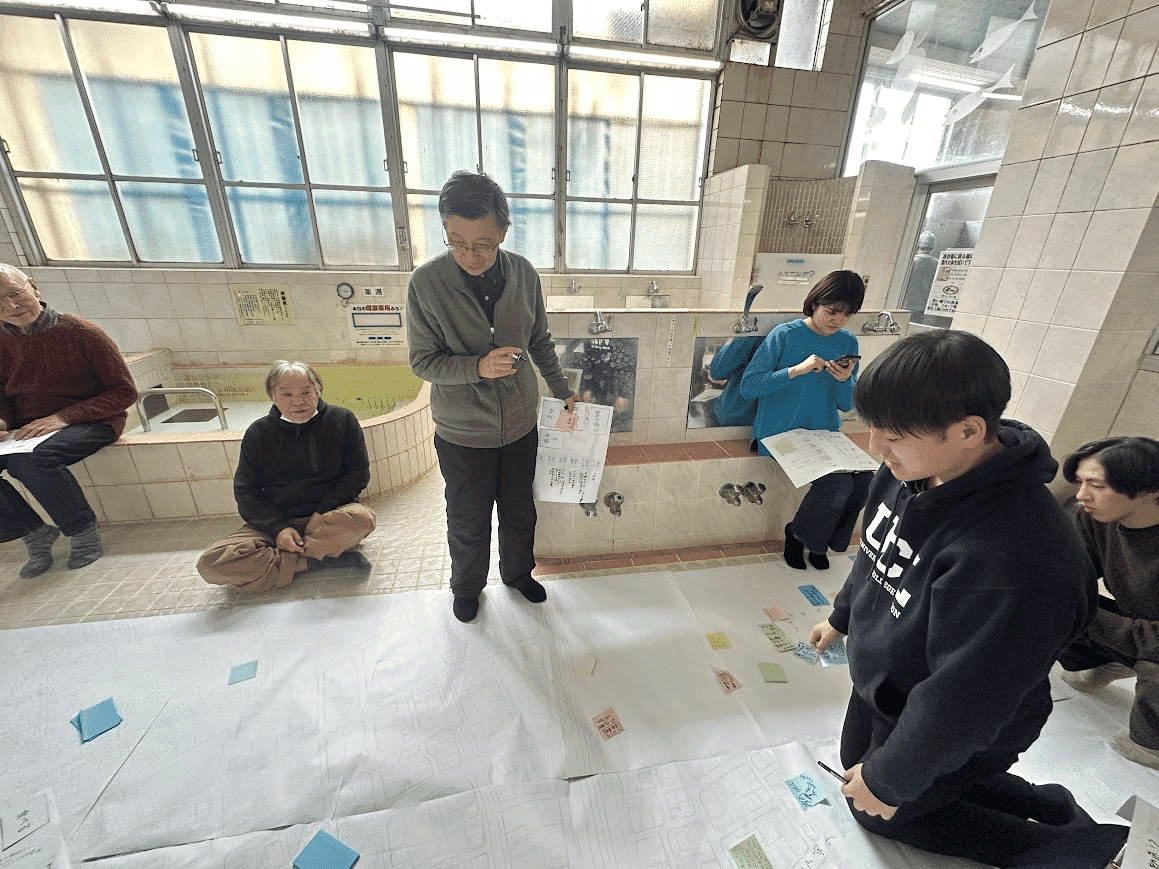
FIG.13
Based on the Future Adventure Workshop, we went out into the city once more to conduct fieldwork. First, our groups had a meal in Tabata Ginza, and then we searched for scenery that matched each group’s timeline and story, taking photos along the way.
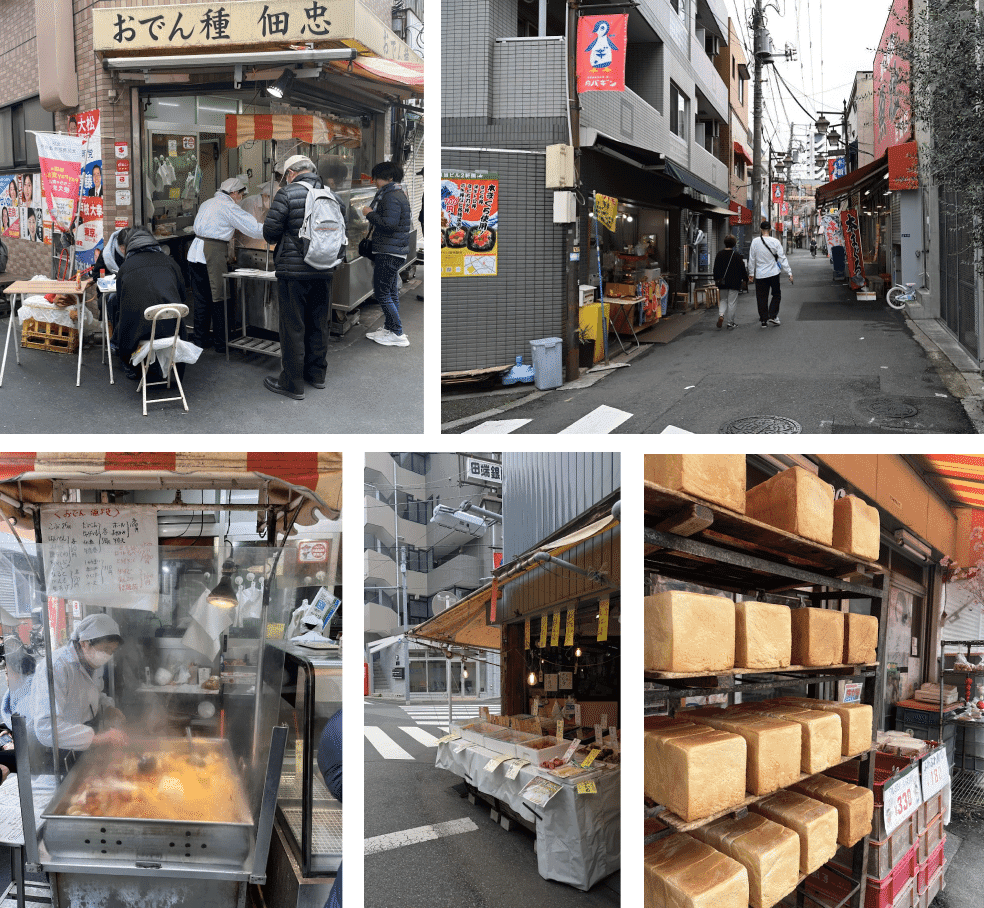
FIG.14
After returning from the fieldwork, each participant marked their route and discoveries on the map, then created collage pieces using the photos they’d taken and pre-prepared materials. Building on the Future Adventure Workshop, they updated their works based on insights gained during the collage process.
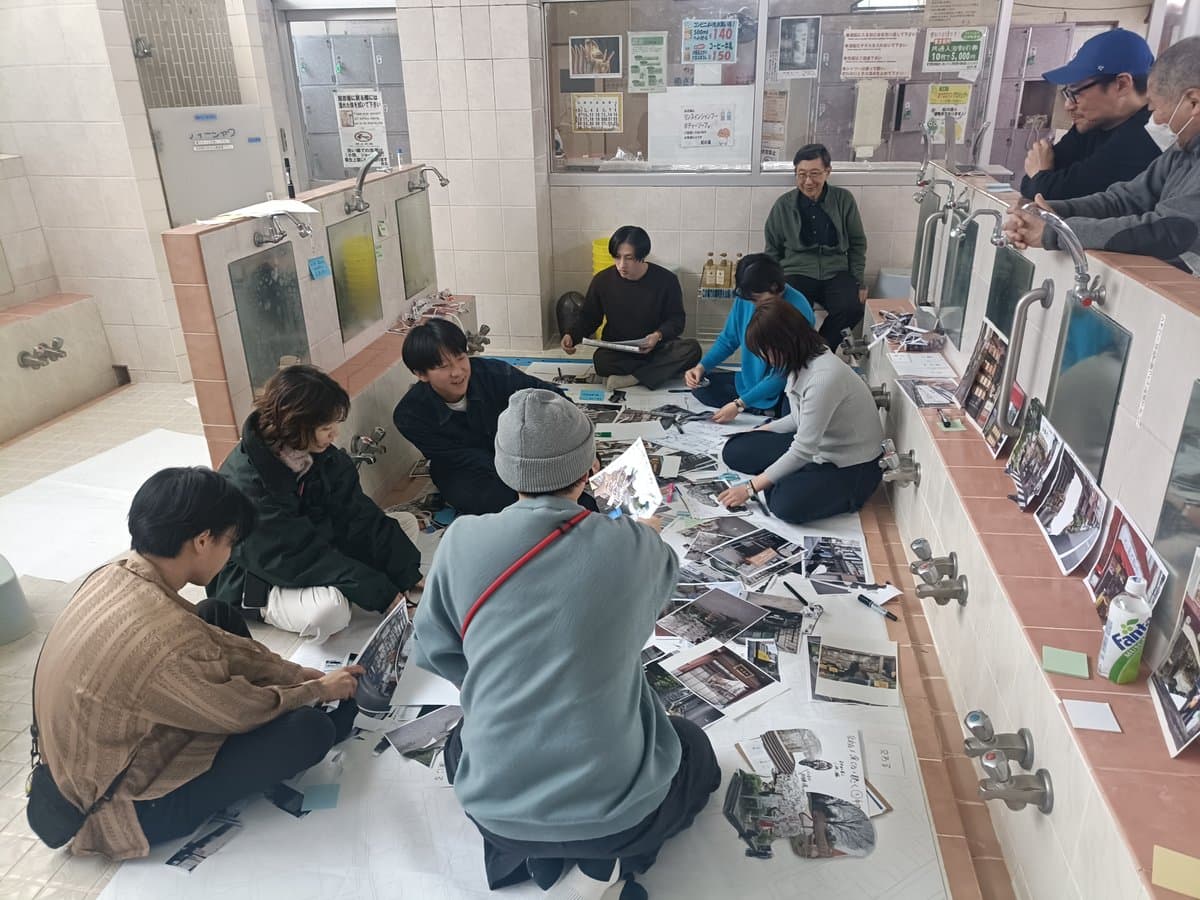
FIG.15
Finally, each participant presented their collage one by one. Stories spanning various time scales—from three years to 100 years in the future—unfolded, and we discussed questions such as: What obstacles might each face? How could they be realized? Is there another perspective from which to view them?
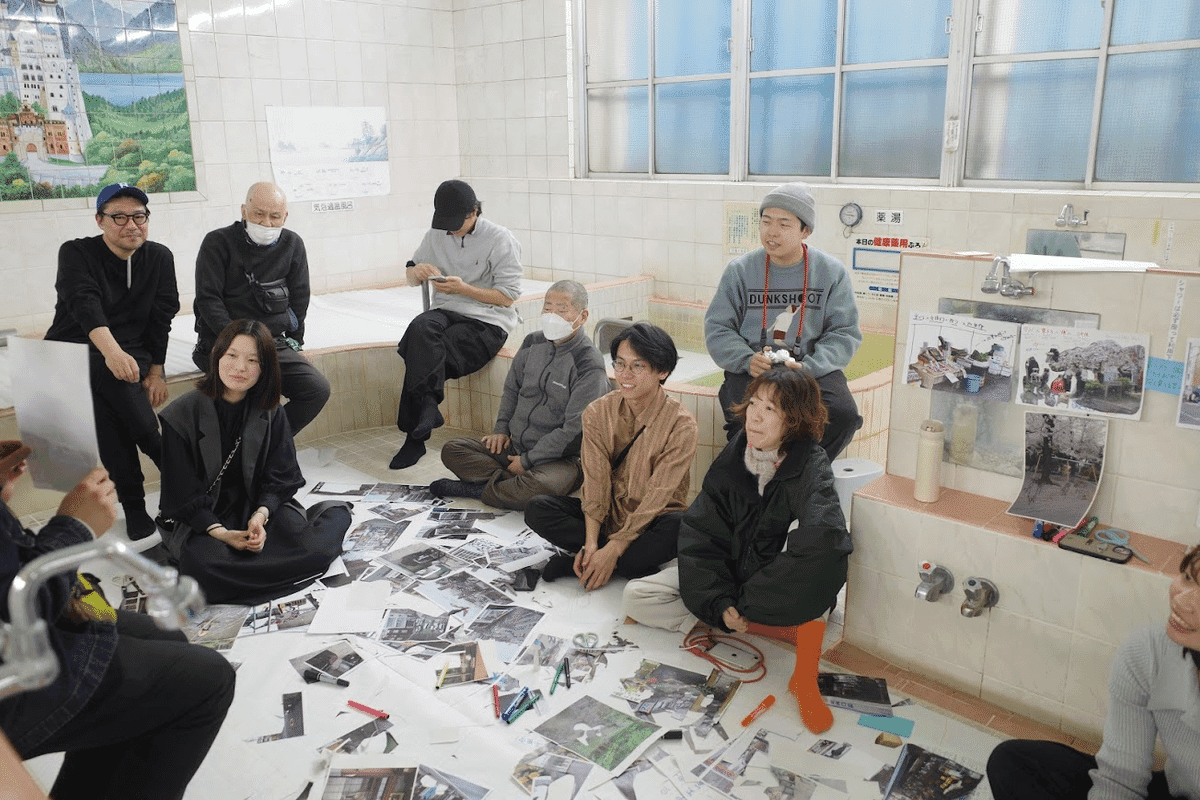
FIG.16
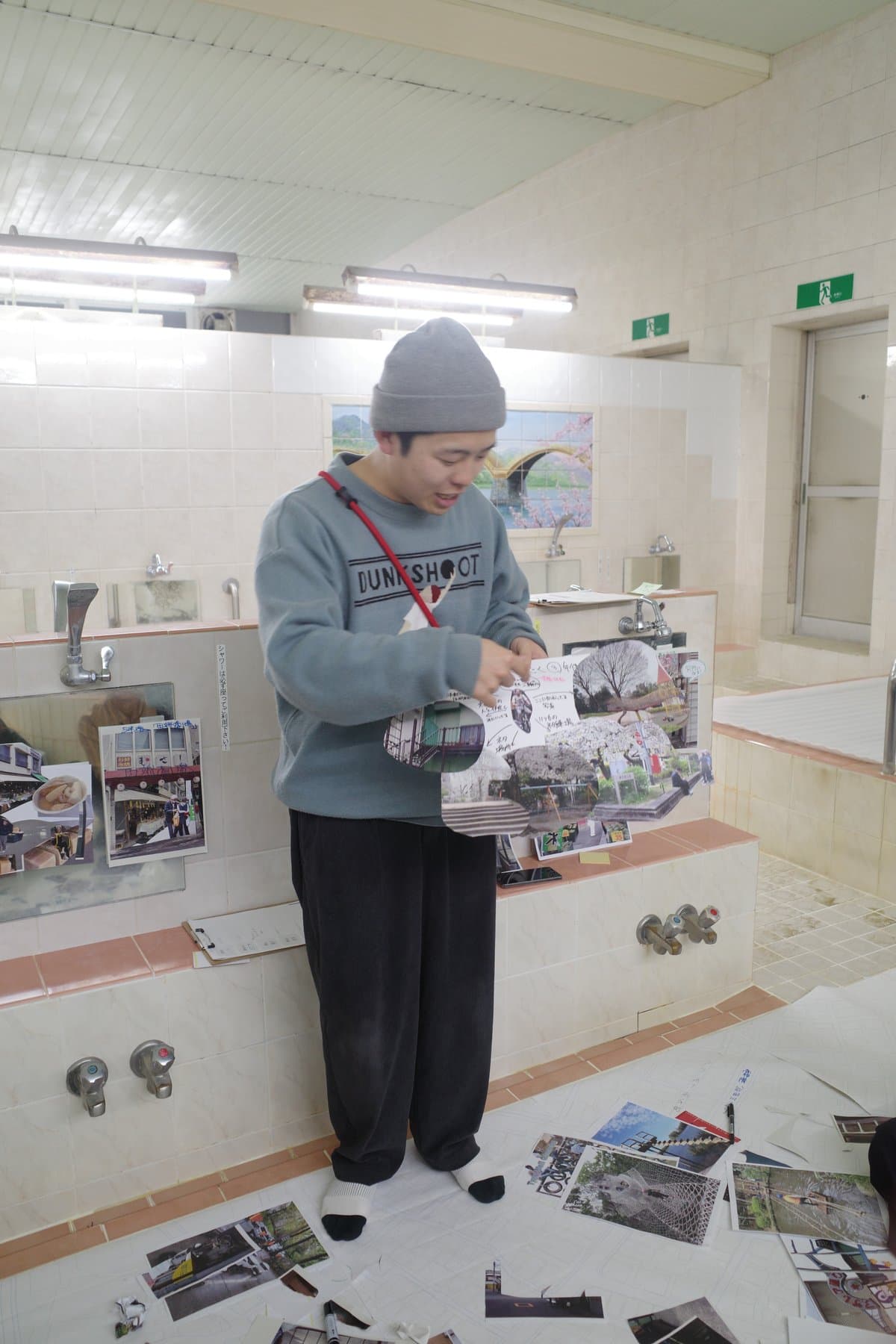
FIG.17
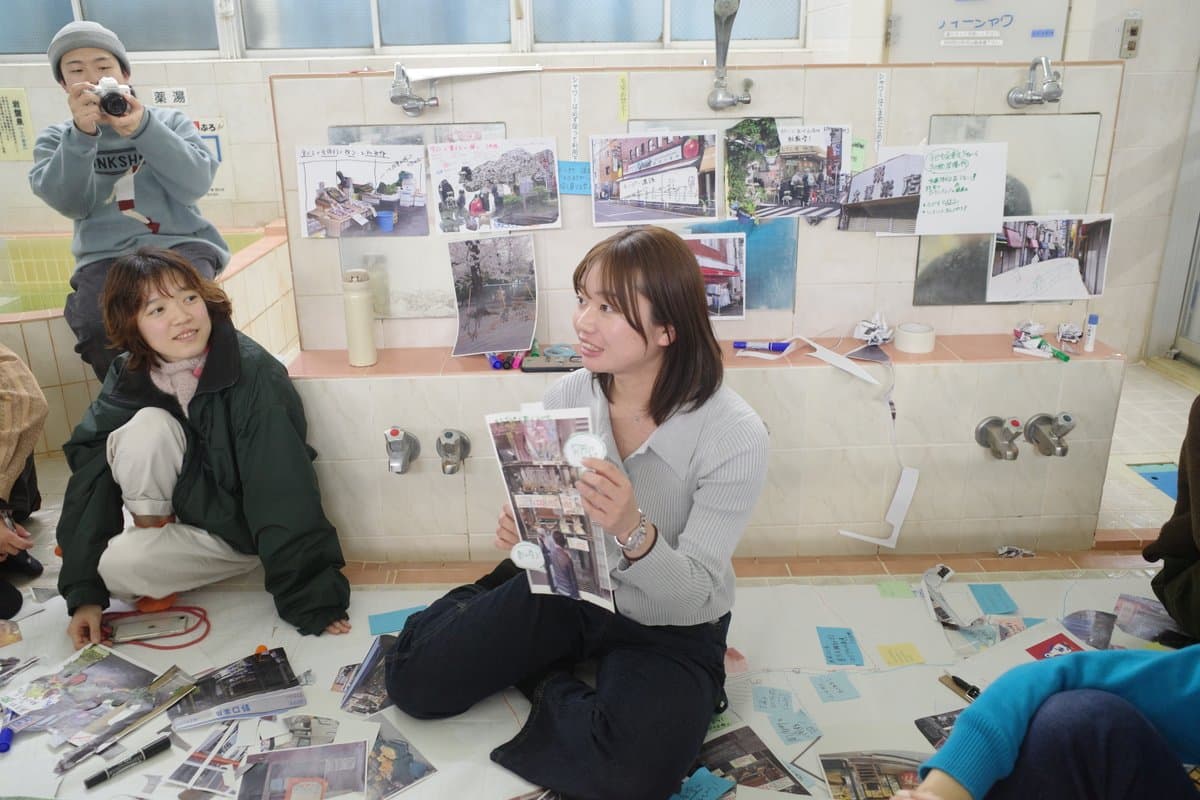
FIG.18
Over 20 works were proposed during the Furo-Niwa Workshop. Here, we introduce a selection of them.
A fictional character dreaming of becoming a comedian works tirelessly, drawing people from the Tabata Ginza Shopping District into the action. By utilizing shuttered vacant stores and a corner of a supermarket as spaces for “performing” and “listening,” the story increases the number of places for “interaction” and transforms the town’s landscape.
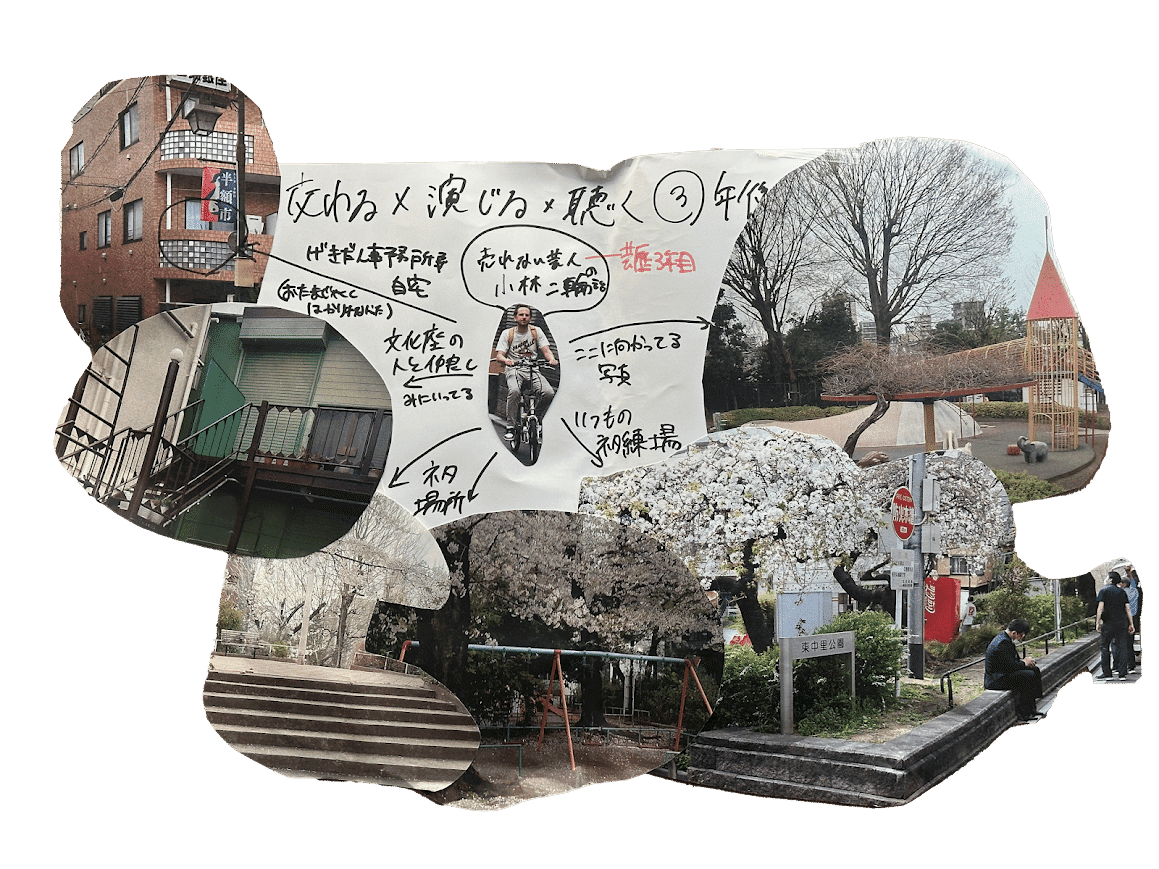
FIG.19
Following the presentation, discussions took place regarding whether there were any vacant stores with closed shutters that could actually be put to use, and how the way a space is used—and people’s attachment to it—might change when multiple potential uses are identified for a single location.
While creating a collage, I noticed the lack of “greenery” in the town. I created a scene in which growing plants along the curbs of the shopping district gives rise to acts of “creating” and “helping one another” through greenery, leading to the regeneration of both the greenery and the town.
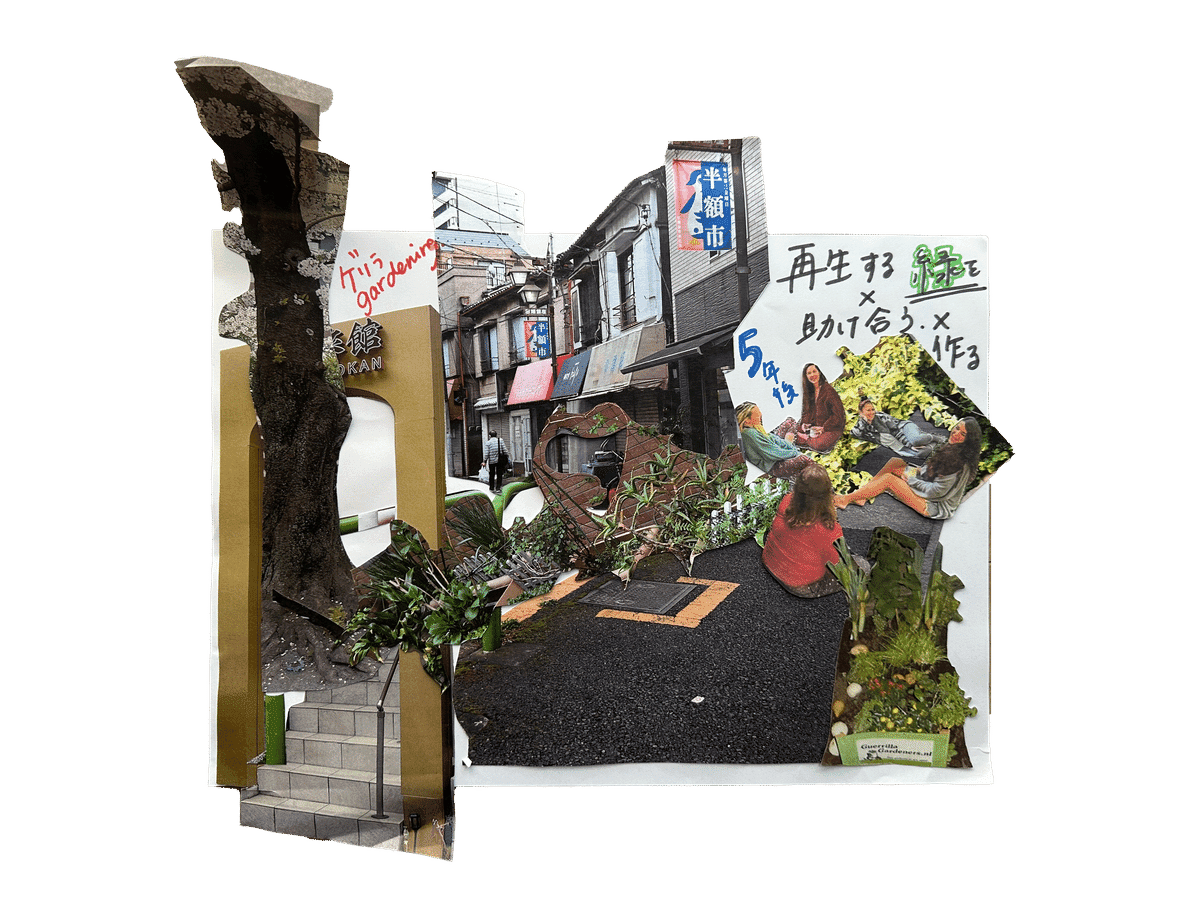
FIG.20
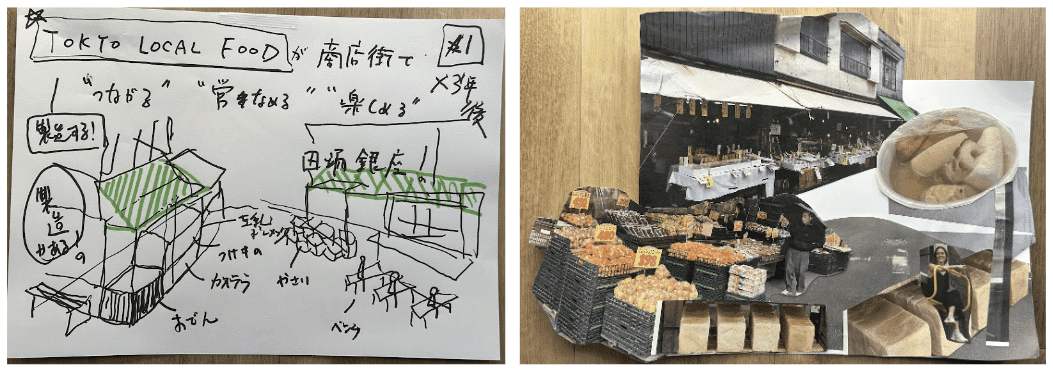
FIG.21
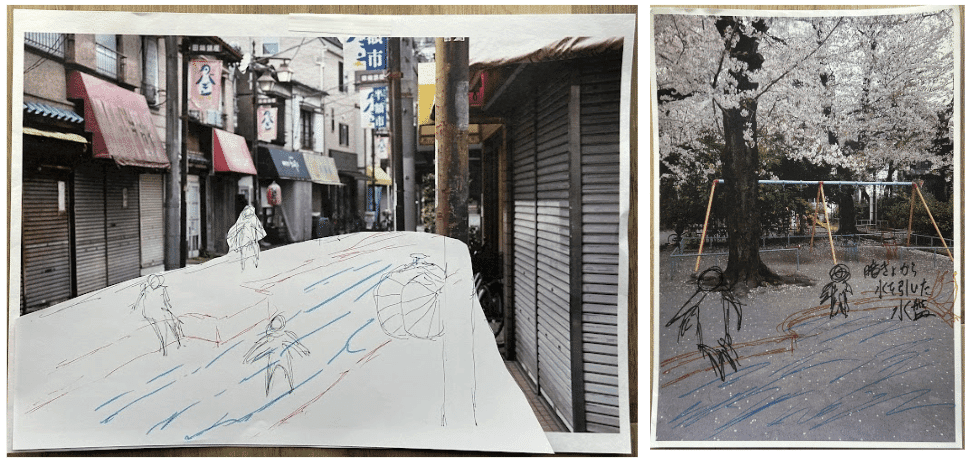
FIG.22
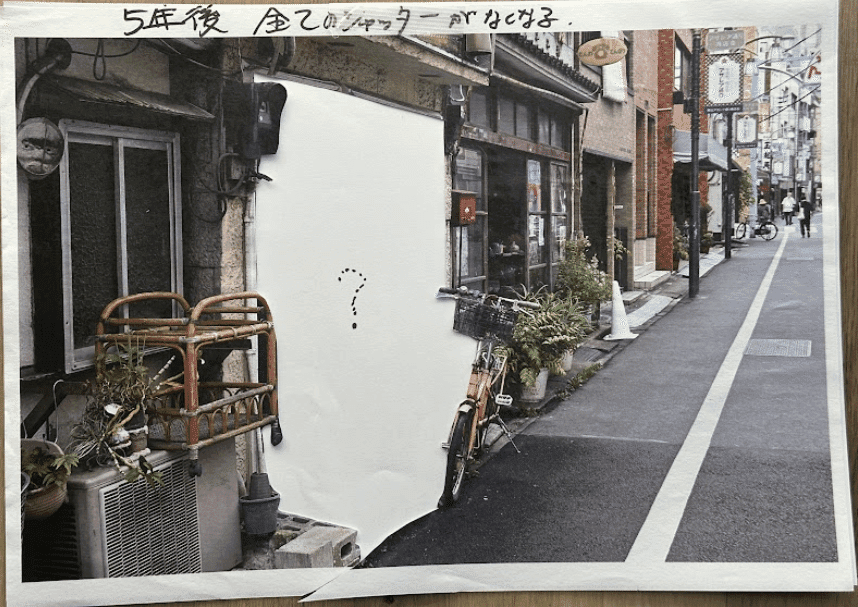
FIG.23
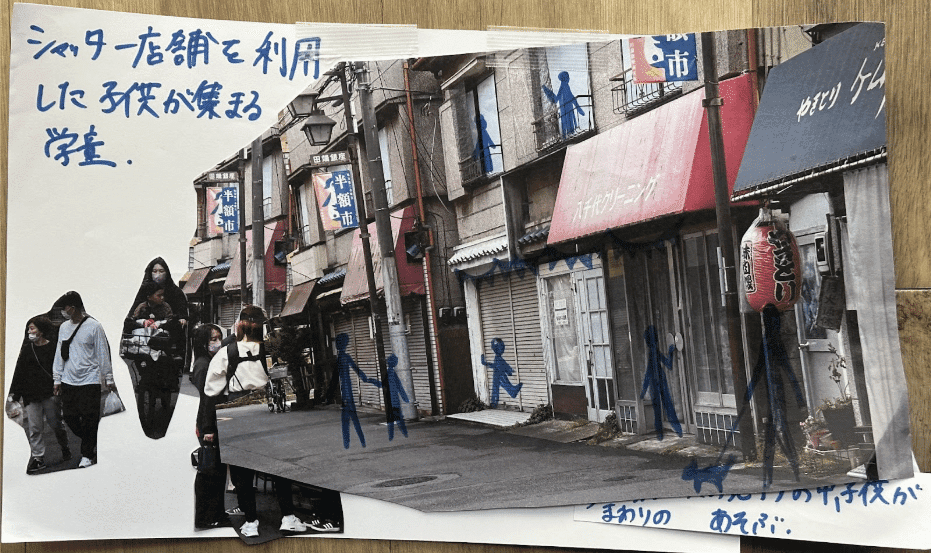
FIG.24
The following are the strengths and areas for improvement regarding this workshop.
[Positive Aspects] ・Because the workshop took a
future-oriented perspective, we were able to engage in free-flowing discussions without getting bogged down by overly practical issues. ・Since the activity involved
collage, we were able to uncover the unspoken desires of local residents. We were able to capture a sense of “It just feels right!” ・Because it was a visual activity, it facilitated conversation even across different generations. ・Using the
artwork as a starting point, it provided an opportunity to question systems and landscapes that are taken for granted. ・We heard many suggestions from
local residents and ward council members regarding specific barriers and ways to overcome them.
[Areas for Improvement] ・How can we make better use of the space with the
map displayed? From a spatial perspective, this should have allowed us to identify issues in a more interconnected way. ・Increase the number of items that can serve as cues for creating
collages—such as a tape measure, dice, shoes, or a scale.
・Many participants found it difficult to get started. Should we try working in groups? ・A phase to
further concretize and delve deeper into the ideas was needed. ・By expanding on and interpreting the
divergent collage ideas, we can arrive at more concrete insights.
This workshop was held as a prototype for a series of workshops designed to freely explore local possibilities that might be overlooked by a problem-solving approach.Moving forward, we will develop even higher-quality workshop methods using techniques other than collage, while holding workshops in various locations across the 23 wards in collaboration with local governments. We will also take on the challenge of developing the discoveries and insights gained from these workshops into projects and ventures led by young people.
Thank you to everyone who participated!
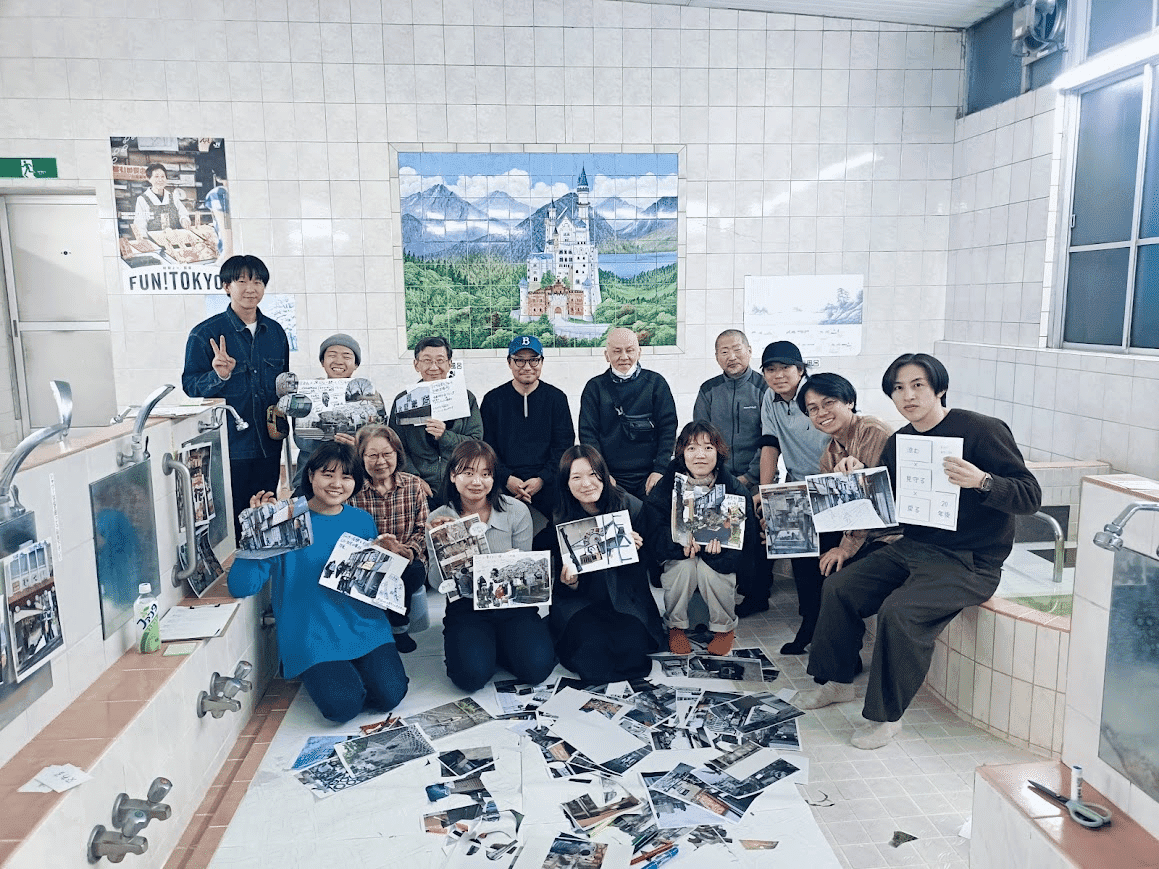
FIG.25


