FIG.1
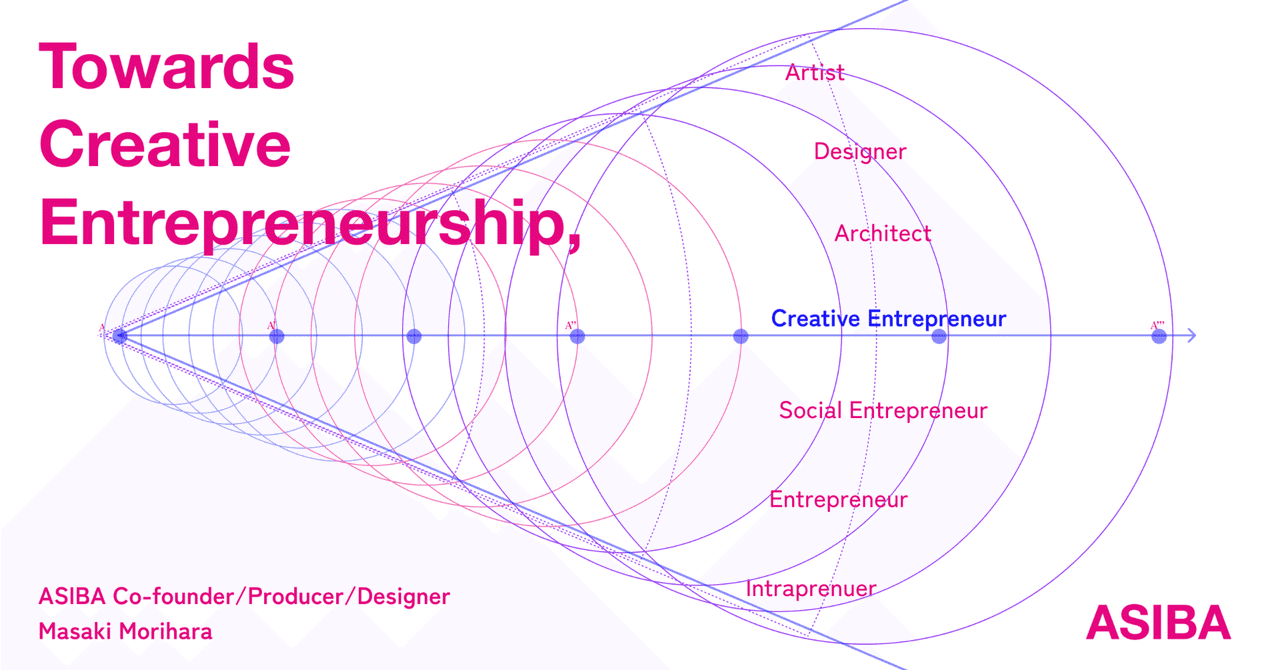
I am Morihara, Co-Representative of the General Incorporated Association ASIBA. Today, I would like to begin by discussing the background and necessity of “Creative Entrepreneurship,” a concept championed by ASIBA.
We believe that in today’s world, where challenges have become so diverse and complex that they cannot be fully addressed within the frameworks of society or organizations alone, there is a need for practices that respond to social issues by drawing on individual creativity and initiative.We are convinced that it is precisely within creative fields—such as architecture, design, and art—that the potential for such practices lies, and we have been cultivating the groundwork for this through our educational programs and business development initiatives.
“Creative Entrepreneurship” refers to an attitude of formulating one’s own questions, building connections with society, and presenting new options through concrete actions. It means not being bound by traditional disciplinary boundaries and embracing and affirming activities that do not fit into existing frameworks.It means continuing to take on the challenge of “creating” without stifling creativity or individual agency, even within the rationality of economic efficiency and business growth. And it means regaining society’s trust and expectations in the pursuit of creating something that does not yet exist. I hope this term will become a rallying cry for realizing such a society.
Today, in addition to updating you on our recent activities, we’ll also be conducting a workshop using the cards you have in front of you. But before we begin, please allow me to briefly share our perspective on “Creative Entrepreneurship,” the insights we’ve gained while running our business, and the things we feel are truly worth pursuing.
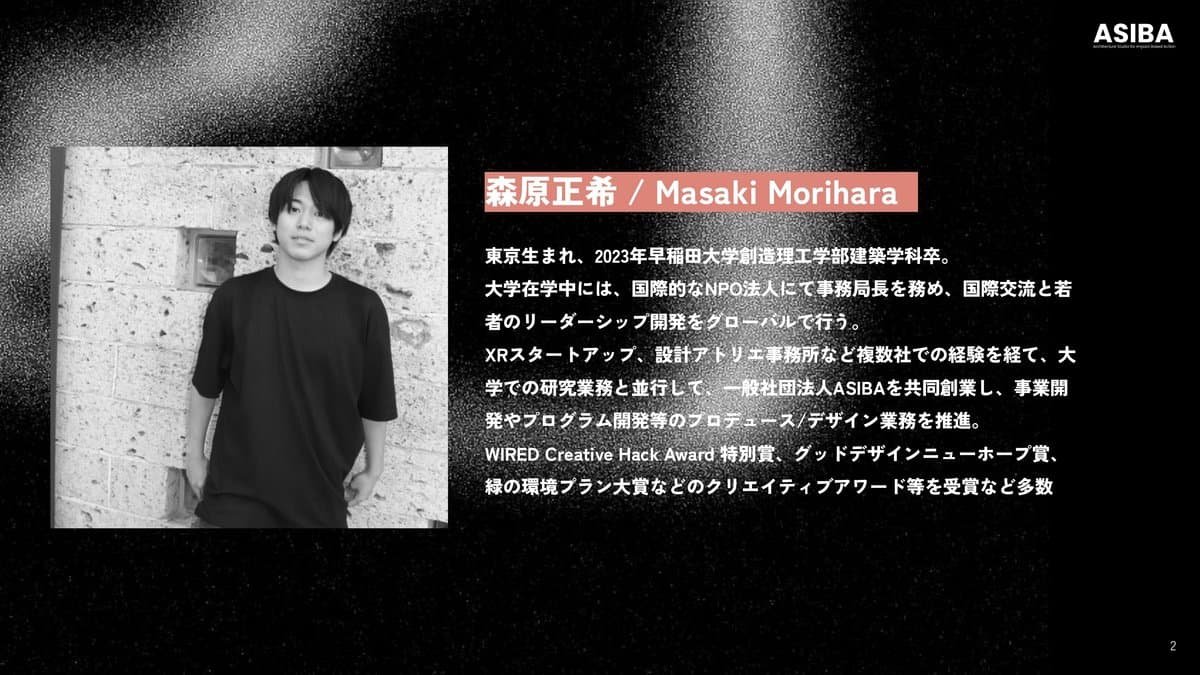
FIG.2
Once again, my name is Masaki Morihara.I was born in Tokyo and graduated from the Department of Architecture at Waseda University. While a student, I served as executive director of an NPO. Afterward, I gained experience at about five companies—including design firms, startups, and architectural practices—while also being a member of the Reihito Nakatani Research Laboratory, which focuses on architectural history. I met Nibei at a joint research seminar organized by the lab, and together we launched ASIBA.
ASIBA started out by borrowing vacant conference rooms and spaces on campus to hold incubation programs and workshops for architecture students in a self-organized seminar format. That was about a year and a half ago. Since then, we’ve independently organized the second session of our incubation program, and this year we held the third session.
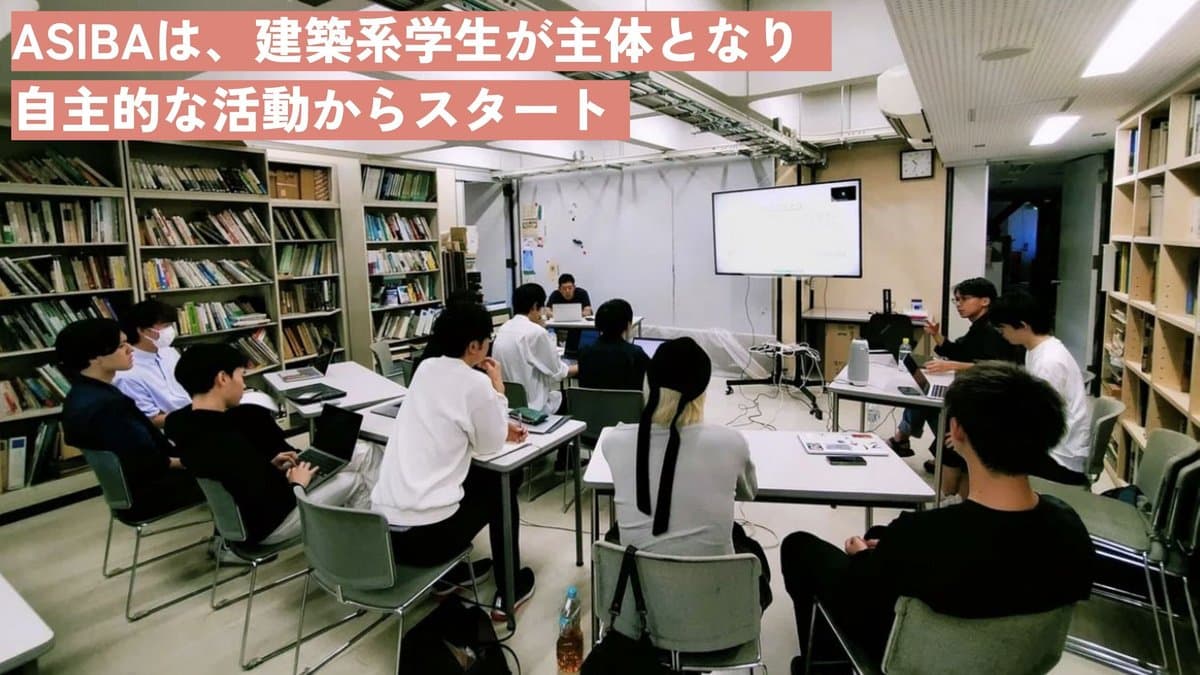
FIG.3
Since starting ASIBA at the age of 23, I’ve made countless discoveries. In particular, through conversations with the young people involved, I’ve come to deeply reflect on questions such as “What is creativity?”, “How should architecture, design, and art connect with society moving forward?”, and “What social role should architects play in the future?”Today, I’d like to share some of the insights that emerged from these practical experiences.
FIG.4
My first insight concerns the question: “What does ‘creating’ mean in the back-and-forth between questions and practice?”
There is a great deal of discussion in the world about solving social issues and how to address existing challenges, and many companies and government organizations are investing capital and human resources to resolve these visible problems.
However, the approach we at ASIBA took was slightly different. For many of the young people participating in ASIBA, it wasn’t social issues or their significance that drove them—rather, it was intrinsic motivation and a strong desire to “create.”While their desire to “create” something—and the things they want to create—is truly wonderful, we began to wonder how that should connect to society and the world. Or, conversely, we began to ask whether there truly exists a new act of “creation” that begins after gaining an understanding of society and the world.
The young people and students who participate in our incubation program start out in a state where they themselves don’t know what they should do or what they want to create. It’s as if they’ve suddenly found themselves alone in a dark meadow.Left to themselves in that state, they would likely be too frightened to do anything but cower. However, if there is even the slightest clue there, they begin to think, “I’ll try standing up on my own,” “I’ll try thinking it through,” or “I’ll try exploring.” As they do so—touching the ground, getting used to the darkness, spotting the starry sky, and understanding the flow of the wind—their own “questions” gradually come into view, even in the darkness.
FIG.5
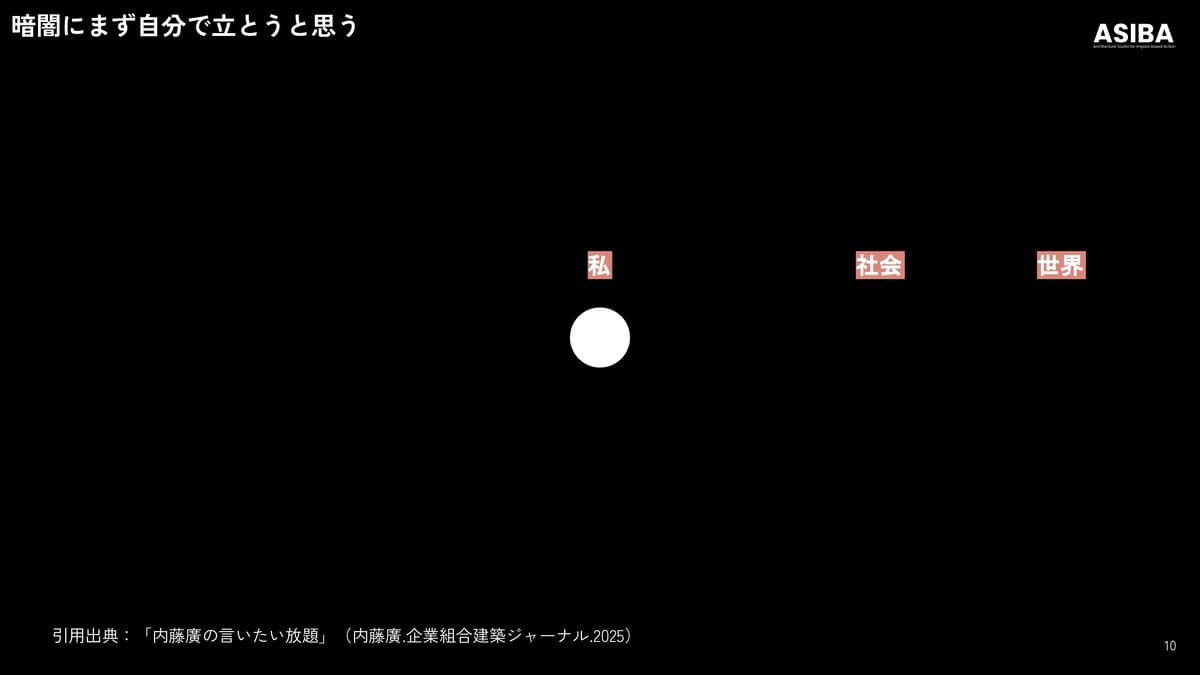
FIG.6
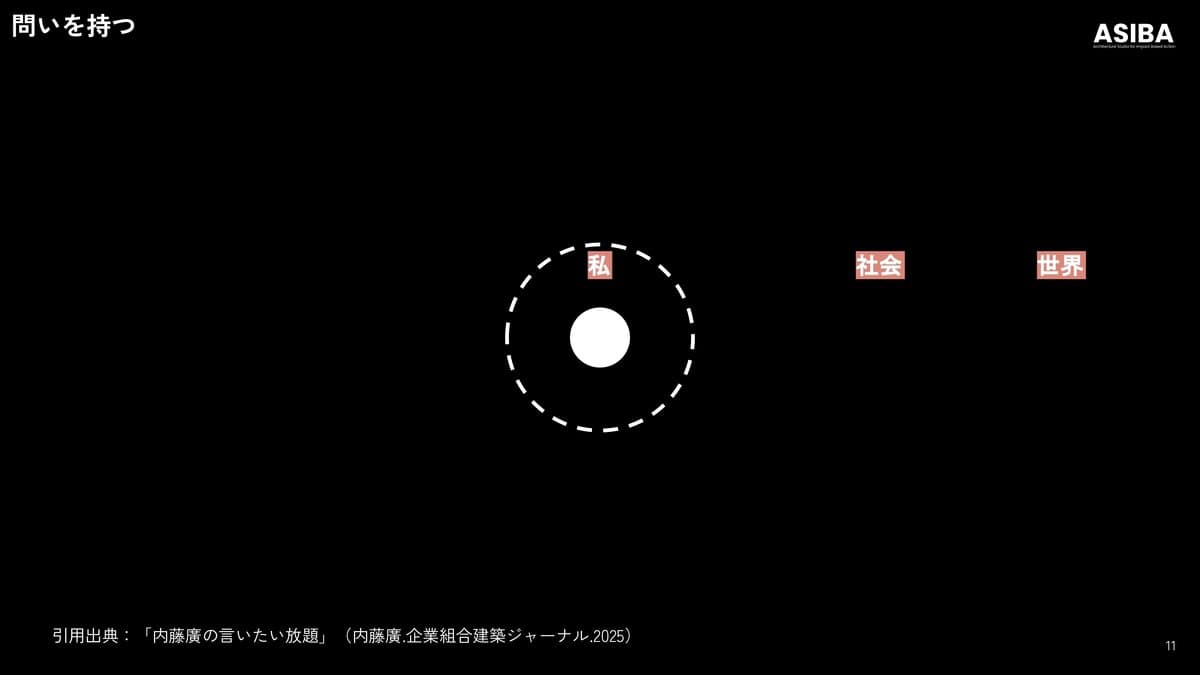
FIG.7
As those questions expand, as you let your imagination run wild, discover things that intrigue you, and actually put them into practice, they gradually take shape, and the space around you begins to appear with greater clarity and a sense of reality.Furthermore, once you “create” something, those ideas become solidified and draw closer to society. You are able to move forward. And through that practice, your questions expand even further, leading you into a chain of progressive stages.
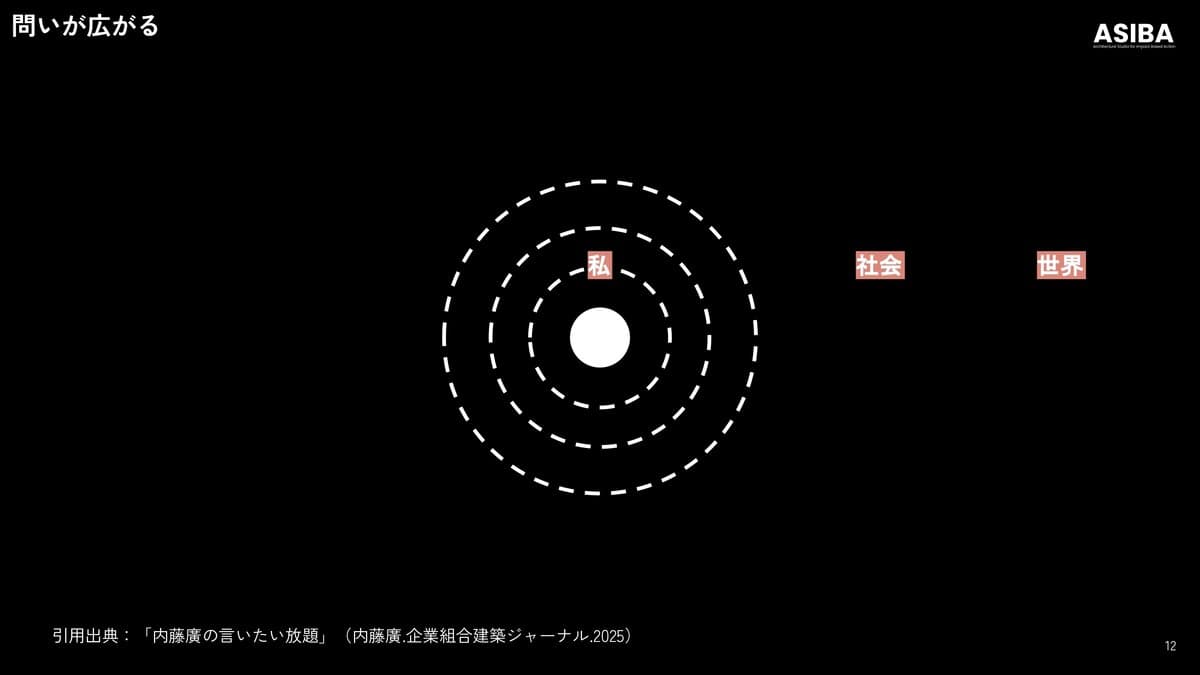
FIG.8
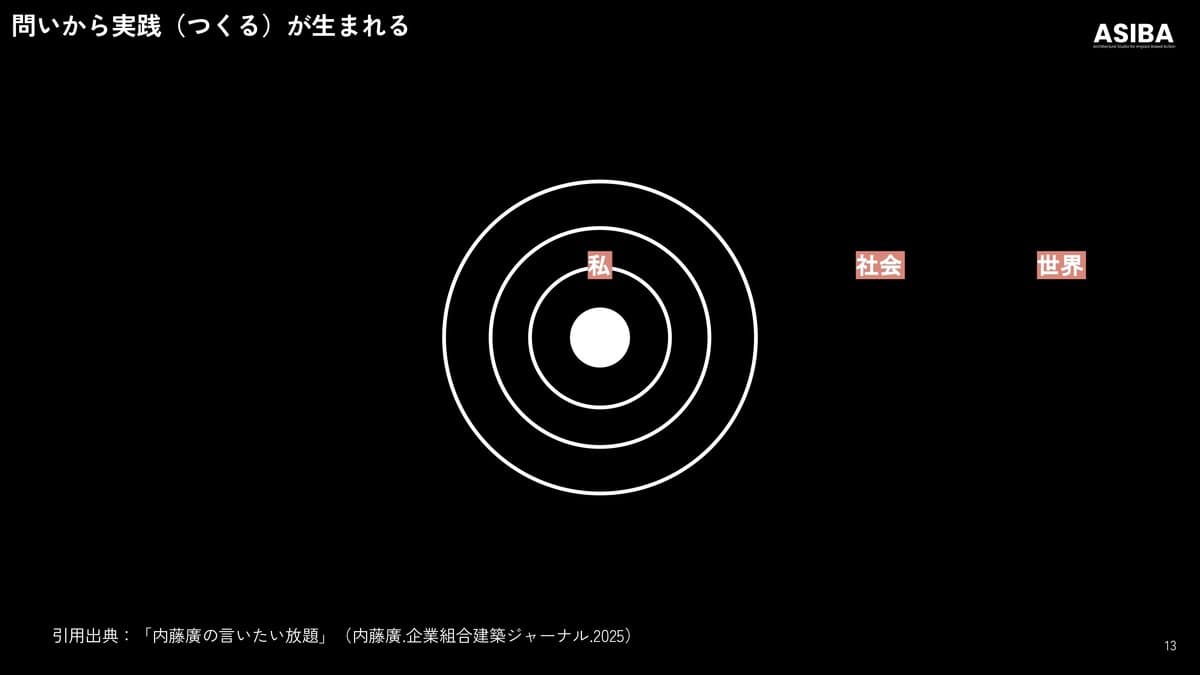
FIG.9
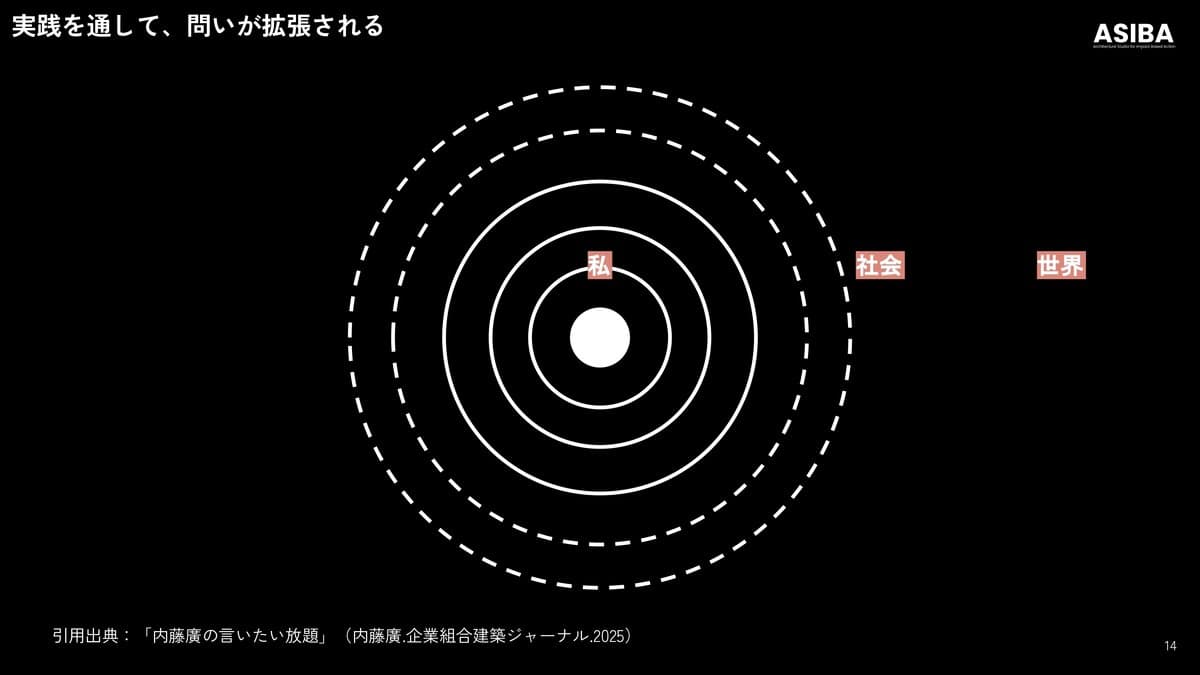
FIG.10
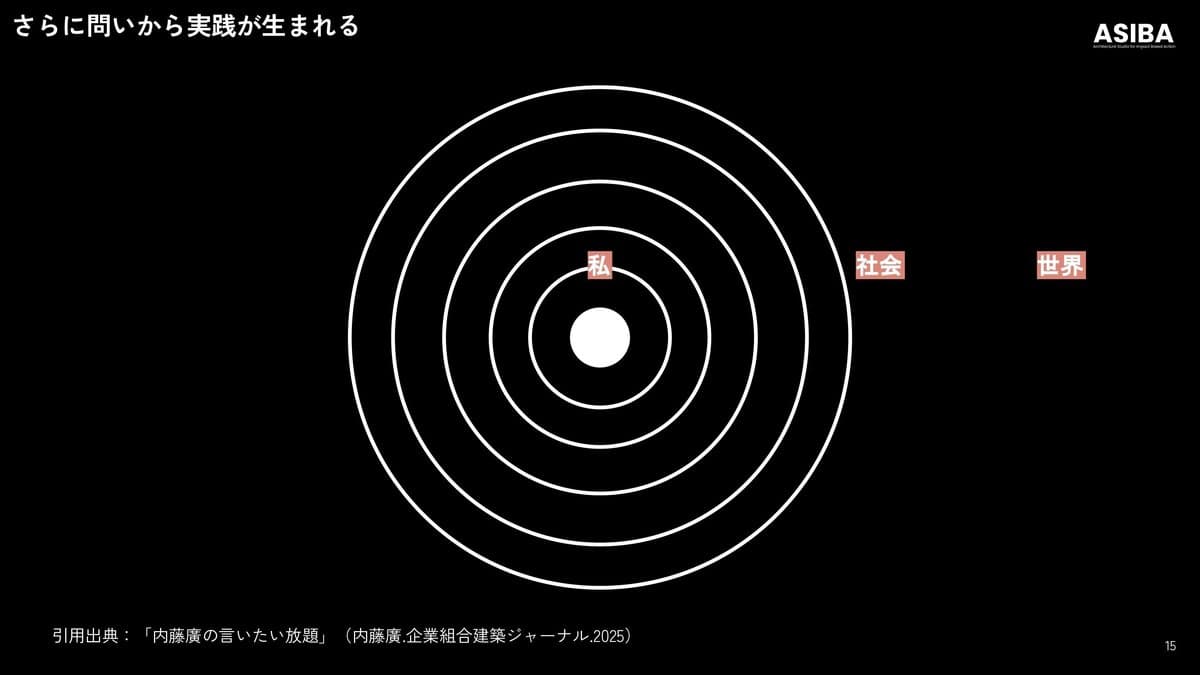
FIG.11
We believe that from there, the questions gain momentum, and as we continue our journey of exploration—from the individual to society, and then to the world—we will eventually develop a clear sense of purpose:a clear sense of purpose—such as “I want to create things in this direction” or “I want to change the world in this way.” Although it begins with making things, we will come to create with a sense of our own dissonance regarding the state of society and the world. This is a state of connecting with society and the world without losing sight of ourselves—a sensation of being seamlessly connected to society and the world.It is a state in which society and the world exist as an extension of one’s own life, and where new possibilities emerge from that connection. Viewed from the outside, a sense of consistency should become apparent: “That person is doing this for this reason, and that is why they are creating this.”
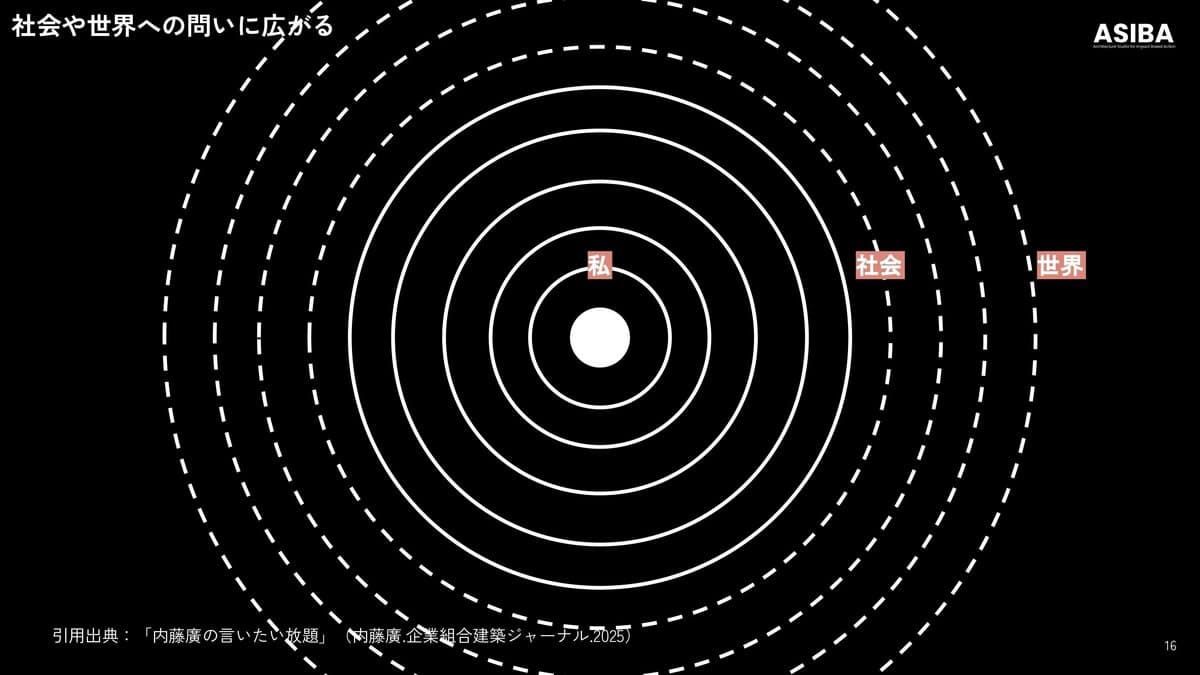
FIG.12
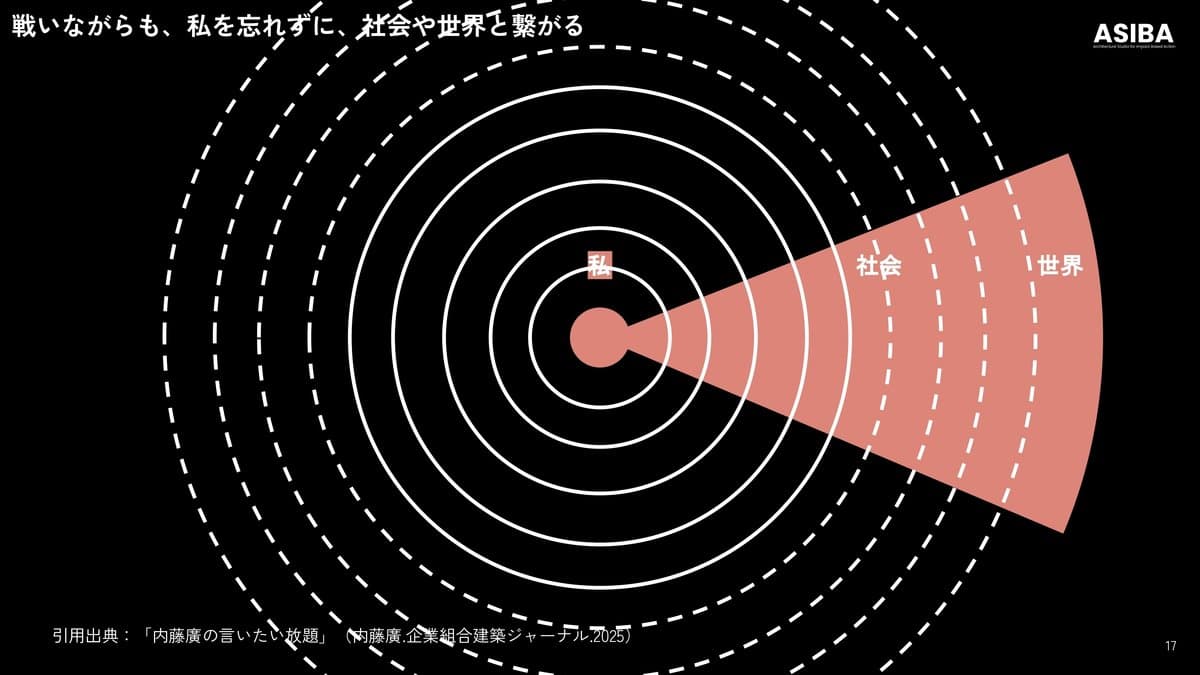
FIG.13
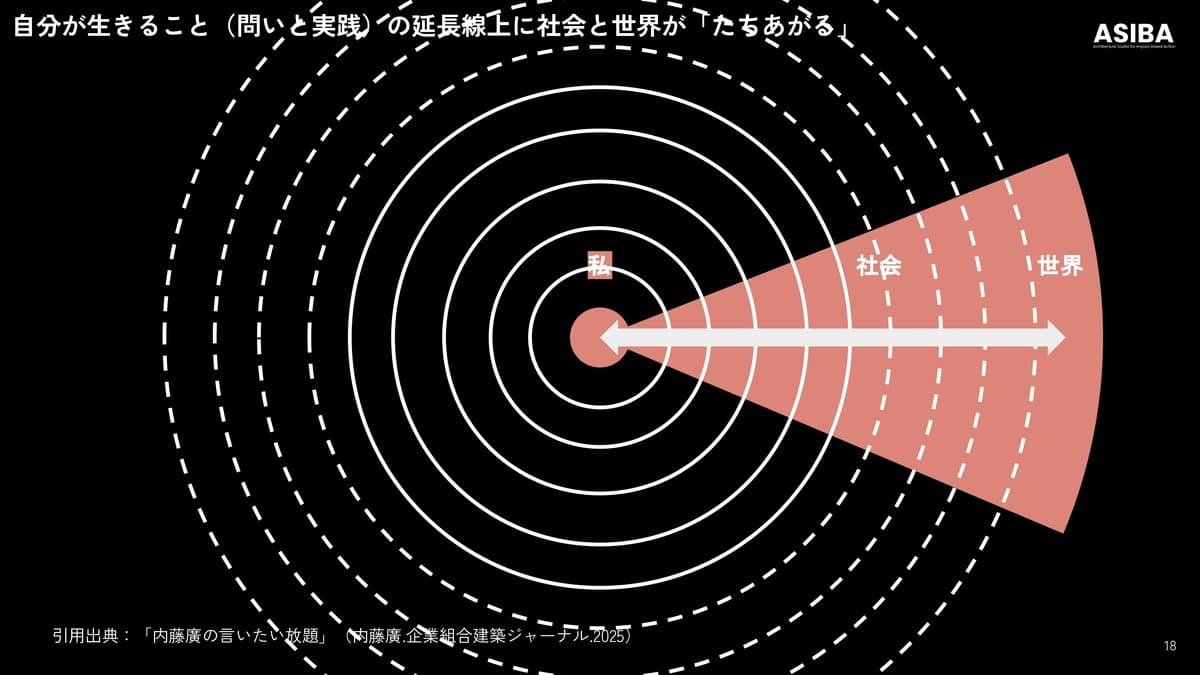
FIG.14
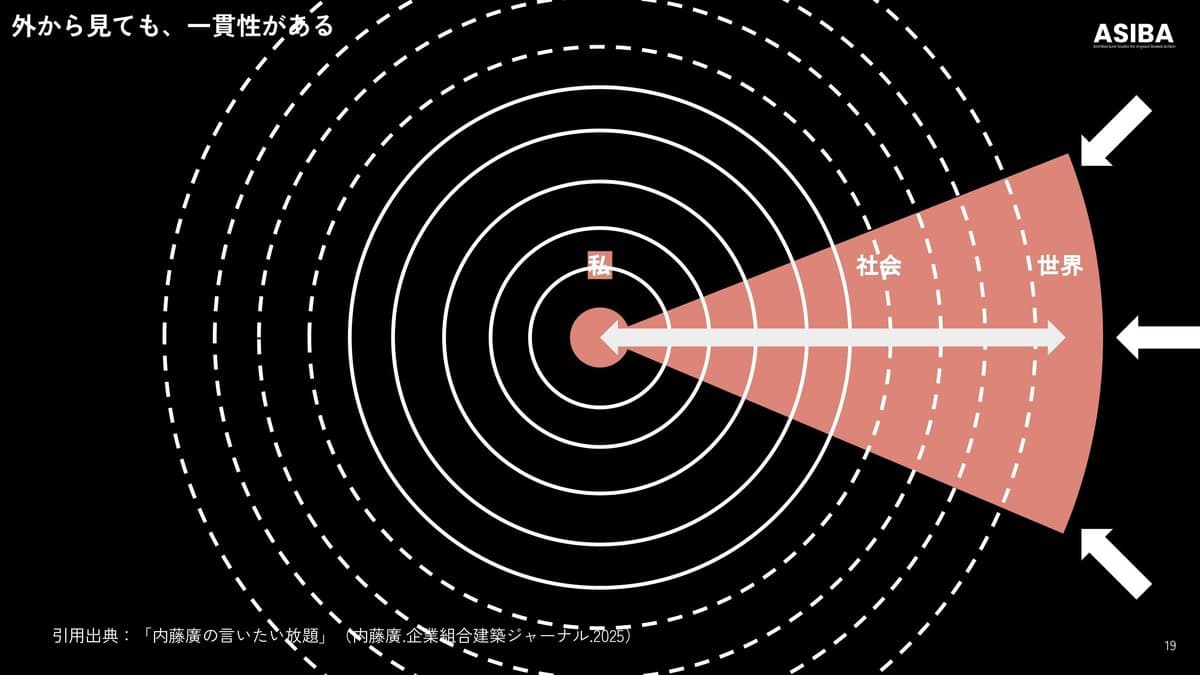
FIG.15
However, there are many cases in the world where the ends and the means are reversed. I feel that in many situations, the focus on “significance” takes precedence, causing personal curiosity and intrinsic motivation to fade. As a result, people end up working just for the sake of work or developing technology just for the sake of technology, drifting away from their original purpose.Technology development, solving social issues, or even creating architecture and cities can become ends in themselves. In the case of startups, only “exiting” or “driving innovation” is prioritized, and essential questions like “What is the purpose?” and “Who actually wants to do this?” tend to be forgotten.
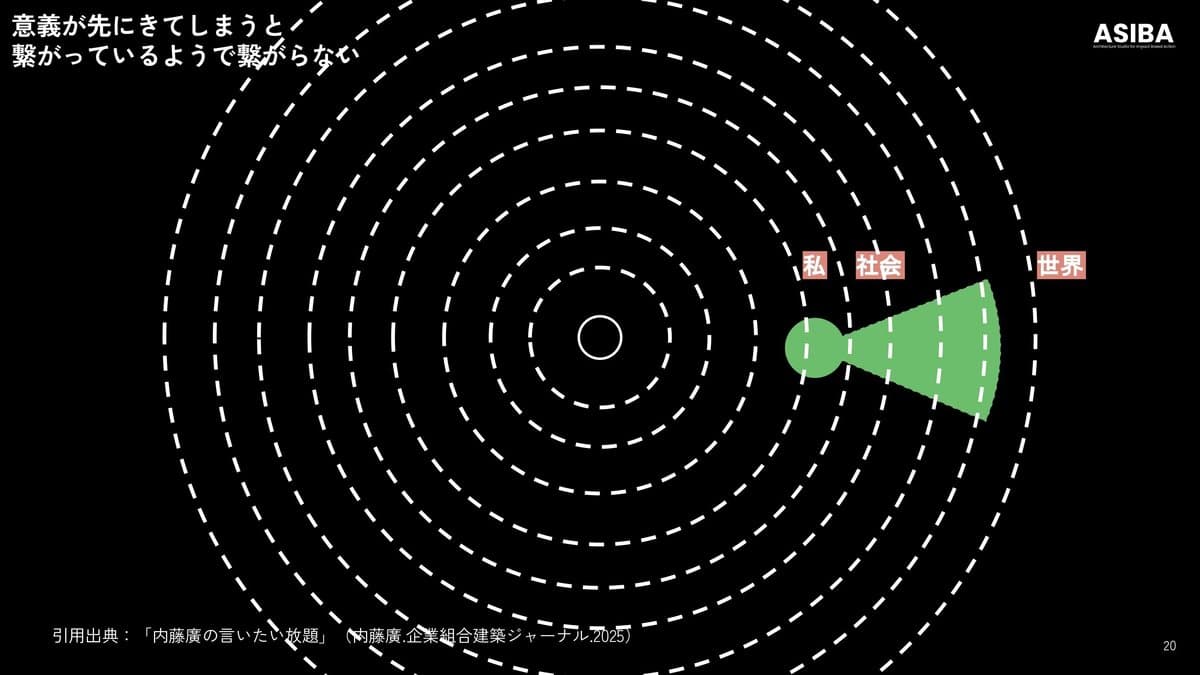
FIG.16
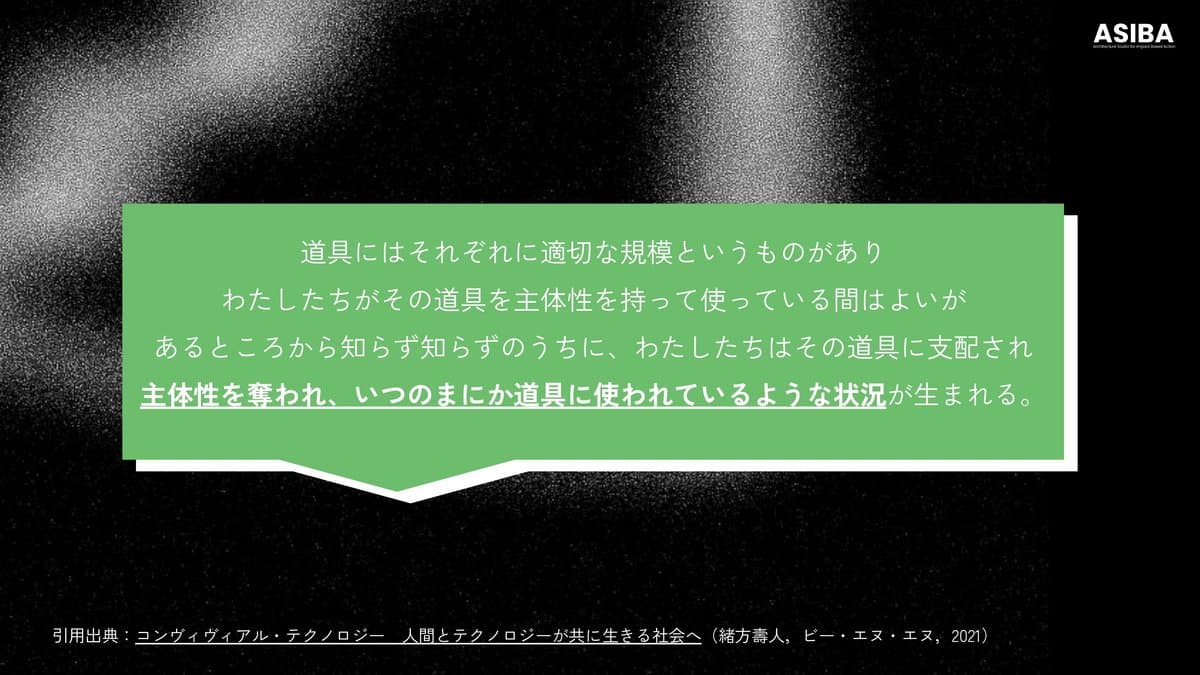
FIG.17
Through ASIBA, we believe we should reclaim individual agency and reexamine the purpose of “why we create things”—returning to this fundamental approach to “making” in society.Together with not only young people but everyone involved with ASIBA, we want to explore questions such as, “Where does your sense of agency lie?” and “What would you like to create?”
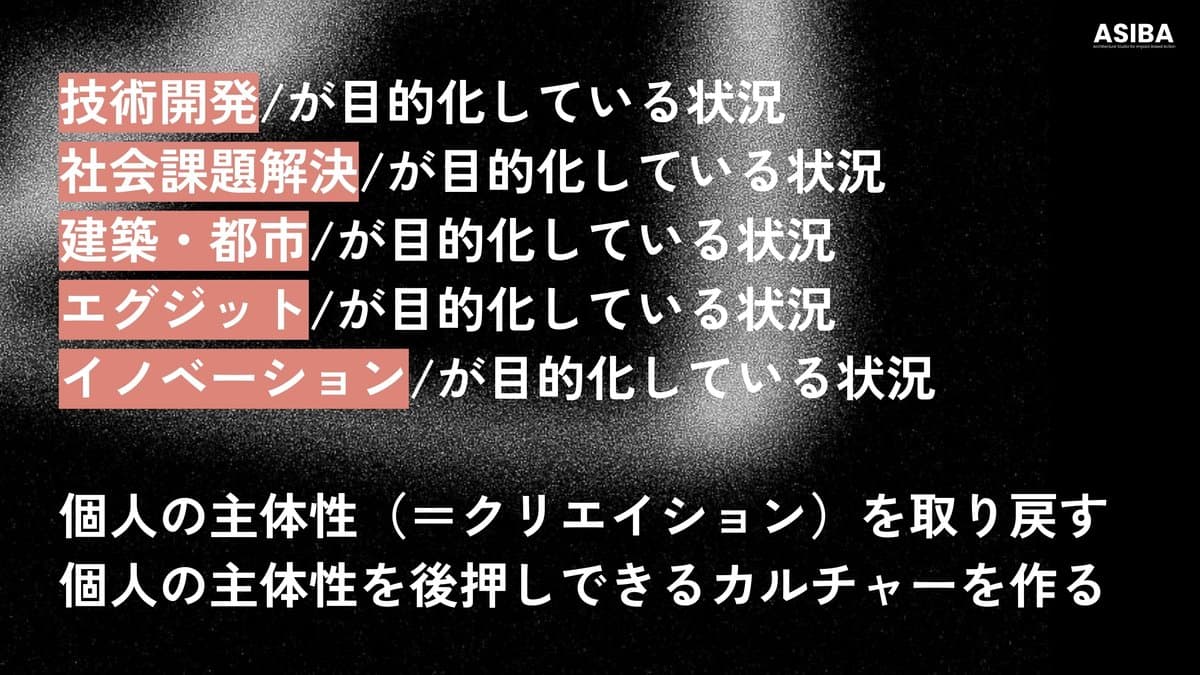
FIG.18
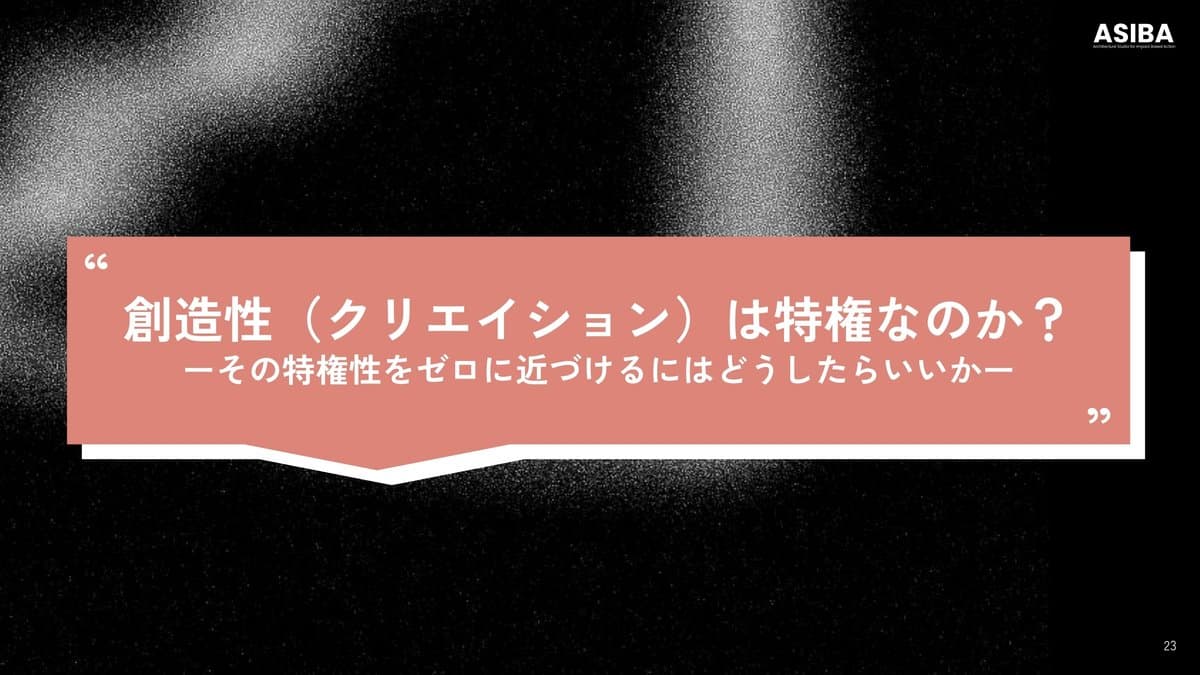
FIG.19
Another insight I’ve gained is the question of whether “creativity and the act of creation” are overly privileged. This is also related to my personal background.
I was born in Tokyo and devoted myself to soccer on a club team starting in first grade; I even won a national championship. I attended a combined junior and senior high school, and although I didn’t attend many classes, I came from a free and open-minded family environment where that was accepted.Later, I studied architecture at a private university, where I thoroughly enjoyed the environment and became completely absorbed in my studies. I genuinely believed, “I want to become an architect” and “I want to design grand buildings.”
However, the COVID-19 pandemic put a strain on my family’s financial situation, and I found myself in a position where I had to “find a way to work on my own.” At that moment, I keenly realized that I had to survive—even if it meant using every skill I had—because unless I survived, I wouldn’t be able to secure a free and creative environment.Watching my friends next to me freely tackle design projects with an abundance of materials and produce high-quality work filled me with frustration. Yet, I still tried to find hope in society and was desperate to create work in my own way, no matter what. That was when I was 20 years old.
At the time, I felt a deep sense of anxiety and frustration. As a minimal act of defiance and a statement of my resolve—to refuse to do what I didn’t want to do and to somehow make a living in the field I aspired to—I spent my days promoting myself all on my own. Even so, there weren’t many architecture or design jobs that anyone would commission from a mere 20-year-old.As a result, I found myself in dire straits, unable to earn even 50,000 yen a month. In those circumstances, I simply couldn’t bring myself to think, as I mentioned earlier, “I’ll stand on my own in the darkness.” In that environment, all I could do at the time was work relentlessly to the limits of my physical endurance, barely manage to attend university, and aim to graduate.
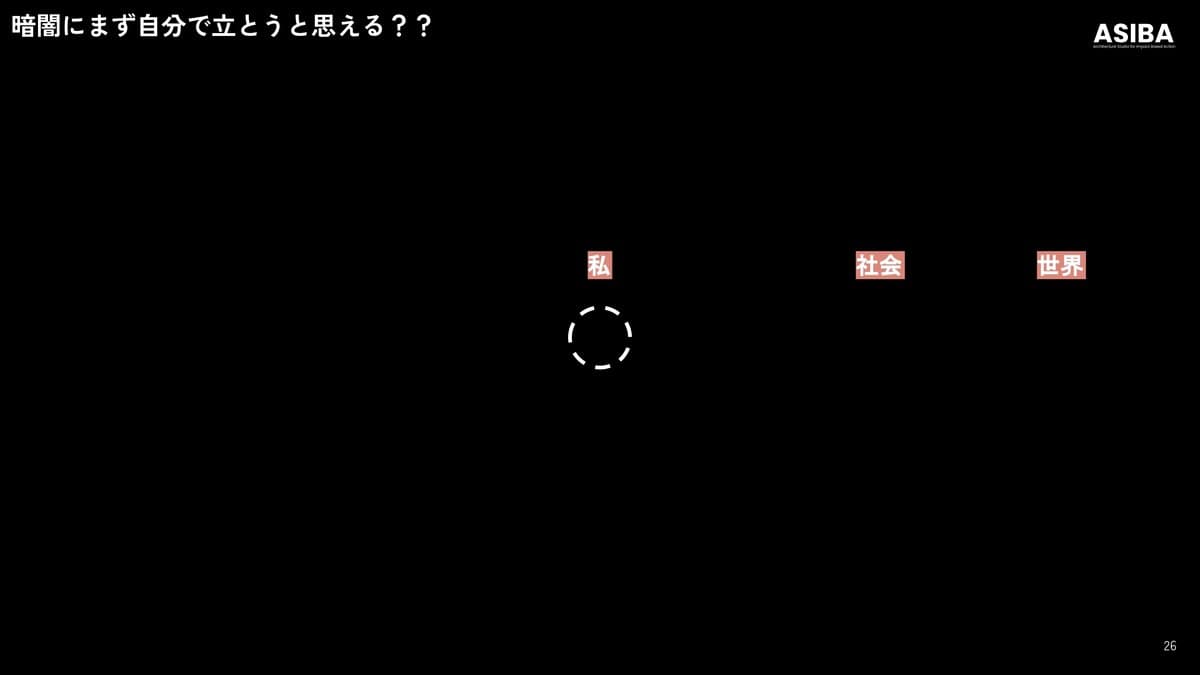
FIG.20
However, even in those circumstances, when you keep moving forward, all sorts of things happen.I was able to meet three adults (who I now consider my mentors) who genuinely rooted for me. They supported me, affirmed me, and—even while scolding me at times—allowed me to take on challenging projects that were far beyond my current capabilities. I’m sure the cost of my education was probably higher than the value of the work itself, but they gave me the support I needed to live a life true to my own questions.It was precisely because they told me, “You’ll be fine,” “It’ll work out,” and “You’ll figure it out,” that I was able to proactively think, “I’ll give it a try,” “I’ll start something,” and “I’ll take the initiative.” I realized that creation can sometimes begin with that kind of support and environment.
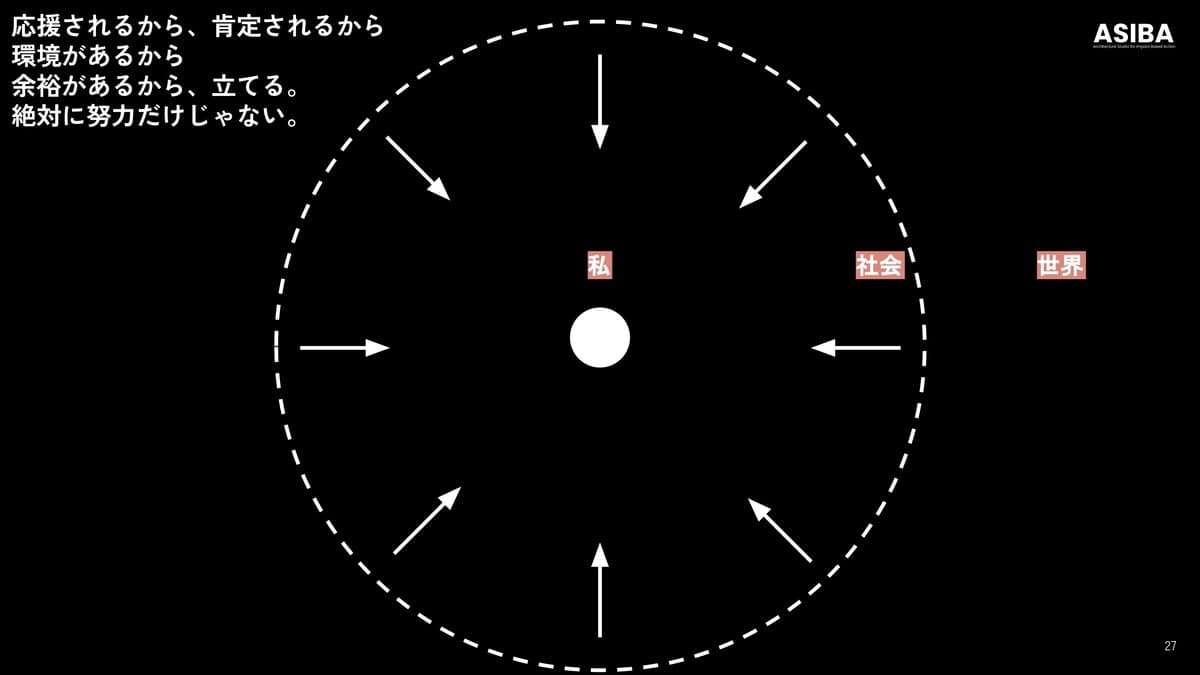
FIG.21
That’s precisely why I believe creativity isn’t something that can be achieved through effort alone, and even today, I don’t think we’re in a situation where everyone has an equal opportunity to express their creativity. Being creative—of course, some people say it’s something only those with free time and financial leeway do, something detached from the real world.
What we value is this: while we ourselves repeatedly engage in “questioning and practice”—driven by a desire to create truly fascinating things, launch startups, and take on a wider variety of creative challenges—we also recognize that this is built upon the industry’s past development and the legacy of those who came before us.It is precisely because the industry has developed and history has been woven that we have an environment where we can freely create models and designs, and enter them into competitions. We cannot create anything while forgetting this reality, and we believe that creativity is built upon respect for everyone who performs their respective roles.
That is why we want to nurture not just ourselves, but the entire field, develop people, and pass on the baton of our culture. At the same time, we also want to create things ourselves. We understand that balancing these two goals is extremely difficult and by no means a rational decision, but we believe we cannot engage in creative activities—such as startups, business ventures, or design—while ignoring them.
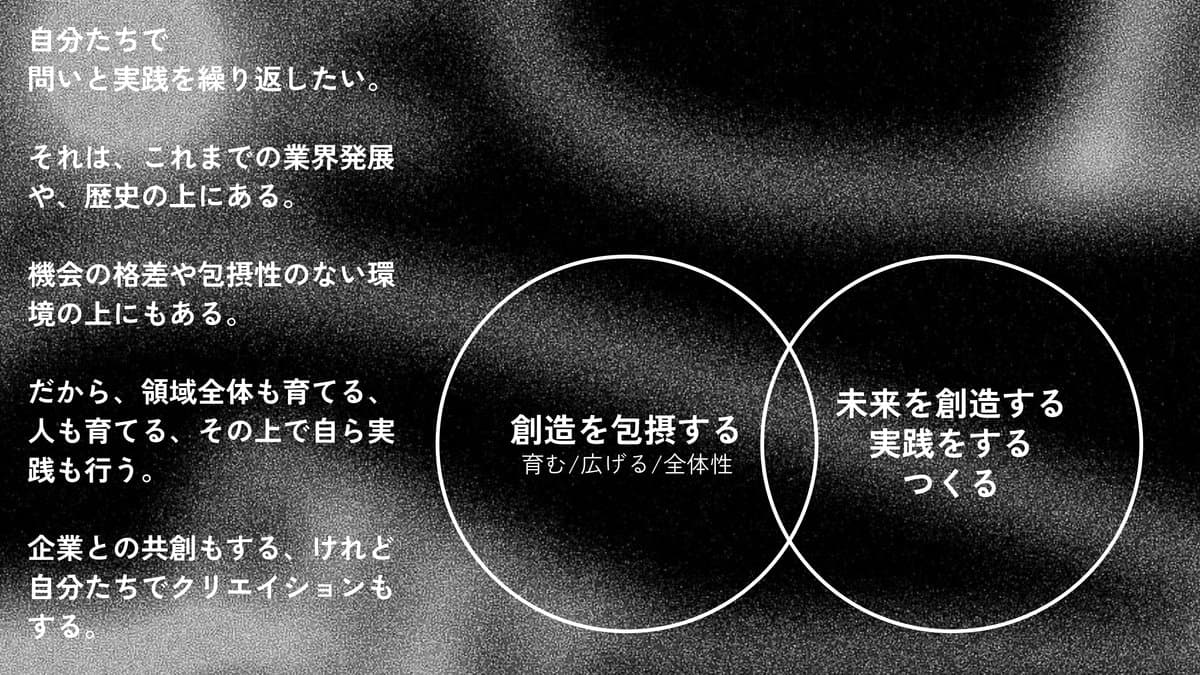
FIG.22
Before terms like “the democratization of X” or “an open X” are even used, we believe that minimizing the barriers to “people being creative” as much as possible and fostering an inclusive environment for creativity is another crucial mission for us at ASIBA.
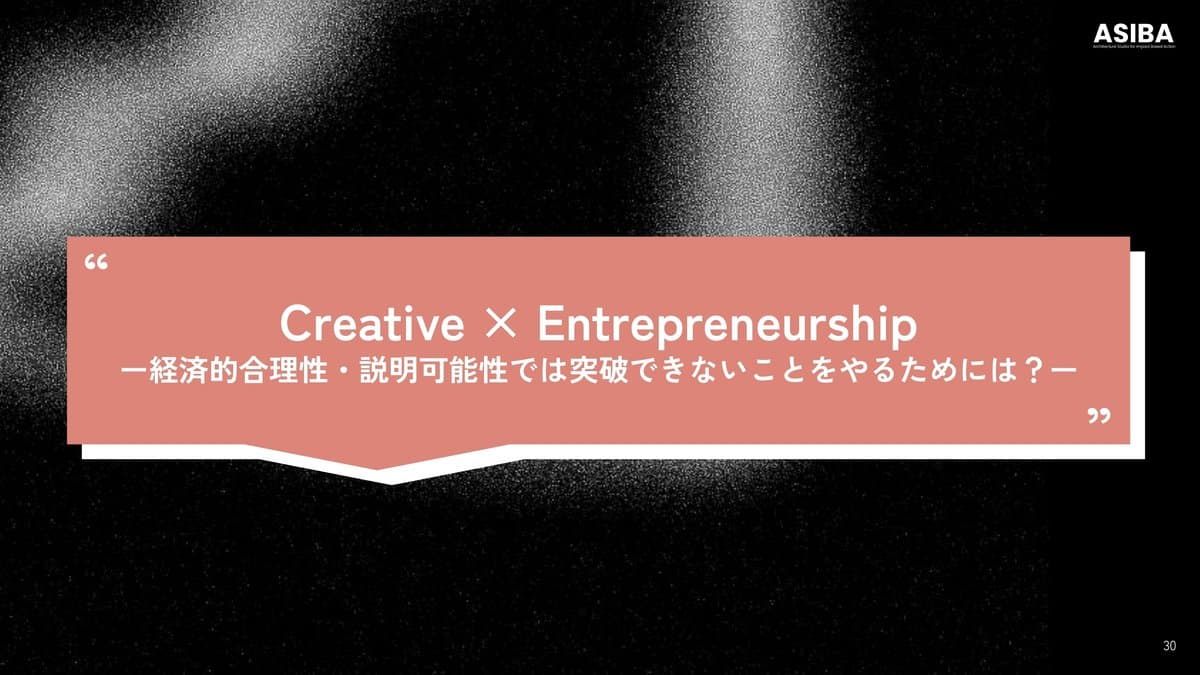
FIG.23
Finally, I’d like to talk about “creativity” and “entrepreneurship.”
At first, I simply thought it would be interesting to combine these two words, but upon deeper reflection, I came to believe that beyond this concept lies a realm that cannot be penetrated by economic rationality or explainability alone.
There are many things in this world that people say, “That’s interesting” or “It’s hard to explain, but we should give it a try”—yet they never take shape. How can we bring these ideas to life immediately, rather than letting them fade into obscurity? The answer to that question may lie beyond the term “creative entrepreneurship.”
Let’s break it down a bit. When we think about the term “entrepreneurship,” we believe it refers to aspirations such as “I want to do this” or “I want society to change in this way,” as well as questions and actions born of curiosity—and, building on that, the willingness to take risks and exercise leadership.
There are various types of entrepreneurship—such as serial entrepreneurship, social entrepreneurship, and intrapreneurship—but what would happen if we combined these with “creation”?Although such a term doesn’t yet exist, I’d like to explore the meaning, significance, and potential of “Creative Entrepreneurship,” starting with its definition.
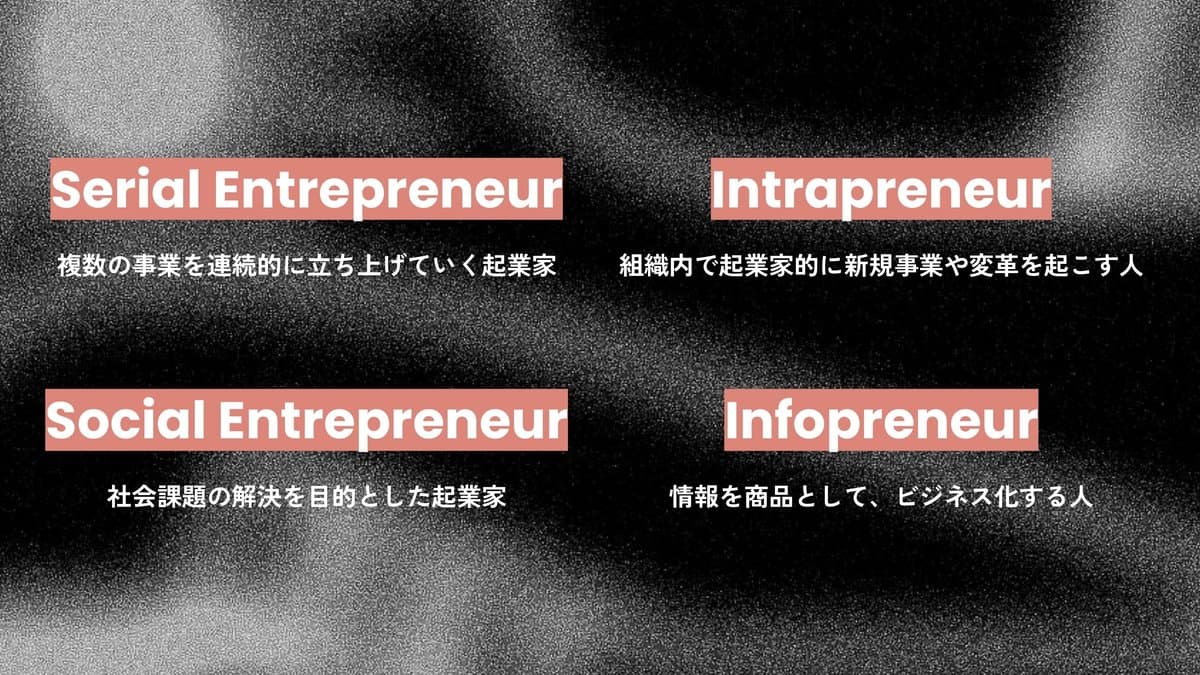
FIG.24
The reason we deliberately use the word “creative” is that, although many of us have backgrounds in architecture, we feel that there are increasingly few problems that can be solved by architecture alone. That is precisely why we must find our own direction by crossing the boundaries of the “creative” fields—such as design, art, science, and engineering—without being constrained by existing models or classifications.Furthermore, we aim to connect people, share ideas to foster empathy, and generate new momentum and solidarity within society. We consider all of this to be “creative.”
I myself have experience in both architecture and working at a startup, and while these two fields are quite distant from one another and differ in nature, I believe that by deliberately bringing them together, something new will emerge. I also feel that this is where we might find a new sense of empathy from society toward ASIBA’s activities.
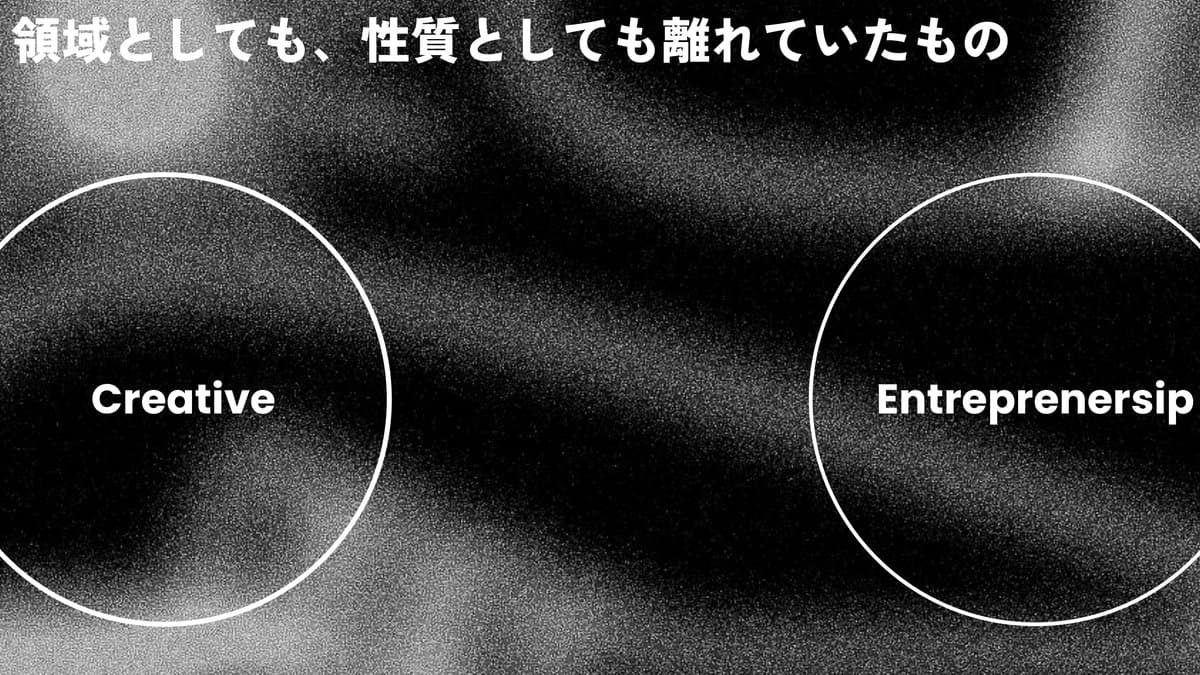
FIG.25
To digress slightly, there was, for example, the Arts and Crafts movement founded by William Morris. In the wake of the Industrial Revolution, aiming to create a society where artisans’ curiosity and the joy of craftsmanship could connect with the wider community, he established a base called the Red House, where he brought artisans together to engage in various creative endeavors.However, in reality, it drifted far from capitalism and settled into a realm of personal, hobby-like creation; the world Morris originally envisioned—where “the personal vision and future-oriented thinking embedded in objects become the mainstream of society”—was never realized.
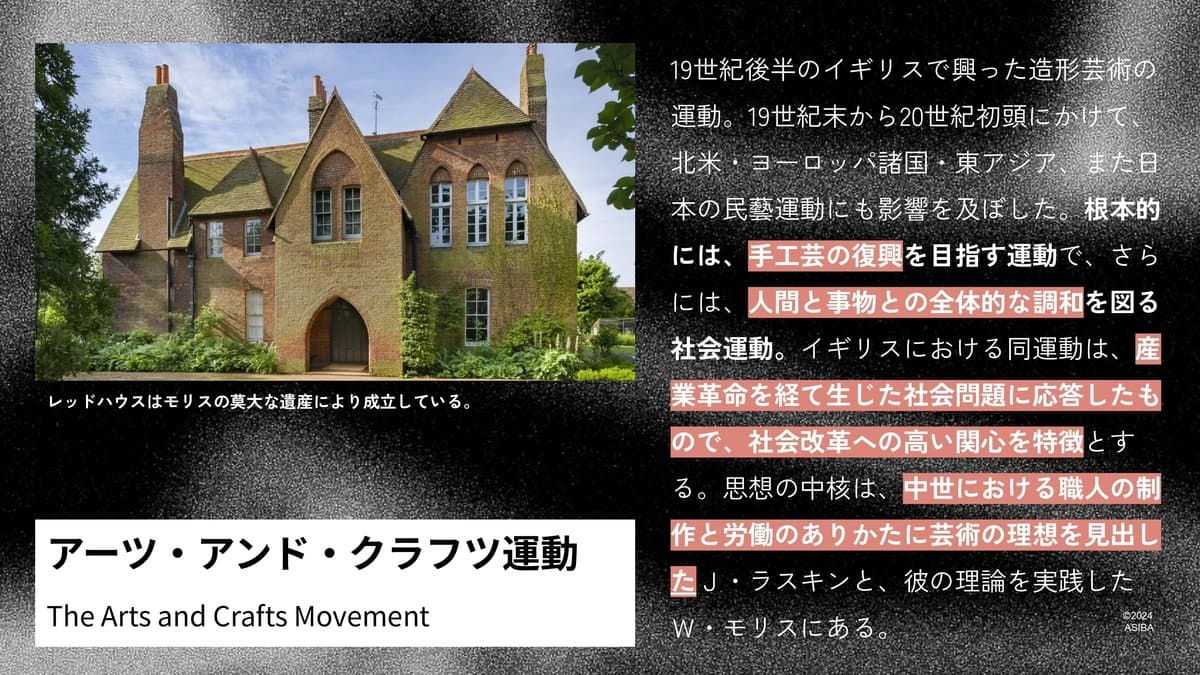
FIG.26
However, while that may have been the case during the Industrial Revolution, I believe that in the modern era—as the creative sphere connects with areas such as startups and project creation—there is potential for visionary ideas and the value and services embedded in products to circulate in the market, and for the joy of creation to permeate society.
Current business models—such as the J-curve, scale-driven approaches, and “market-first” strategies—inevitably have their social limitations. We believe it is possible to respect creativity, earn trust, and see those ideas take tangible form and circulate in the market.That is precisely why we are taking on the challenge of deliberately combining our work with startups—which currently operate outside our usual sphere—and we intend to continue working toward a society where these two worlds converge.
FIG.27
I believe there are various perspectives on “Creative Entrepreneurship.”Among those gathered here today, there are entrepreneurs as well as representatives from general contractors and developers. One aspect of my hope is that this term will serve as a way to embrace and affirm activities—such as art, design, and architecture—that have been difficult to articulate or easily define within traditional categories.
Another aspect is my hope that it will become a new rallying cry—one that allows us to take on the challenge of “creating” without stifling creativity or individual agency, even within the rational framework of economic efficiency and business growth.
Finally, in a climate where it’s often difficult to simply say “that’s great” about “being creative” or “trying to create something that doesn’t yet exist,” I hope this term will help restore a sense of trust in creativity—a trust that allows us to genuinely say “that’s great” about such endeavors.
We ourselves are still relatively inexperienced—we’re all young people in our mid-20s—so we don’t yet fully understand what this phrase will come to mean, and some may even consider it unrealistic. However, we sense great potential in this phrase. We look forward to exploring its meaning together with you at today’s event.
============= This article is a transcript of a pitch given by Morihara, Co-Representative of the General Incorporated Association ASIBA, on “Creative Entrepreneurship” at “ASIBA ATLAS #03 Creative Means More.”
Credit


