岩田愛理
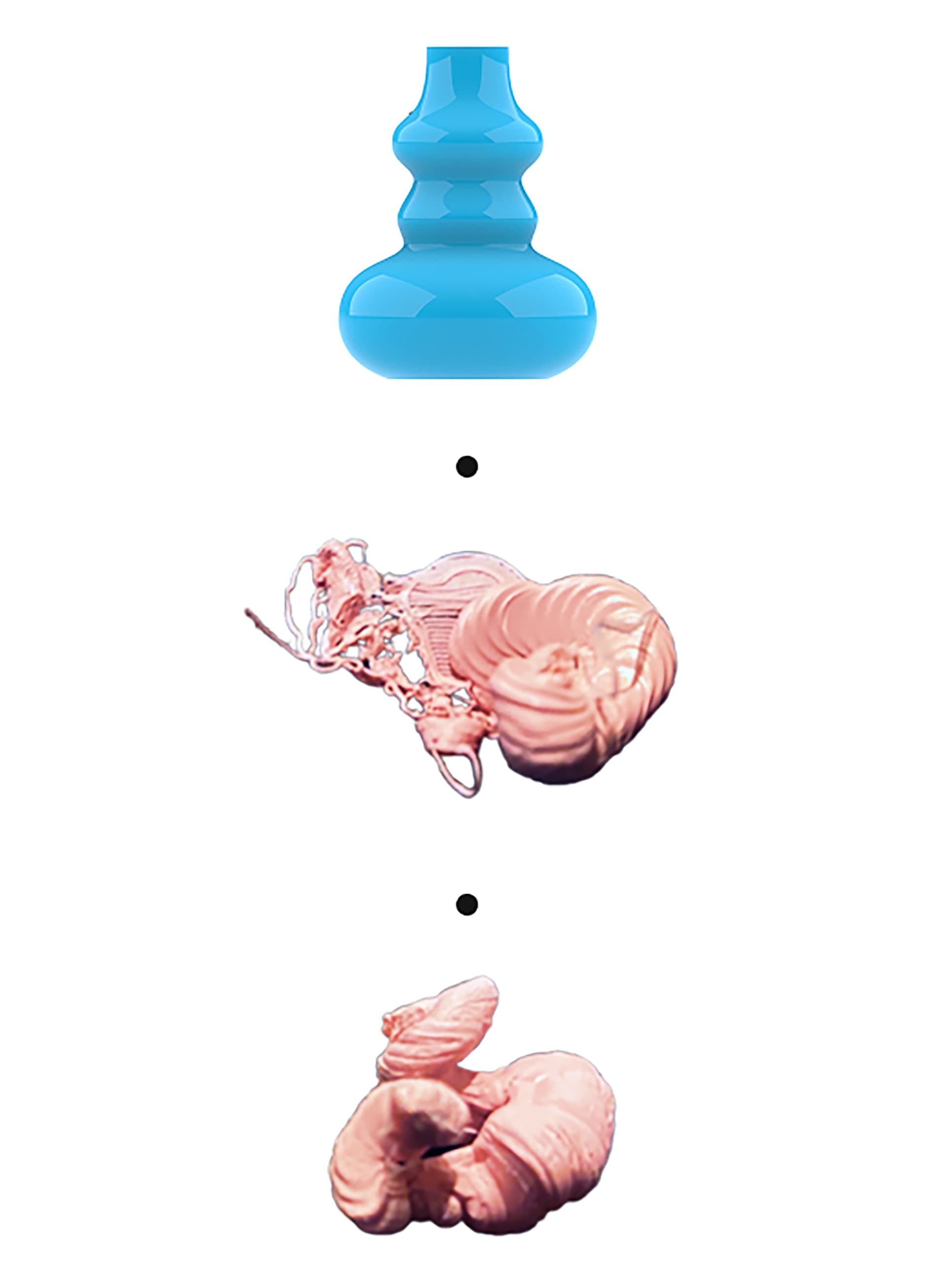
FIG.1
An editorial meeting—one that even the ASIBA Crew found to be sudden and mysterious. For that meeting, I hurriedly created a piece of work as a pre-assignment. I modeled it in Rhino and tried to print it on a 3D printer. However, the print failed twice.
[The Journey to Trash]
I headed to work while thinking about what to make → fell asleep on the train and rode past Hirai → went back one stop and finally arrived at Kameido → stopped at a 7-Eleven on the way to buy a Sunsun collaboration item → Sunsun puppet → Sunsun is so fluffy(So cute!) → Saw a weird-looking vase in Kameido → Blue → Let’s make it → Oh no, I’m running out of time—I have to print it → But I only have pink filament right now → Figured, “Pink’ll do,” and out came a pink vase, expelled from my frantic mind.
But in the end, I ended up with two pieces of weird junk! This is some unknown thing that came from over there! It kind of looks like a creature and is cute.
Now that I’ve encountered this “unknown junk,” let’s get to the main topic. The agenda for this meeting was “Play and Humans.” I’ll share my thoughts on the question: Do humans create for themselves? Or do they create for others?
Personally, I’m in the habit of constantly creating lots of this “unknown junk,” and whenever I think, “This is actually kind of cute for junk,” it sparks inspiration—leading me to think, “I could make something with this! Let’s give it a try!” I feel like I’ve been playing this kind of game for a long time. When I think about it that way, my motivation for creating might not actually be for others.The moment an idea sprouts is right in the midst of play, and in that moment, I’m definitely creating for myself. But the instant I try to implement it in society, other people suddenly appear in the world I’ve been creating all by myself, and from that point on, I start to care about how others see it. Issues of capital and system-building arise, and a responsibility as heavy as lead weighs down on me.As a project grows, you end up involving people internally, and external evaluations come into play, so you have no choice but to create for others. With the expectations of so many people weighing on your shoulders, you can’t afford to do a half-hearted job. That’s why they say adults can’t play casually.
Looking back, there have been many times when I, too, felt I couldn’t create what I truly wanted because I was trying to live up to societal expectations, client expectations, or the pressure to “become someone.” At ASIBA, we’re thinking about how we can free creators from these shackles.We’re working together to build a space where we can start by putting what we want to do into practice on a small scale, and eventually even transform the ecosystem itself. While we value product design as active participants, changing the structure of the industry is just as important.
I feel like I’m really creating—and that things will work out—when I’m just playing around, following the natural flow of what I want to do.
I don’t really want to create for other people.