UNBUILD Virtual Exhibition
For architectural works that question every premise
A joint event with O Inc., the company behind “MEs,” a 3D world-based interface for next-generation creators. The exhibition focuses on architectural thinking and modes of expression born through graduation projects, creative work, and research — ways of thinking that exist before being absorbed into the real-world demands of institutions, function, and feasibility. Works themed around “UNBUILD” are exhibited within the 3D world-based interface “MEs.” Exhibited works are selected through open calls and curation, in Japan and abroad, aiming to create opportunities for young creators to present their work and raise their visibility. The project also sets up a space for open critique and discussion among cross-disciplinary experts — architects, artists, and scientists — to reexamine the possibilities of architectural expression from multiple angles.
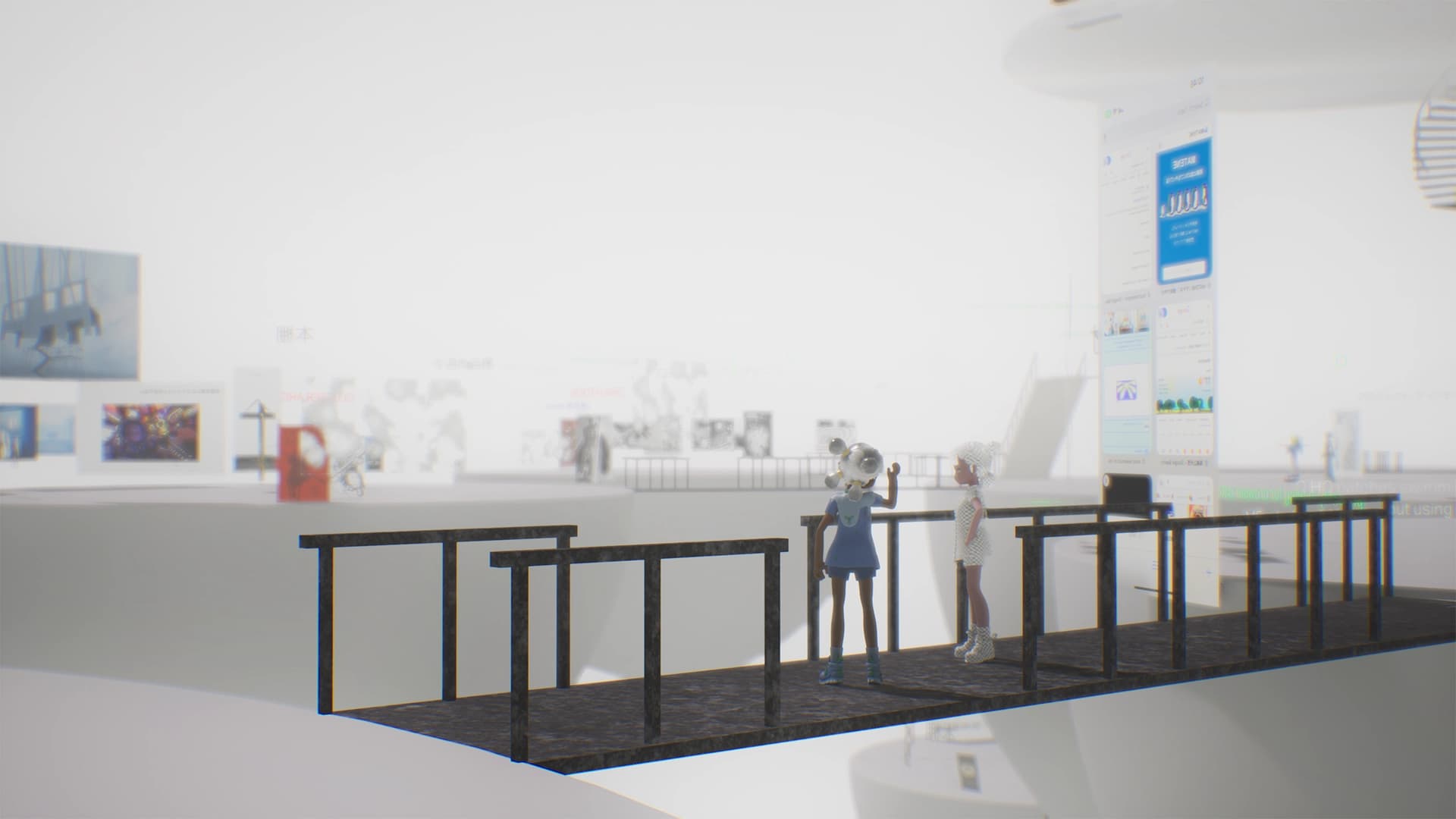
FIG.1
UNBUILD Virtual Exhibition - Background
- The conditions surrounding architecture are becoming increasingly complex and diverse. As the number of factors—such as social issues, institutional frameworks, technology, and costs—continues to grow, we believe that the space for questioning the very premises themselves, or for freely contemplating a sense of unease and unanswered questions that have not yet taken shape, is gradually shrinking.This project aims to reexamine the future-oriented imagination, expression, and forms of creation inherent to “architecture.”
- There are situations where the processes behind artistic expression are rarely brought to light. In today’s environment, the thought processes and trial-and-error involved in creating art often remain hidden from view.Graduation projects, research, and experimental work involve numerous attempts and moments of uncertainty, yet opportunities to share them are limited. The reality is that the more an idea defies feasibility or institutional constraints, the fewer venues exist to discuss it—including the intermediate processes involved.
- The Need for a New Space to “Share Architecture as an Experience” Virtual spaces provide a venue for experiencing and contemplating architecture not just through drawings or panels, but as actual spaces. This exhibition aims to create a space where architectural thinking can flow across national and disciplinary boundaries, leading to new questions.
About MEs
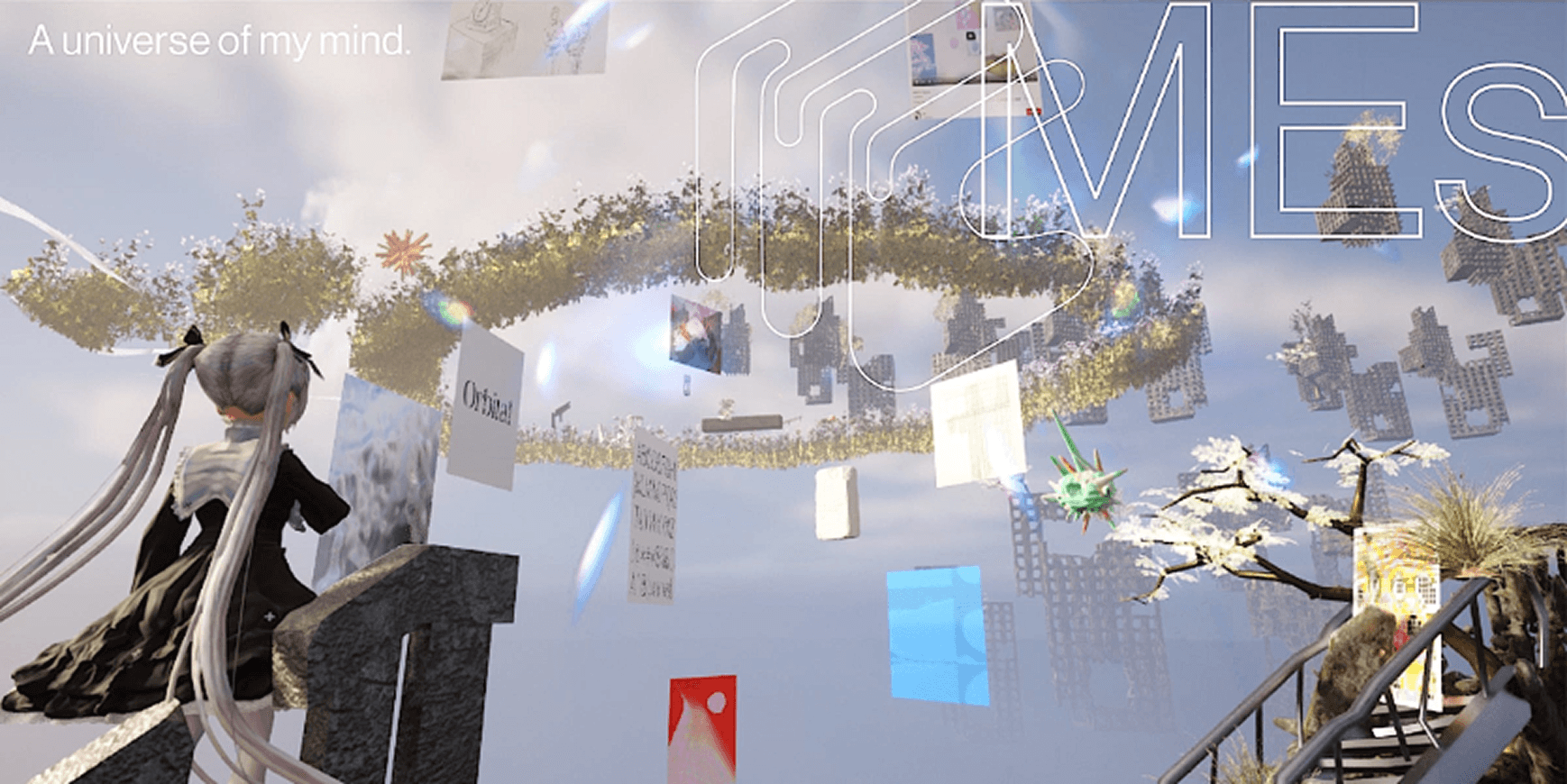
FIG.2
MEs (Mind Environment System) is a 3D world-type interface for next-generation creators developed by O Co., Ltd.
MEs is a virtual world platform designed for creative communication, collaboration, and community building, where people’s memories, thoughts, and creative processes are visualized and manifest as a space that can be shared and experienced. Within MEs, abstract ideas take shape as an environment where one can walk around.Sketches, research, experiments, and fragments of notes crystallize into concrete forms called “Patches,” and by collecting and integrating them, new creative dialogues and insights emerge.
Deeply respecting virtual space as a powerful tool for introspection and expression, MEs provide a deeply creative environment that fosters self-awareness, sharpens critical thinking, and cultivates flexible imagination.
Eligibility
- Eligibility is open to individuals or groups—both domestic and international—working in architecture, design, art, technology, or other fields related to spatial expression, or who have graduated from an architecture-related educational program within the past three years.
- Applicants must be able to exhibit their work in the metaverse using MEs during the exhibition period.
- Proposals for “UNBUILD” works that demonstrate architectural or spatial imagination—such as graduation designs, graduation projects, research, experimental projects, or equivalent endeavors. Any form of expression is acceptable, including architecture, urban design, installations, media art, and virtual spaces. The feasibility, scale, intended use, or institutional constraints of the proposal are not a factor.
- Entries must be intended for exhibition in the metaverse space (MEs), and applicants must be able to submit the necessary data and materials and upload them to MEs. Each applicant may submit only one set of files (multiple files permitted) per work or project.
- The work must strongly resonate with the statement of the UNBUILD Virtual Exhibition.
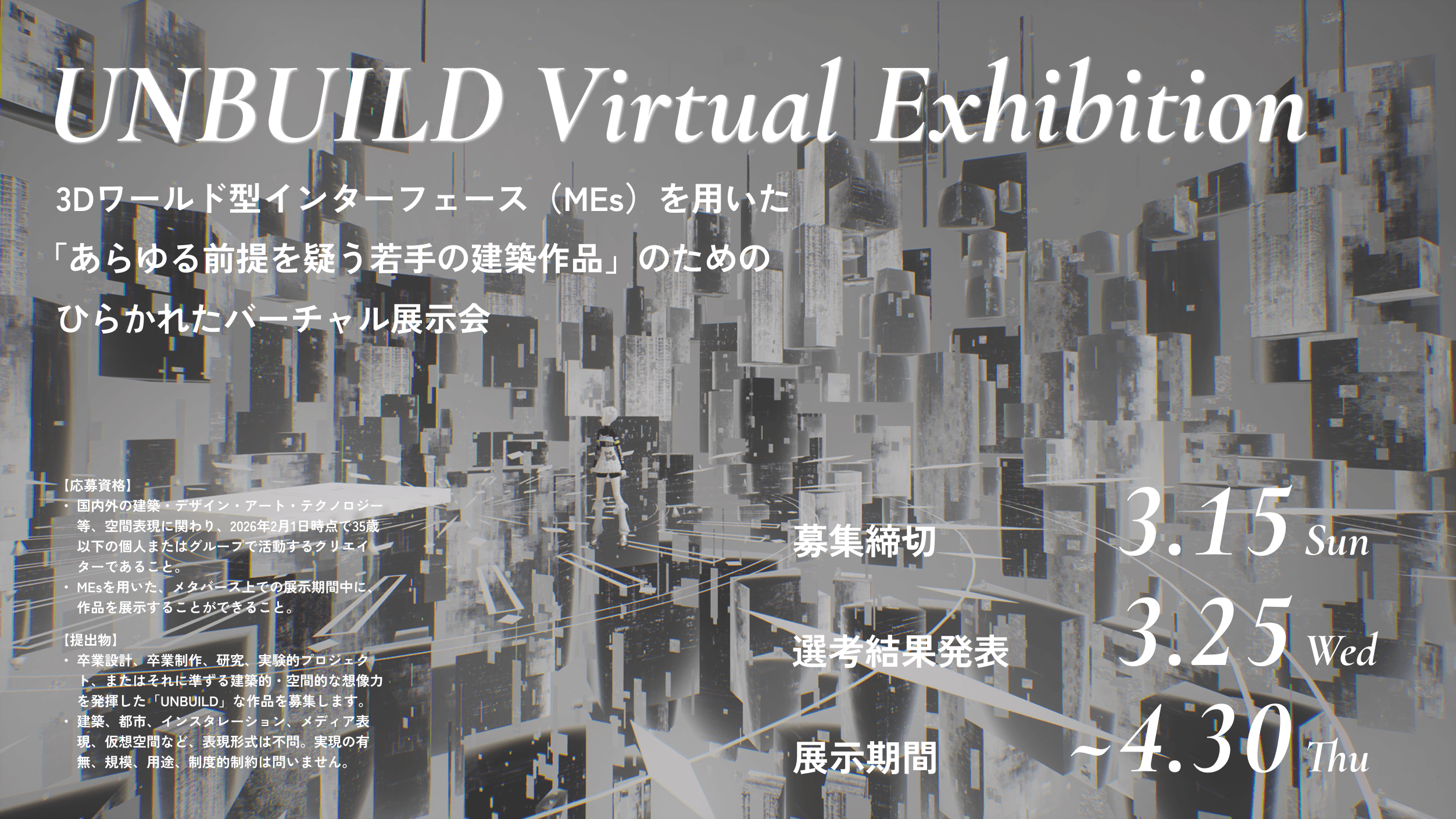
FIG.3
Jury
- Rei Wakita, Artist
and Professor at the Faculty of Environment and Information Studies, Keio University.Ph.D. (Policy and Media). With the aim of “approaching the essence of things through form,” she pursues new forms of expression that blend art and science. Major exhibitions include “Dragon Rain” (Kennin-ji Temple / Zen Night Walk Kyoto, 2024), “Over Billions of Years”(Moerenuma Park / Sapporo International Art Festival, 2024), “For Alan and Keith” (Keith Haring Museum, Nakamura / Hokuto Art Program ed.1, 2022),“Rei Wakita – Photons” (Seishun Art Village Museum of Light, 2018), an 8K video and sound installation with musician Tetsuya Komuro (Ars Electronica Festival, 2016) and a live performance (MUTEK/Red Bull Music Festival, 2017),“The Takahashi Collection: ‘Faces and Abstraction’—In Collaboration with the Seishun Birch Art Museum Collection” (2018), among others. - Rebecca Merlic: Digital
artist, architect, and experimental filmmaker. Rebecca Merlic (born 1989 / HR·AT·DE) is a European digital artist, architect, and experimental filmmaker based in Vienna.She was educated at the University of Applied Arts Vienna and the Academy of Fine Arts Vienna, and studied at the Atsushi Kitagawara Lab at the Tokyo University of the Arts. Her work is strongly influenced by themes such as alternative ways of being in society, transcending socio-economic conventions, and exploring artistic and architectural expression through new technologies.To date, she has received the Marianne von Willemer Digital Media Award (2020), the DKB VR Art Award (2023), Content Vienna, the Theodor Körner Prize for Art and Science (2023), and Knowledge Capital Osaka’s “OMOSIROI,” among others.In recent years, she has presented her work at museums and international venues both in Japan and abroad, including the Museum of Contemporary Art, Zagreb (MSU), the National Museum of Art, Oslo, and the Osaka Expo. - Nozomi
Matsumoto is a Design Director at nendo. She studied industrial design and speculative design at RISD (Rhode Island School of Design).Drawing on a career that transcends the boundaries of business, art, and design, as well as a multifaceted perspective shaped by living in Japan, the U.S., and East Africa, she pursues a unique approach centered on empathy. Currently, with a mission to “enrich the world through ‘Made in Japan,’” she leads international design projects. - Founder and CEO of aHaruO
Ltd. He is developing “MEs (Mind Environment System),” which weaves the creative process into the virtual world.She studied industrial design and computational art at RISD (Rhode Island School of Design) and was selected for *Forbes JAPAN*’s “30 UNDER 30” list in 2023.He designs interfaces for introspection, slowness, and unexpected dialogue that arise within the inner world.
CREDIT
inhouse
collaborator
external


