INC-3rd Term Secretariat Interview #4
FIG.1
I’m Tsunoda, an ASIBA student supporter. In this interview, we spoke with Tatsumi Sone, who created the key visual for the ASIBA Creative Incubation Program 3rd. We delve into the thoughts behind the key visual and explore Sone’s background as an artist who works across various fields.
— Thank you for joining us today. Could you please start by briefly introducing yourself?
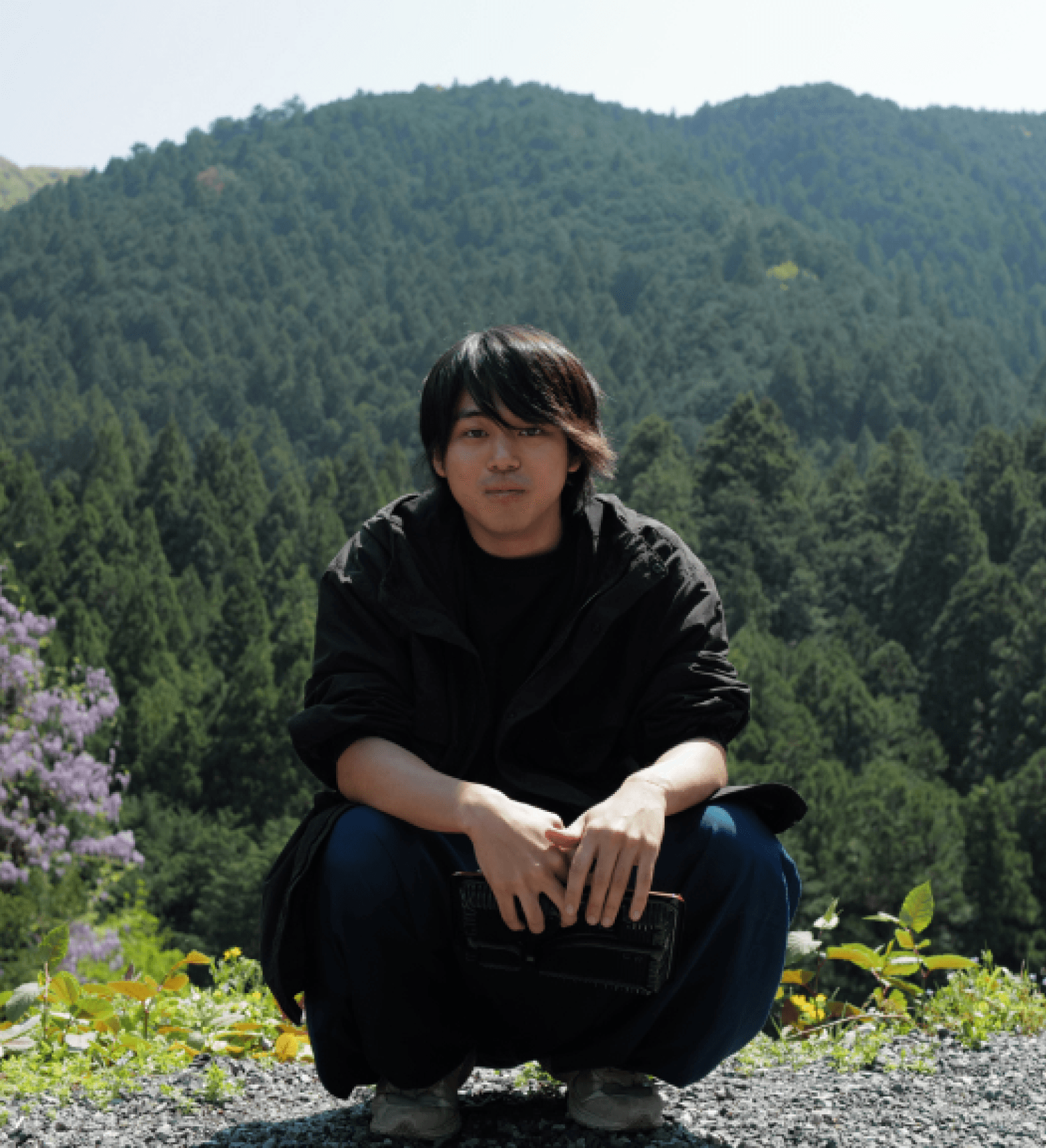
My name is Tatsumi Sone. I studied architecture as an undergraduate and graduate student at Tokyo Institute of Technology (now Tokyo University of Science). For my master’s degree, I studied abroad at Delft University of Technology in the Netherlands.I graduated in the spring of 2024 and have been working as a freelance architect and graphic designer ever since. I take on individual projects and also run “Tabula Press,” a publishing project I launched with friends. I continue to create while exploring the relationship between graphic design—which is two-dimensional—and architecture—which is three-dimensional. Starting this year, I’ve been active as a member of GROUP, an architectural collective.
── Would you say architecture serves as your main pillar?
Sone: Yes, that’s right. As with this ASIBA project, I often collaborate on graphic design work with architects, so in that sense, I see my graphic design activities as an extension of my drawing practice. If you ask me if architecture is the mainstay, then yes, it certainly is the central pillar.
── I apologize for asking such a basic question, but what exactly is “drawing”?
Sone: In the context of fine art, “drawing” typically refers to something where you can see the traces of the hand, but in architecture, it refers to technical drawings.It refers to technical drawings or anything that illustrates a concept. Basically, when translating the English term for “technical drawing,” we use “drawing.” So, fundamentally, we use the term “drawing” as a general term for all two-dimensional representations related to architecture. Although architecture ultimately results in three-dimensional structures, the means of expression remain two-dimensional right up until the very end.The structure of the industry involves taking these two-dimensional drawings to the construction site. Consequently, the proportion of two-dimensional creation is surprisingly large, and in that sense, I think there’s a connection to graphic design. Essentially, graphic design also uses the language of graphics to compose two-dimensional compositions, so in that regard, architectural drawings and graphic design are very similar.
— I see. Thank you for explaining that so clearly. What are your thoughts on the relationship between art and design?
Sone: My basic understanding is that architecture is included within the realm of design. If we consider “design” as one category and “art” as another, I’ll proceed on the assumption that architecture falls under the umbrella of design. In Japanese, the term “design” is often translated as “sekkei” (設計). Speaking in that context, I don’t think it necessarily refers only to beautiful things. Even objects created without an artist’s intent—for example, houses built by home builders—are, after all, designed in some sense. I think that if you take “design” to its absolute extreme, the banality of it can become glaringly obvious.Take data centers or waste treatment facilities, for example. When we use the katakana term “design” to refer to such things, I think the biggest difference lies in the presence—or absence—of a creator. I believe the presence or absence of a creator is what distinguishes design from “sekkei.”
And in terms of the presence of a creator, I feel that art and design are similar. I often have the opportunity to work with artists, and I feel there’s a major difference in the fact that artists don’t have clients, whereas designers do. Fundamentally, design is a profession that cannot exist without clients.Both architectural design and graphic design require clients. A major difference is that the framework of art doesn’t presuppose a relationship with others. The moment you set out to do architecture or design, you can’t avoid forming a connection with someone who will provide you with something, can you? I feel that design and art differ in their approach depending on whether or not they involve collaboration with others.
There was a time when the term “speculative design” was all the rage. A man named Anthony Dunne wrote a book that made him famous overnight, and at the heart of it was the question of whether the kind of thinking that art has practiced could be reflected in the field of design in a slightly more scientific way.Artists place great importance on feedback from results; to put it negatively, there are leaps in their process, but if you look closely at those leaps, they might actually contain possibilities. By incorporating this into the act of design—and thereby thinking about different ways of doing business—I realized just now, as we were talking, that this context resonates with what ASIBA refers to as “creative entrepreneurs.”I felt that crossing the boundaries of architecture, design, and art is similar to this entrepreneurial way of thinking. However, there hasn’t really been much discussion about the practical level yet, so I’m interested to see how ASIBA will develop from here.
— Could you tell us about the thoughts and intentions you put into creating the key visual?
The Sone Program itself is divided into seven phases, each with its own core values, and I thought one of the program’s strengths was that a specific goal was set for each phase.It’s difficult to expect someone to become a “creative entrepreneur” all at once, but by breaking it down into smaller, manageable parts, ASIBA allows even those who are unsure at first to tackle them one by one. I really liked that structure.Each step also has its own imagery and theme, and my concept involved interpreting the values and imagery embedded in each session in my own way and weaving them together.
For example, for “Uncovering One’s Own Perspective,” I envisioned movement starting from a single point and radiating outward; for “The Cycle of Questions and Practice,” I created graphics that convey the sense of moving forward even while repeatedly passing through the same points.In architecture, while you can design a room, it’s difficult to express the movements within it; however, I believed graphics could achieve this, so I created the key visuals aiming for a state where many movements are contained within a single room. That’s why I intentionally made it look as though all the movements are contained within a rectangle. I created it with the image of a room filled to the brim with movement.
── When designing, are there any things you’re careful to do to bring out your own style, or any mottos you follow?
It’s actually quite rare to be involved in both architecture and graphic design. I feel like the relationship between two-dimensional and three-dimensional space is always present in graphic design. As with the Incubation project, I consciously create two-dimensional designs that suggest a sense of depth within the plane. I hope to establish this as my own signature style.
── When you design, are there any role models you look to for inspiration?
Sone: Actually, I didn’t major in graphic design, so I’m not very knowledgeable about it. That’s why I apply architectural thinking to my graphic work. Since architecture is what I’ve studied—and I have a vast amount of knowledge in that area—it’s easier for me to create effective work by approaching it from that perspective. I’ve never approached graphic design purely from a graphic design standpoint, and I’m not sure I could do it—it seems too difficult.I might be able to simply imitate a style, though.
But actually, I’m sure there are references out there that can bridge architecture and graphic design even more effectively. I firmly believe that both “architectural graphics” and “graphic architecture” definitely exist, so that’s an area I’d like to explore further. I believe architecture has its own order and system of language, and I think those elements can be presented in a much simpler way. Right now, there’s too much cross-pollination between different media, and as someone learning from those who came before me, I feel it’s necessary to show, in a pure way, where things originated and how they came to be.
── What are your expectations for ASIBA?
Sone: When I was invited to the Discord server, the first thing I noticed was how passionately and personally everyone is involved in their work. It’s so impressive that it almost feels a bit out of the ordinary (laughs).My overall impression is that this is a group brimming with energy. From the perspective of architecture-based entrepreneurship, architects and graphic designers tend to operate on a “wait-for-the-client” model, but ASIBA actively seeks out clients on its own, doesn’t it? I’m watching this and thinking that this approach is likely what will change the way work is done.I think the probability of a project turning out well increases significantly if you approach it by first taking the initiative to involve others in your vision. Since the current industry’s standard approach is to prioritize the client’s opinions while trying to incorporate one’s own strengths, I believe ASIBA’s alternative way of securing work—which defies that norm—has the potential to actually intervene in the structure of the industry itself. I’m very curious about how we’ll address the fact that those with money and land tend to hold more power. I’ve been watching them and think they’re taking an interesting approach. I get the sense they have the ability to create projects out of nothing.
── Thank you very much!
Credit
Related Works
INC-3rd Term Secretariat Interview #2
INTERVIEW
2025.10.15.