CREEN Conference Special Interview #4
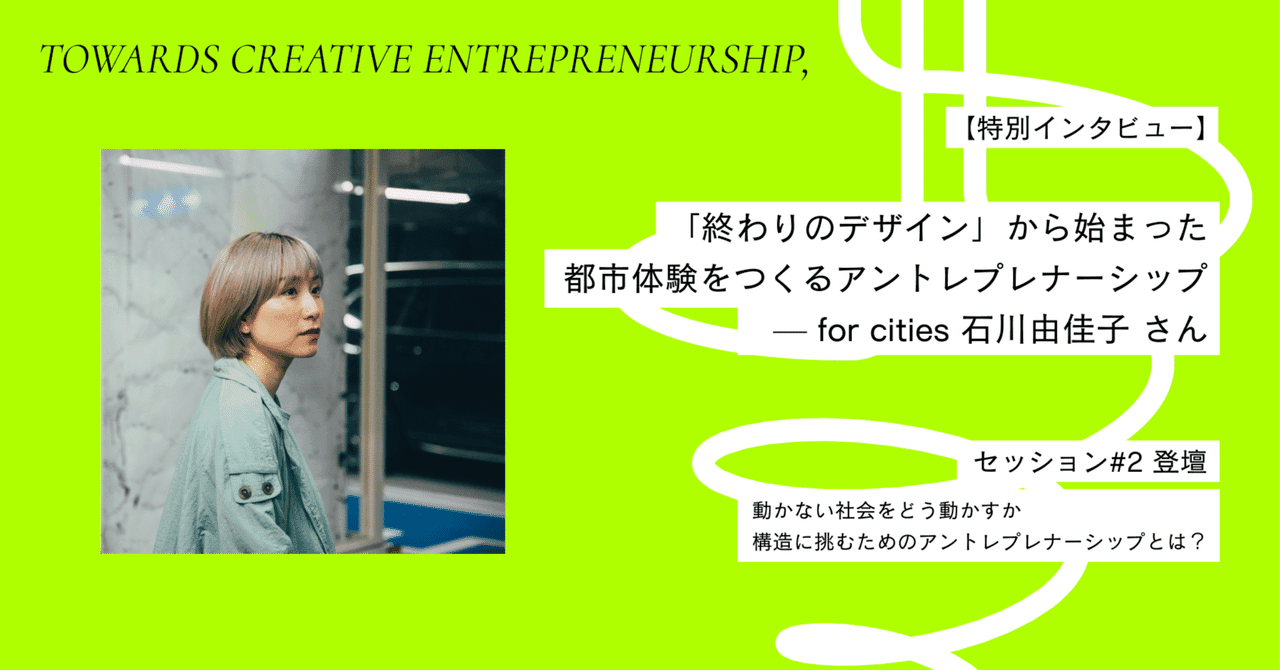
FIG.1
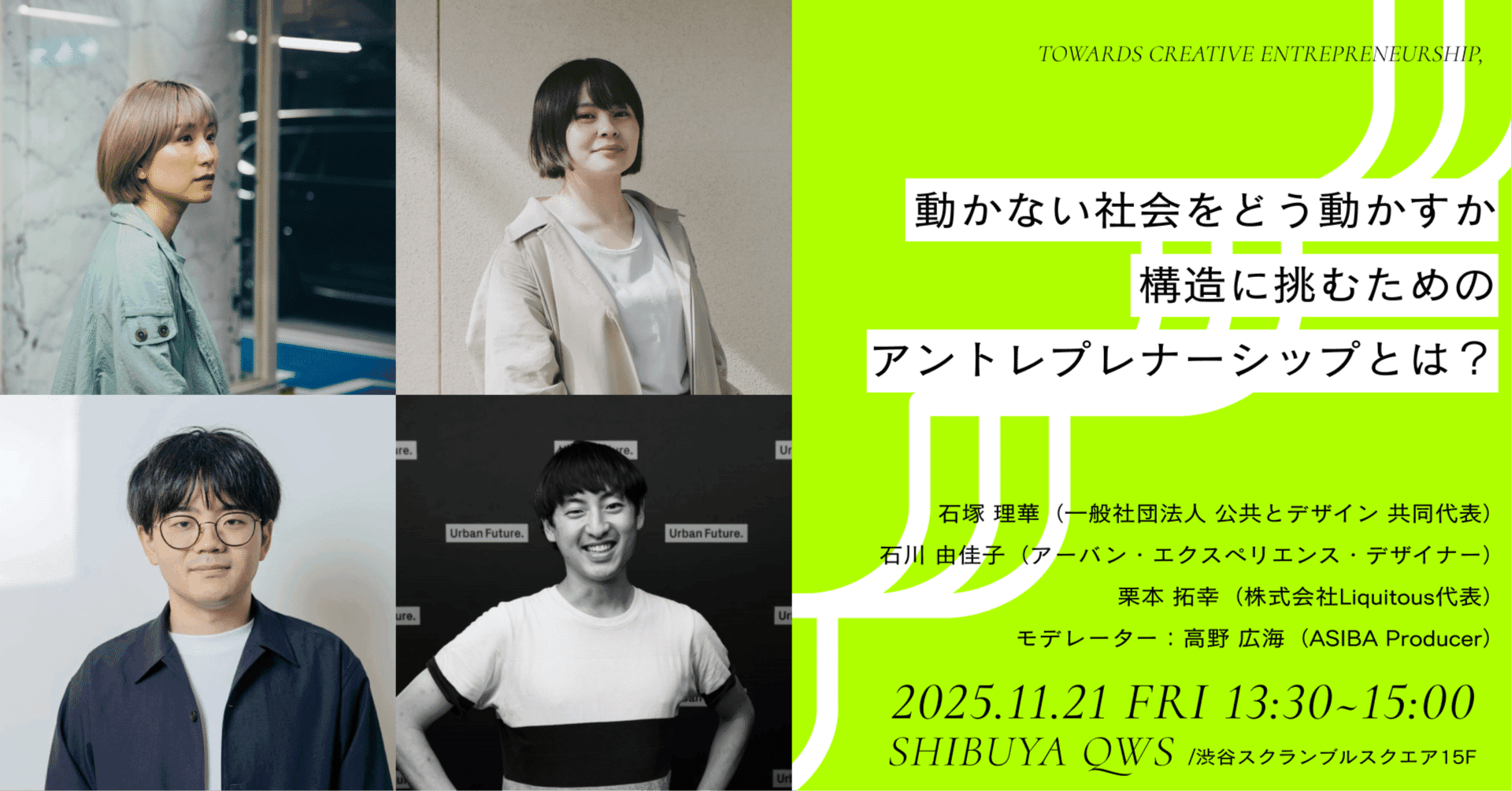
── On Friday, November 21, the one-day conference “Towards Creative Entrepreneurship: Exploring the Possibilities of Social Implementation in the Creative Sector and Its Methodology” will be held at Shibuya QWS.For this article, we spoke with Yukako Ishikawa of for Cities, who will be speaking in Part 2 of the conference, titled “How to Move a Stagnant Society: What Is Entrepreneurship for Challenging Structures?”
Yukako Ishikawa, Urban Experience Designer / Urbanist: Guided by the motto “Mastering the city with our own hands,
” she designs citizen-participatory urban experiences in collaboration with people from diverse backgrounds both in Japan and abroad.After working at Benesse Corporation and Loftwork, Inc., she became independent.She founded “for Cities,” a general incorporated association dedicated to urban experience design, and serves as its co-representative director. She has led space design projects in multiple cities both in Japan and abroad, including Tokyo (Mitsubishi Estate/Sony Park mini, etc.), Kyoto, Kobe (Kobe City/KIITO, etc.), Amsterdam, Cairo, Ho Chi Minh City, and Chiang Mai.He leads the “Dear Tree Project,” a data platform for street trees that reimagines the relationship between cities and green spaces, and works with local communities and government agencies to utilize urban greenery effectively. He serves as a director of the Social Green Design Association, a general incorporated association dedicated to envisioning and creating the future of work related to green spaces.He launched “watage,” a community hub in Kanda, which operates as an urban design studio for young people. The studio conducts activities centered on the theme of the city, including research, planning, editing, and the development of educational programs. It was awarded the “Regenerative Company Award 2023” by WIRED.My favorite moment in the city is “the walk home.”
Takano: When I read your articles and other work, I get a strong sense of your identity as a “designer.” On the other hand, how do you position your sense of self as an “entrepreneur” within yourself?
Ishikawa: To be honest, I’ve rarely been asked about my mindset as an entrepreneur, and I haven’t really given it much thought either.The reason “for Cities” was incorporated and operates as a company stems from a sense of unease I felt about how I was involved in projects. At the time, I was working on client projects in various cities, but since those were strictly the clients’ projects, I felt uneasy about not being able to define the “end” on our own.
Building communities and shaping situations is a flexible, long-term process without a clear-cut endpoint—it doesn’t end simply because specific metrics have been met. For me, not being able to design that “ending” myself was the greatest source of frustration when thinking about communities. So, I started this company to fully commit to taking responsibility for our activities and presenting them to society.
I’ve often seen local initiatives burn out and come to a disappointing end, or projects conclude without their processes ever being made visible. I view “the end” not as the conclusion of everything, but as a “milestone” for moving on to the next phase. The question is: how can we create that milestone creatively?Until now, the focus has been on “building” cities, but a society is approaching where we will no longer be able to construct new buildings through the traditional “scrap-and-build” process. In that context, how do we utilize what already exists? How do we create endings that lead to the next phase? Or how do we return things to the environment? Designing these aspects will become extremely important going forward.
Takano: As someone involved in urban planning myself, I feel that themes like “fostering a public spirit” or “urban experience” tend to sound a bit abstract and “vague” when compared to society’s critical agendas. What is the significance of your decision to deliberately engage with this field, Mr. Ishikawa, and what prompted you to begin this work?
Ishikawa: The word “city” may sound like something vast, but I view “creating individual living landscapes” and “shaping daily life” as the smallest units of the urban experience. Our focus is on how we can spread individuals who engage proactively with the city—that is, “urbanists”—across various regions, and how we can design local environments that foster that mindset.
Fundamentally, I treat every project as a personal endeavor. The desire to improve my own life or the lives of those around me—the feeling that “I want to see this kind of landscape”—is the starting point and motivation for my work.For example, rather than aiming to “cultivate a public mindset among the entire population of 100 million,” I first want to embody that mindset myself, and I hope that my colleagues working alongside me will also develop it. I approach my work with the image of “spreading small ripples” in this way.
Takano: Mr. Ishikawa, you’ve placed great importance on building urbanist networks like “for Cities.org” from the very beginning. What was your intention behind this?
Ishikawa: “for Cities.org” has become a platform—akin to an idea database—with members currently registered from about 65 countries. There were two main reasons I started this. First, while involved in urban development projects in Japan, I became acutely aware of the lack of diversity at “tables for discussing cities.” I felt uneasy that discussions always seemed to proceed with the same familiar faces.
The other was a sense of envy toward the well-established platforms and supporting foundations in other countries—particularly in Europe—that facilitate cross-border, cross-sectoral discussions about cities. I wanted to create a community in Asia where that kind of dialogue could flourish.
My goal was to “think locally on a global scale.” For example, Manila in the Philippines faces challenges similar to those here in Kanda, so we’re developing projects by drawing on practices from there. I wanted to create a dynamic movement where we could learn from each other’s local practical knowledge across national borders and disciplines.I wanted to meet “like-minded people” around the world who share the same passion for their cities and to generate new initiatives through these connections.
Takano: Initiatives like “watage” in Kanda—where people move into areas slated for redevelopment by developers ahead of time—are truly unique, aren’t they? What potential do you see in this approach?
Ishikawa: “Watage,” the community hub where I’m currently involved in everything from its establishment to its day-to-day operations, is located in an area scheduled for redevelopment in 10 years. We’re working with the developer to shape this space with that long-term horizon in mind.
Underlying this initiative is the concern I mentioned earlier regarding the “lack of diversity at the table where urban planning takes place.” The opinions of elementary and middle school students are not reflected in decisions regarding the design and functions of public squares. Yet, it is their generation that will be the primary users of those buildings 20 years from now.
It is becoming increasingly important to identify the values held by future generations and bridge the gap to incorporate them into larger plans. Through our activities and thought experiments at “watage,” we are putting this bridging into practice. I feel that we—along with the developer and the entire community—are beginning to learn together about the themes that will shape the city of the future.
Takano: That said, activities that begin with “place-making” and operations—let alone those that start even before redevelopment—are tasks that only a studio with a proven track record like for Cities can undertake, and they present the challenge of being difficult to quantify in terms of conventional economic value. What is needed to increase such practices in society?
Ishikawa: You’re absolutely right—while the cost of constructing a building is easy to calculate, “assigning value” to the intangible aspects is difficult. That’s precisely why I believe it’s crucial to establish new “evaluation criteria” for these activities and demonstrate results that can be shared among stakeholders with differing perspectives.
For example, in another project starting in Nishi-Shinjuku, we’ll first test the design and operation of the plaza following redevelopment in a temporary space.Until now, we had no choice but to test things “after they were completed,” but we want to demonstrate that these kinds of “process tests” and “compatibility tests” can be conducted in a variety of locations at low cost. I believe it’s possible to give new meaning to “budgeting” in this way and to link it to corporate missions.
Takano: Finally, if there are any topics you’d like to discuss with the other panelists, please let us know.
Ishikawa: I’d like to discuss “how to foster a public spirit.” I previously helped with a “Decidim” project (a citizen participation platform implemented in Barcelona) in Shibuya Ward, but even though the system’s UI/UX was good, it didn’t work out because the users lacked a culture of discussion and advocacy. It’s difficult to simply import Western-style democratic processes as-is. Japan needs a different approach.
There’s a phrase I cherish that was given to me by a Dutch urbanist: “Not too big, not too much.” It’s a way of thinking that views “within reach” and “within the scope of one’s feelings” as the basic units.
We can no longer paint “grand narratives” for social change. From now on, the approach will be about how to empower “small narratives.” Tools like Decidim might also work, depending on how they’re combined with scale and scope.
Since administrative boundaries do not necessarily align with the boundaries of daily life, we need to redesign how we draw new boundaries. I’d very much like to discuss this sense of scale with all of you.
Special Interview: The Ethics of Design Challenging Structures - Public and Design with Rika Ishizuka
CREEN Conference Special Interview #5
INTERVIEW
2025.11.18.