CREEN Conference Special Session #2
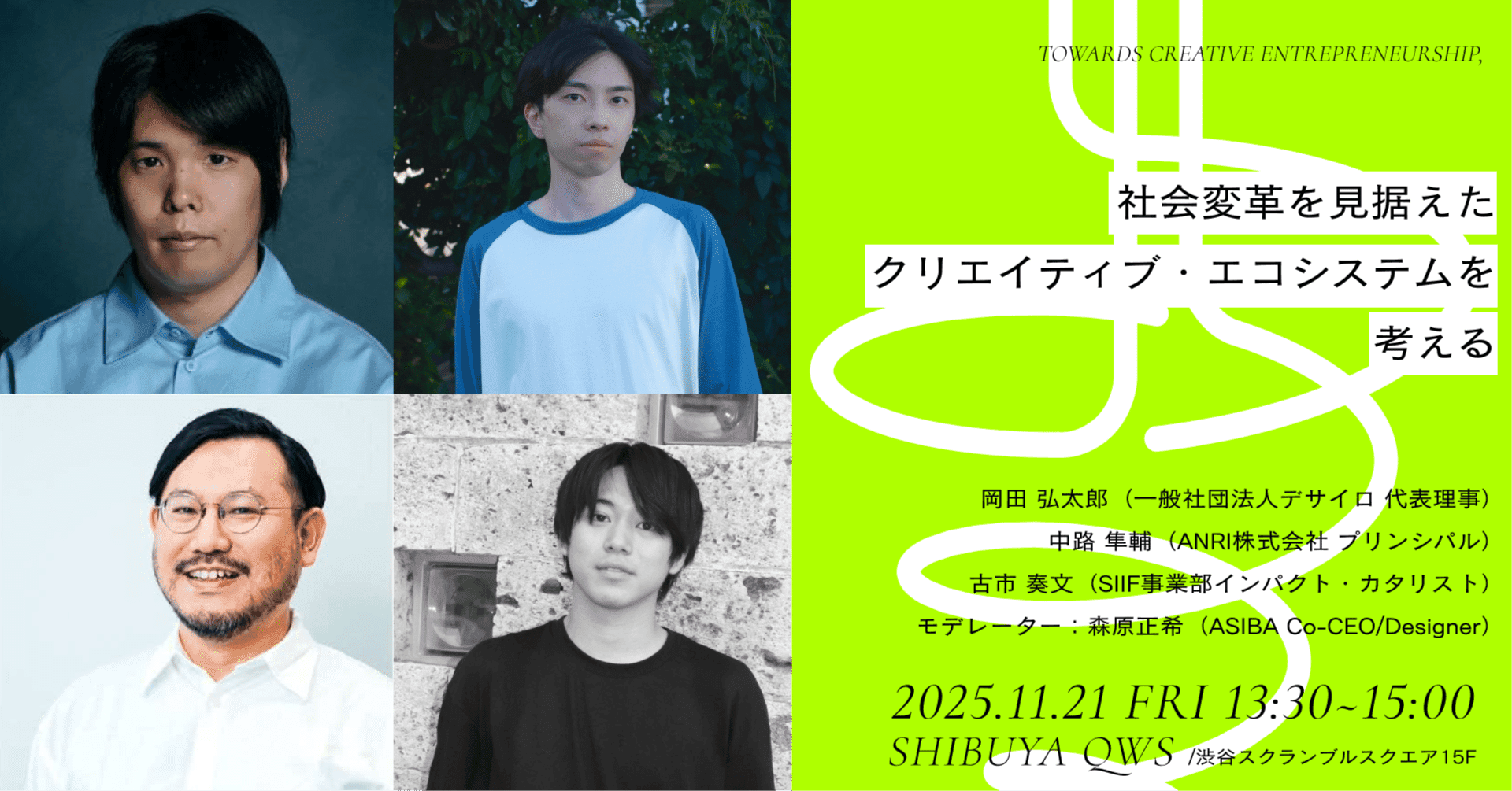
FIG.1
Many of the challenges facing modern society are vague and highly uncertain, and it will surely be difficult to break out of this situation relying solely on traditional market principles.In response to these social conditions, isn’t the “creative and aesthetic vision of the future” embodied in fields such as architecture, design, and art the very solution we need? And isn’t a new ecosystem necessary to liberate the potential of these fields from the constraints of economic rationality? This article reexamines the intrinsic value and social demands of creativity and explores the form a new ecosystem might take to foster the culture of the future.
(This article was published on November 21, 2025,as part of the one-day conference “Towards Creative Entrepreneurship—Exploring the Possibilities and Methodologies of Social Implementation in the Creative Sphere,” co-hosted by the General Incorporated Association ASIBA (hereinafter “ASIBA”) and @Kamata Co., Ltd. (hereinafter “@Kamata”) at Shibuya QWS. This article is a reconstruction of Session 3“Envisioning a New Creative Ecosystem with a View to Social Transformation.”)
Morihara: Regarding our three guests today—Mr. Nakaji just expressed concern, saying, “It looks like you’ll have your work cut out for you as moderator”—but personally, I believe we can all connect through a common thread. First, I’d like to start by exploring the challenges each of you faces. I thought the phrase “oppressed elements” that Mr. Nakaji mentioned earlier was absolutely brilliant. Could you please pull up the materials?
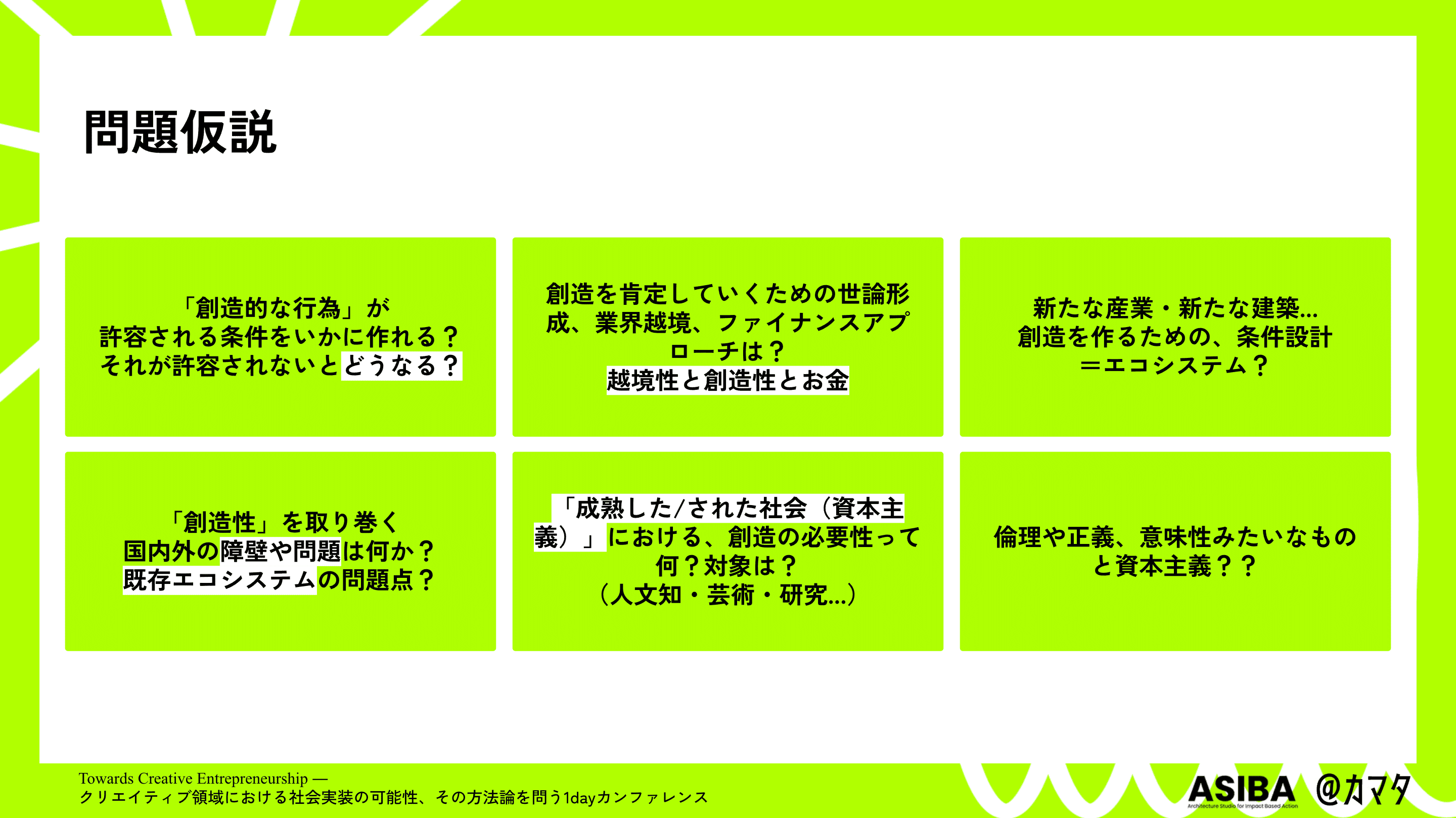
FIG.2
Assuming that capitalism is maturing and heading toward its end, I think the very nature of the need for creativity—and what exactly it’s aimed at—has become rather vague right now. When we think about an ecosystem for creating something beyond capitalism’s end, is that an endeavor to re-edit our existing culture and re-examine the conditions under which it operates?First, Mr. Okada, from an academic perspective, could you tell me what you currently perceive as being “oppressed”?
Okada: For example, when considering the empowerment of research through the flow of funds, I believe that going forward, we’ll need a framework that goes beyond simply providing grants to include the measurement of social impact.Recently, there’s been a movement—such as “productive interactions”—to measure not just the number of citations a paper receives, but also how effectively research activities are utilized within a network. I think there are various ways we can draw on the approaches to measuring impact being explored in the field of impact investing, including this trend.
Nakaji: Whether it’s corporations or foundations, I feel that Japan lacks creativity in how it uses money. The outputs are creative, but when it comes to money, it feels like people have settled into the mindset that “this is the best way to use it” or “this is just the way it’s done.” I get the sense that interesting organizations are good at “editing” their money, and companies that use money creatively are also growing their businesses.
Mr. Okada Nakaji, for example, has redirected 5 million yen from the management fees of the venture capital firm ANRI into a “Humanities Scholarship,” thereby changing the destination of those funds.
Nakaji: When considering the advertising effectiveness of ANRI as a company, we could, of course, run newspaper ads. But if we tackle issues that are necessary in this day and age and generate buzz, we can get coverage in the newspaper without paying advertising fees. Of course, there’s a genuine desire to provide support through scholarships, but I also think it’s more beneficial from a purely business perspective to do it this way.
Morihara: I think the reality is that many executives feel they must be accountable for how they spend money and can’t invest in anything that doesn’t have a specific name or meaning attached to its inputs and outputs. In research as well, I suspect we’re seeing situations where the same researchers receive research grants indefinitely, and I’m curious about how we can break through that.
Okada: I often think about things like “ideological impact.” For example, at Omron, the “SINIC Theory”—a theory of future prediction presented by founder Kazuma Tateishi and others at the International Future Studies Association in 1970—serves as one of the company’s foundational pillars.Precisely because societal uncertainty is increasing so much right now, I believe it’s crucial for business leaders to develop new philosophies and ideas that serve as a foundation.In the U.S., venture capital firms like Andreessen Horowitz have set an agenda called “American Dynamism” and are steering society in that direction. I believe that when Japanese companies implement such ideological foundations, academic knowledge will come into play in various ways.
Nakaji: Speaking of which, where did the concept of impact investing actually originate?
Furuichi: Impact investing is an approach that originated in the United Kingdom.
Nakaji: Really? I thought it was the U.S. They’re just so good at creating concepts like that, aren’t they?
Morihara: In that sense, it’s quite close to the keyword “editing” that Mr. Okada mentioned—in the sense of reimagining the narrative.
Okada: I think what I’ve been doing through my work in the media is quite close to that context.The other day, I was reading a book called *A History of Philosophy on the Archipelago* by Ryohei Noguchi, a researcher in philosophy and intellectual history. This ties back to what we were discussing earlier about ideological foundations. Noguchi categorizes the characteristics of this archipelago into three aspects: isolation, peripherality, and national seclusion. He points out the need to create universality from the bottom up——that is, ways of thinking imported from the so-called West—and instead creating universality from the bottom up. I feel that now, more than ever, it’s important to ask anew, “What is Japan?”
I’m pretty sure Seigo Nakaji-Matsuoka said something really insightful about this. Why is it that in big corporations, acronyms like “ESG” immediately become all the rage? Also, it really struck me how, despite desperate efforts to invest in various fields to expand Japanese culture overseas, the most recent success story in international expansion has actually been VTubers.VTubers emerged from what you might call a bottom-up culture; they spoke in Japanese without giving globalization a second thought, yet their content was translated on its own over there and became a hit. Ever since I saw that example, I’ve come to realize that we really need to pay more attention to what’s happening on the ground.
Morihara: So that’s a concrete example of universality emerging from the grassroots, then.
Okada: On a related note, I’m curious—what kinds of ideas are emerging for financing schemes suited to investing in cultural assets, where short-term economic returns and economic value are difficult to measure?
Furuichi: In the realm of impact investing, there are indeed several areas where we’re putting a lot of effort into. For example, this includes investment agreements designed to strike a balance—where we don’t aim to profit solely from capital gains, but rather receive dividends while ensuring the sustainability of our investment activities.Beyond that, we’re also exploring frameworks where shareholders don’t exercise voting rights to influence management, but instead prioritize communication and engage in different ways from the planning stage onward.
Nakaji: I get the feeling there are actually many more possibilities in that area that haven’t even been explored yet. For example, if you invest in an artist through a standard venture capital framework, to put it simply, they’ll inevitably end up aiming for a route like appearing on “Music Station” and boosting sales…But what’s truly important—more so than simply being accepted by the general public—should be the artist’s individual musicality and creativity, right?
For example, something we tried a while back was creating a private placement bond where the interest rate rose the more successful the artist became. We structured it so that the returns might be higher than buying government bonds, and we actually raised about 65 million yen.ANRI itself didn’t make any profit from this—I just did it on my own—but I do hope we’ll see more discussions about how there are alternative ways to raise funds in the creative sphere like this.
Morihara: These days, with AI, you can create a website in just a few seconds, so there isn’t really that much added value in new graphic styles anymore. In this environment, I think the creative industry—especially the digital sector—is increasingly finding itself in a situation where it can’t generate profits unless it develops its own services.But the barriers to identifying new challenges, presenting them, securing funding, and bringing them to market are incredibly high—I suspect this will become an industry-wide challenge. I think things like bridging linguistic gaps and crossing boundaries are incredibly important here, so I’d love to hear your thoughts on that.
Nakaji: There should be plenty of money out there, yet it rarely flows into the humanities or creative fields. I’ve been wondering why that is—is this also a matter of aesthetics? I’ve been thinking about how we might create a movement that says, “Isn’t it cool to spend money on these kinds of fields?” but I haven’t quite figured out where to start. How does impact investing overcome this hurdle?
Furuichi: In our industry, we call it “catalytic capital.” We’re very conscious of how to first generate risk-free capital and allocate it toward investment to support creative endeavors.Simply put, there are actually a lot of wealthy people in Japan, and the question is how to get them to channel that money into investments in the impact sector and create a positive flow of capital. Recently, with the emergence of a new profession—the “philanthropy advisor,” who manages the assets of high-net-worth individuals and supports their investment decisions—I feel like the tide is starting to turn in that regard.

変化の呼び水、カタリティック・キャピタル|SIIF
1. イノベーションを阻む「壁」 お金は、社会を変える「呼び水」になりうるか? 社会・環境システムにポジティブな変化をもたらしうるソリューションが成長・拡大するには、ビジネスやサービスモデルの価値検証とスケールの土台となる環境整備が重要です。 しかしながら、社会の変化を目指す財団やインパクトVCなど資金の出し手の金融リソース、つまり一件あたりの助成額や投資チケットサイズには限りがあります。よほど例外的なケースを除いて、社会を変える可能性を持った革新的な事業をコンセプト段階からスケールまで、リスクを取って一気通貫で支援するのは現実的ではありません。 2012年にMonitor G
FIG.3
Morihara: As I was listening, something occurred to me—I started wondering what “good for society” actually means.I believe the role of professionals like creators and architects is to identify social issues, conduct research, and discover the seeds of future solutions. In that context, isn’t there a certain limitation to continuing to invest based on a predefined notion of what constitutes “benefit to society”?
Nakaji: It’s really hard to explain in a single sentence, isn’t it? That diversity might be both the strength and the weakness of liberalism—I find it difficult to bring it all together. Everyone’s thinking along similar lines, but compared to conservatives, it’s hard to present a common goal that everyone is aiming for, isn’t it? Lately, I’ve noticed many instances where this weakness of liberalism is being exploited.
Morihara: The more plausible an explanation is, the easier it is to unify around it—and the more it tends to veer toward populism—while also making investment decisions easier. Finance just keeps accelerating, doesn’t it? But on the other hand, to maintain ambiguity and diversity, we end up drifting toward a humanistic trend that emphasizes the need for humanities-based knowledge to understand what we don’t understand.Actually, one issue I’m very conscious of is that these days, people engaged in creative activities tend to be almost exclusively from the elite class. Even hip-hop, which originally emerged from cancel culture, isn’t really like that anymore. Lately, I’ve been sensing a sense of its demise.
Let me ask a question as well.I think we’ve discussed the design of how those with money and those who’ve raised it allocate those funds, but I also believe the recipients’ mindset and how they use the money are quite important. Even if the amount is the same, from the funders’ perspective, there’s a specific vision and intention behind it, isn’t there? How can we ensure the money isn’t simply used like any other grant, but rather that recipients resonate with the designed flow of funds and use it accordingly?
Okada: It’s a really difficult issue, isn’t it? In our case, we’ve implemented an “Academic Incubation Program” that provides researchers not only with grants but also with ongoing support. While I wouldn’t say it’s been a complete success—we’re still in the process of refining it—I do think that thinking things through together while providing that ongoing support is key.However, if we try to meticulously measure the impact of activities for the recipients, it can hinder their freedom to create. I’d like to keep thinking about what the right balance is.
FIG.4
Morihara: That’s truly the biggest hurdle we face in ASIBA’s incubation program as well. Fundamentally, artists, creators, and aspiring architects participate in the program to create their own work. In short, they aren’t looking to do something with commercial viability in mind—in fact, concepts like commercial viability or business models are just a huge distraction to them.While it’s important for them to discover the creative spirit of being an artist in this way, I think it’s also crucial for creators to eventually take the leap toward social relevance and scalability. The reality is that not many creators have managed to cross that boundary yet.
Nakaji: I don’t have a clear answer either, but I think venture capital provides the right kind of external pressure. Basically, it’s a bit of a pain. You have monthly meetings with the entrepreneurs you’ve invested in and receive all kinds of reports.I used to think, “An hour won’t make much of a difference anyway, so what’s the point?” But an investor I respect told me, “No, your role is to make entrepreneurs give you bad news even when they’d rather not.”After all, isn’t it a bit unpleasant to have to report to your investors that you didn’t really do anything this month? I do think venture capital has this aspect of being a “necessary evil”—something that shows up occasionally after the money has been invested.
Furuichi: When I invest, I always do so with the hope that, through impact assessment, the entrepreneurs will paint a picture of the future they want to realize through their business or research.If they can’t envision that, I feel it probably means we’re still not communicating effectively and our role is being misunderstood. Above all, I think the ideal scenario is for us to become fans ourselves first, share the same vision, and move forward together as we dream alongside them.
Morihara: One thing that’s been on my mind lately is that, in recent years, Silicon Valley has become like a pirate—destroying everything through social innovation in a highly disruptive way. But personally, I hope to see a quantitative increase in activities driven by a sense of justice, ethics, and purpose—not just that.
Okada: This might be related to what you just said, but what concerns me right now is that, since the advent of large language models, the humanities haven’t been responding very effectively to questions about the nature of humanity and the human condition in an AI-driven world.Situations are arising that cannot be fully explained by the notion that technology is hindering humanity. For example, I believe we’re on the very brink of a situation where AI agents will know our preferences inside and out, and we’ll end up merely consuming whatever is presented to us.I strongly feel the need to work with researchers in the humanities and social sciences to develop discourses and ideas capable of countering such a situation.
Morihara: As AI evolves at an incredible pace, the range of expression has expanded tremendously, and it’s become something of an embodiment of the Enlightenment—but in reality, people aren’t actually being enlightened. Rather, I think it’s also a tool that triggers a decline in self-esteem, making people wonder, “What’s the point of my own creativity?”I think whether we can overcome this depends heavily on fields like design and research. While Mr. Okada and I view this from a perspective somewhat closer to academia, I’m very curious to know how Mr. Furuichi and Mr. Nakaji perceive this landscape—and what societal demands are placed on creativity and research.
Furuichi: Even in the fields of impact investing and ESG, there are actually areas where we’ve pretty much exhausted all possibilities. There are stories suggesting that, in the end, therapy was the most effective way to shift the prevailing trends. For example, there are even “tours” where people gather at specific resorts for about two weeks to try to change their mindset toward the environment (laughs).
Nakaji: So, in the end, it comes down to people’s hearts and minds.
Furuichi: That’s right. I think there’s a part of it that ultimately comes down to a shift in mindset. To put it another way, when it comes to making a profit, we should definitely pursue that—and to do so, it’s absolutely necessary to persuade society and gain its understanding and empathy. In that sense, I wonder if existing businesses and social businesses are, at the end of the day, really the same.
Nakaji: I see. I think business is convenient—especially if you aim for long-term revenue, I believe it can actually make society a better place. While the fundamental goal is revenue, focusing too much on the short term isn’t good for the business either. So, by applying business logic—specifically, figuring out what to do to grow long-term revenue—you can actually address quite a few social issues.There are all sorts of ethical perspectives, but if you make decisions based on the premise that making a profit over the long term is important, I don’t think you end up straying too far from that.
Morihara: Speaking of which, painting, for example, has come full circle as a medium, hasn’t it? But business might not have come full circle yet—at least in terms of the range of expression. It’s something everyone is passionate about, but I get the sense there’s still plenty of room for stylistic transformation.
Nakaji: Mr. Aoki from Classicom said he wants people to view business just like a work of art. In short, he’s saying that since a company is also a work of art, there must be various ways to approach it.The idea is that companies that happen to generate a lot of operating profit tend to have higher market capitalizations, but take OpenAI’s current stock price, for example—it’s likely driven by a completely different context, based on the perception that this company is going to change society or have a significant impact. That’s both an aesthetic and a fantasy. In that sense, I find business to be a fascinating entity.
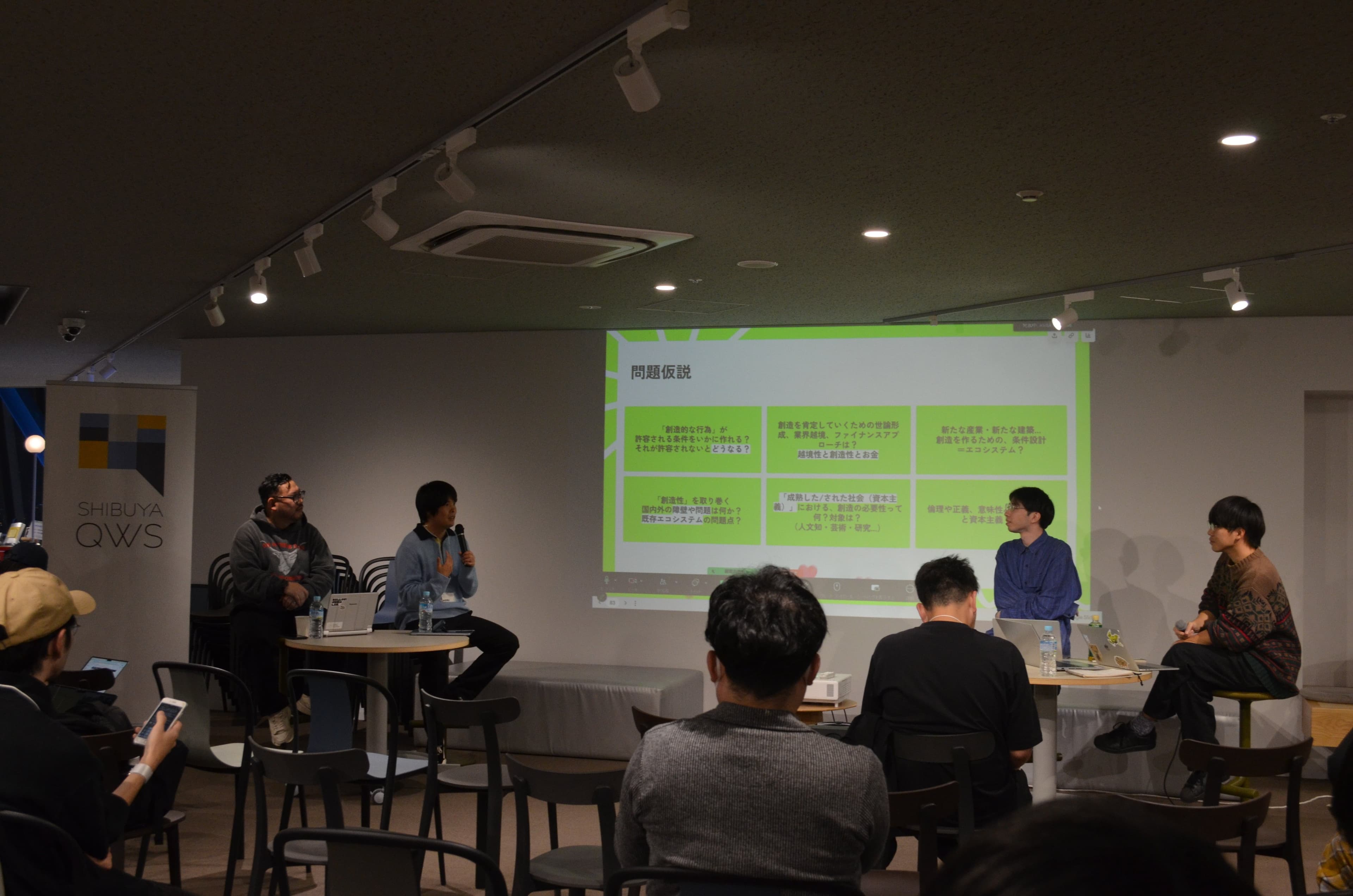
FIG.5
Morihara: Thank you. The discussion has been more passionate than I expected, which I’m truly delighted about. Since we’re running out of time, I’d be grateful if you could conclude by offering a key takeaway—based on our discussion so far—on how we should transform the ecosystem for future creativity.
Okada: Today, I’ve shared a few thoughts on the theme of “editing ecosystems.” Since I recognize that there are few people taking on this role, I hope we’ll see more “ecosystem editors” emerge in various fields so we can share our knowledge.Another point is the creation of a “playbook.” When building an ecosystem from scratch—like the ones Desiro and ASIBA are aiming for—it would be great to have a tool that helps us identify the optimal financing schemes.
Furuichi: I’m in charge of future visions and similar initiatives at a foundation, and speaking with everyone today has made me realize once again that when considering what the future might look like, we should shift our focus toward non-technological approaches (e.g., archaeological approaches).Rather than grappling with vast and elusive concepts like “the future” or “society,” I’ve reaffirmed my desire to explore the future starting from tangible, hands-on approaches—such as engaging with the world within myself or overcoming divisions one by one through communication with the people right in front of me.
Nakaji: Right now, we live in a society where the only financing options are “high-blood-pressure” venture capital and “low-blood-pressure” banks.I truly believe that diverse forms of capital are necessary to support a diverse range of creative projects and worldviews, so as a venture capitalist, I’d like to give more thought to various asset classes and return structures. If both the creative and financial sides can evolve together in this way, I think we’ll be able to build a more diverse creative ecosystem.
Morihara: Everyone, thank you all once again for joining us today!
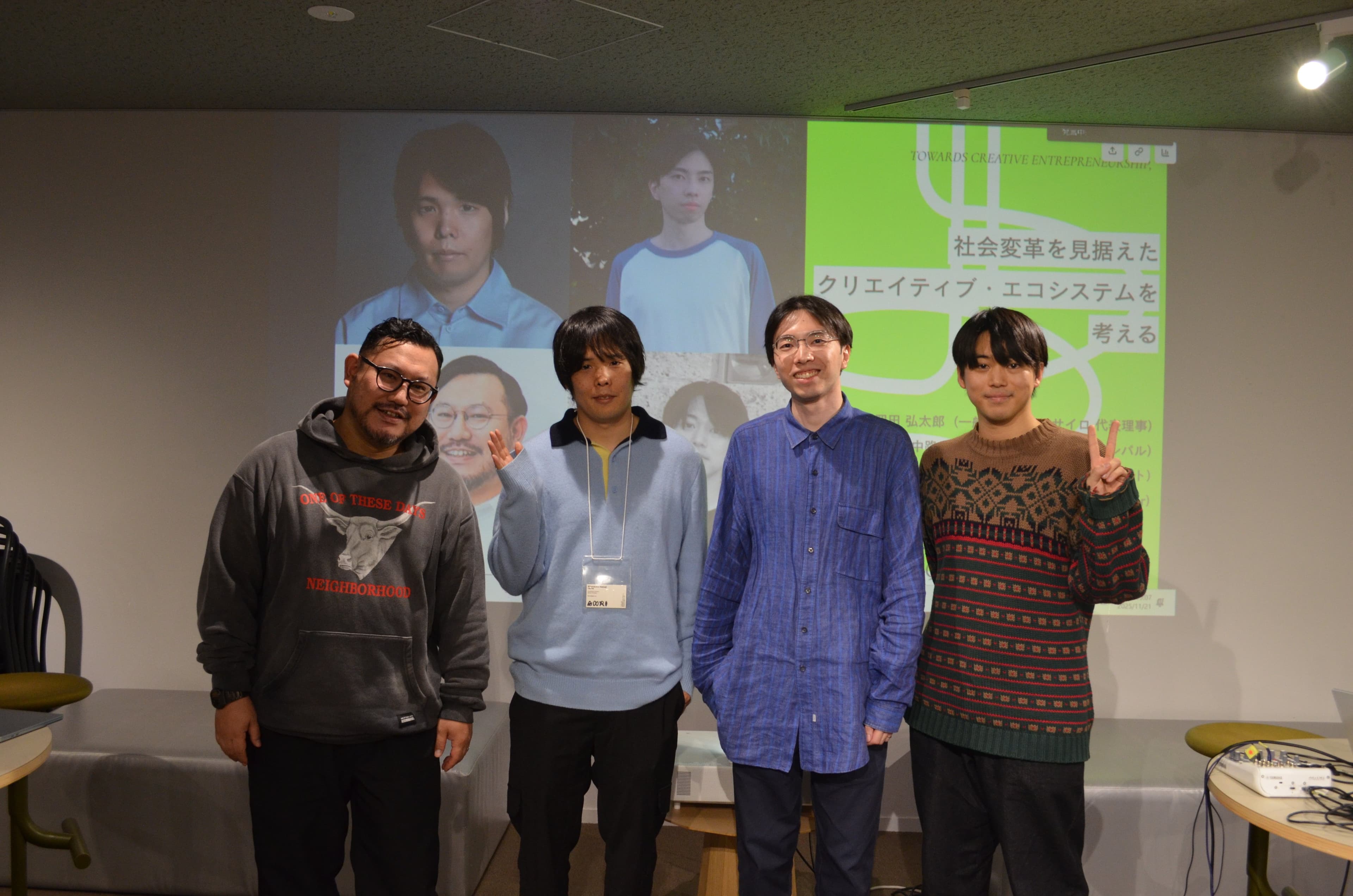
FIG.6
Credit
Related Works

Towards Creative Entrepreneurship
TALK
Related Texts
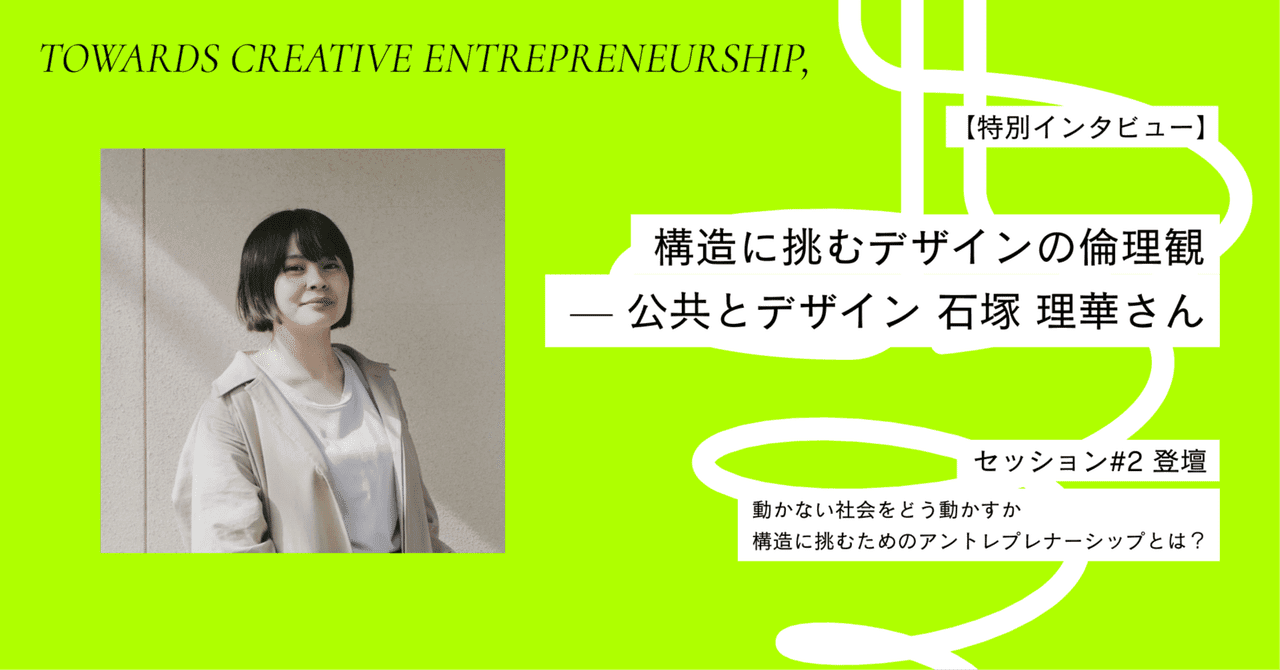
Special Interview: The Ethics of Design Challenging Structures - Public and Design with Rika Ishizuka
CREEN Conference Special Interview #5
INTERVIEW
2025.11.18.
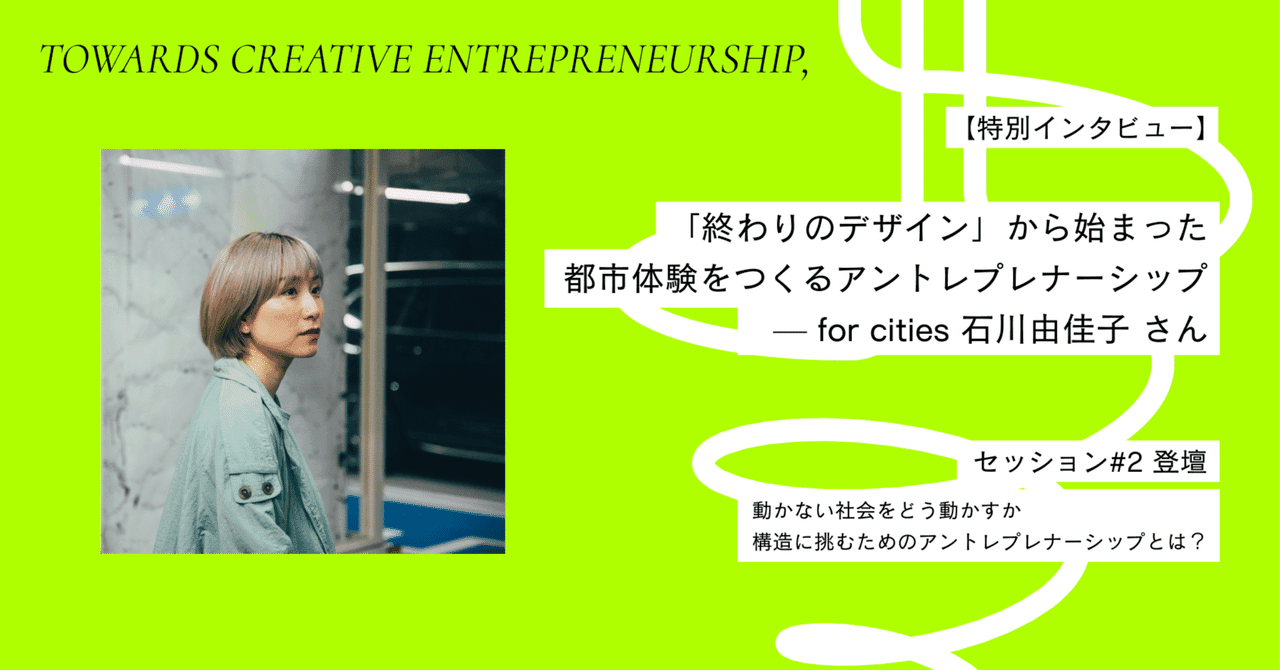
Special Interview: Entrepreneurship in Urban Experience Design Starting from 'Designing the End' — Yukako Ishikawa from for Cities
CREEN Conference Special Interview #4
INTERVIEW
2025.11.16.
Special Interview: What is Entrepreneurship Challenging Democracy? - Takayuki Kurimoto from Liquitous
CREEN Conference Special Interview #3
INTERVIEW
2025.11.14.
Special Interview: How to Approach Impact Investment to Preserve Culture - Kanefumi Furuichi from SIIF
CREEN Conference Special Interview #2
INTERVIEW
2025.11.07.
Special Interview: What is the Finance System that Enables Creation? - Shunsuke Nakaji from ANRI
CREEN Conference Special Interview #1
INTERVIEW
2025.11.07.
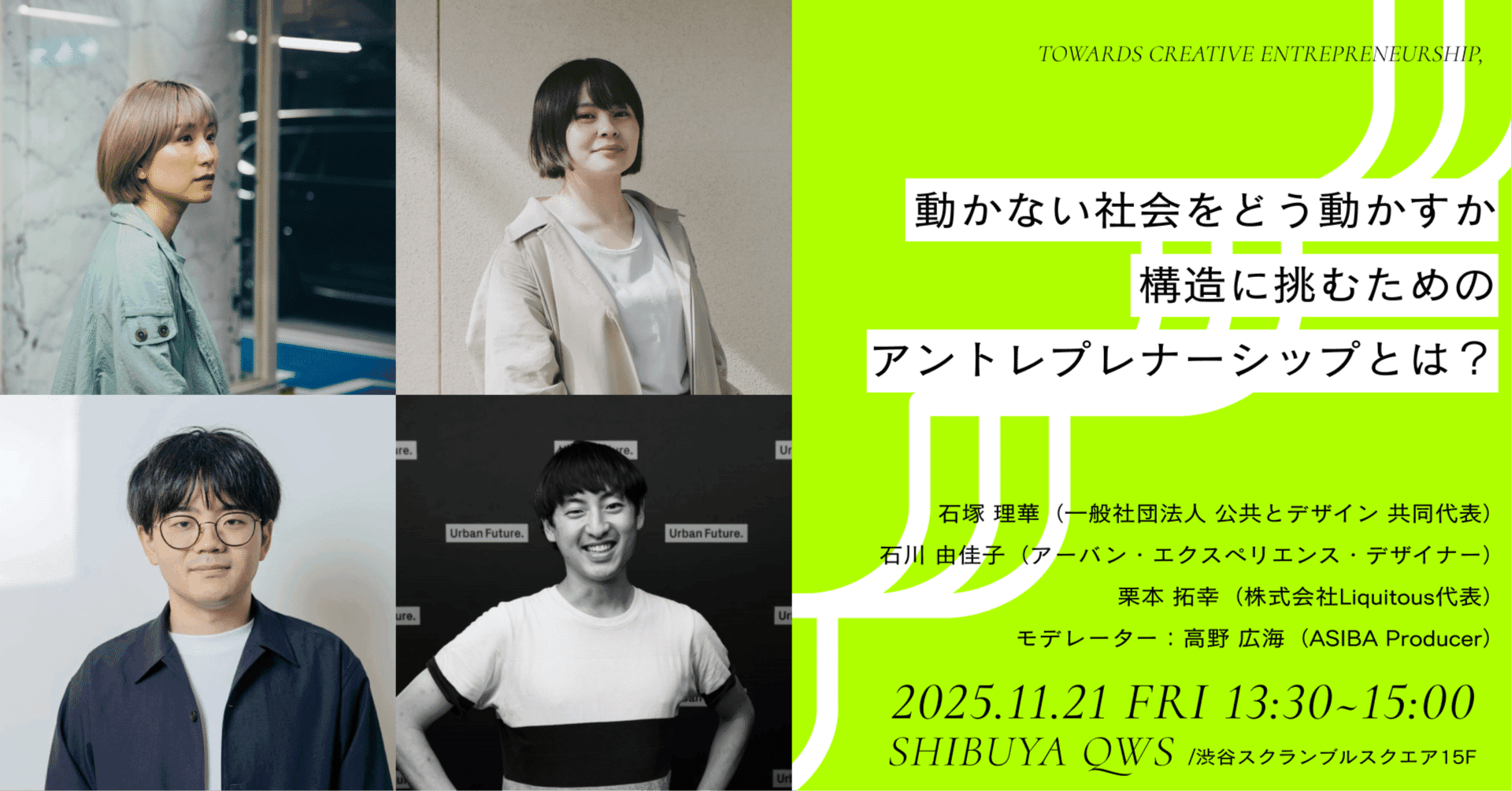
How to Move an Inactive Society: Entrepreneurship to Challenge Structures
CREEN Conference Special Session #1
DIALOGUE
2025.12.26.


