CREEN Conference Special Session #1
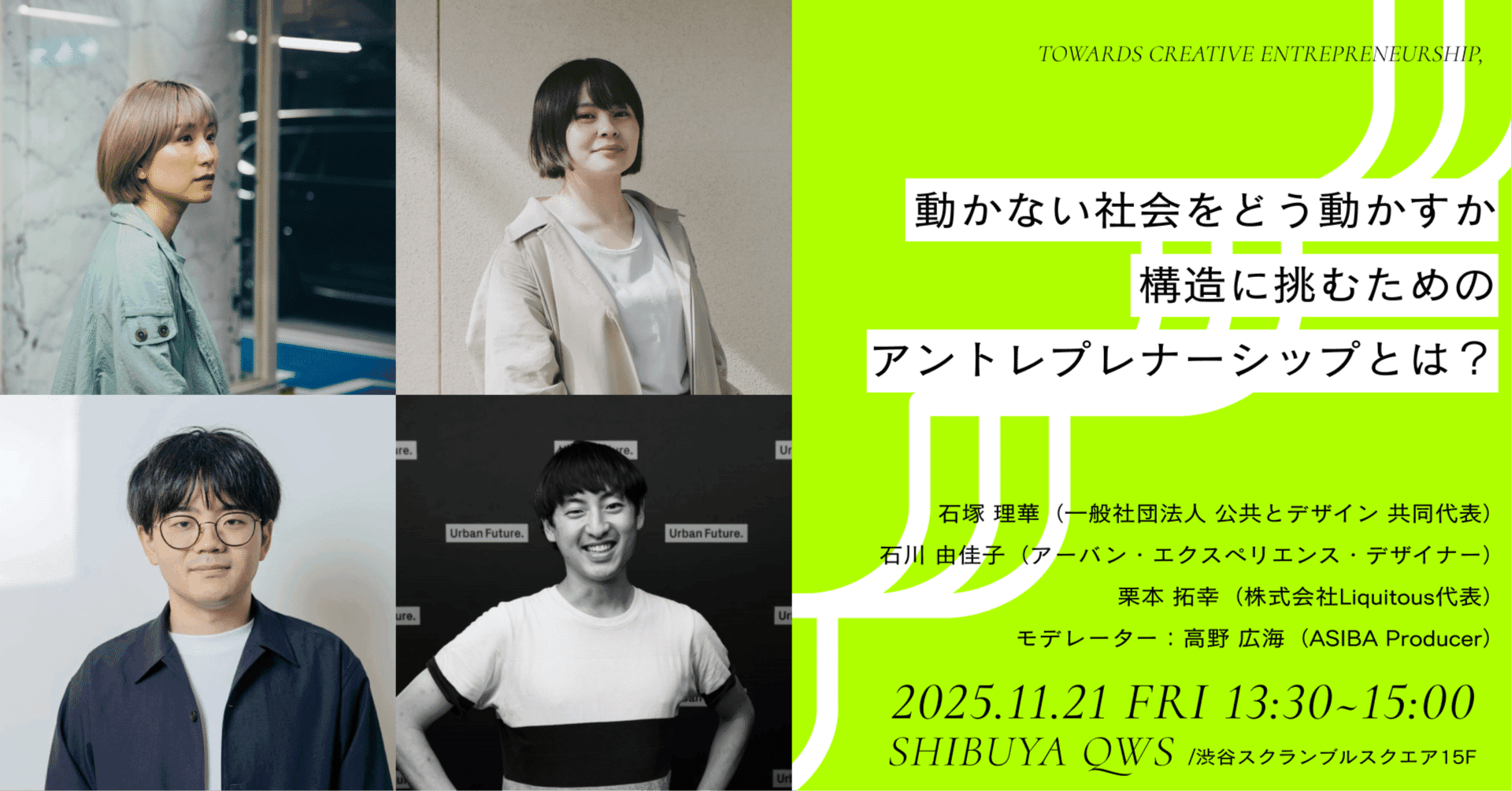
FIG.1
Areas such as public administration, citizen participation, and community development involve the interplay of multiple systems, organizations, and relationships, and do not change easily. Nevertheless, precisely because these areas are so closely tied to people’s daily lives, there is a need for both the will and the methods to drive change in them.Three practitioners who exercise entrepreneurship in non-market, public-sector domains discuss how they confront “inertia” in their respective fields and what strategies they are employing to drive social change.
(This article was published on November 21, 2025,at Shibuya QWS as part of the one-day conference “Towards Creative Entrepreneurship—Exploring the Possibilities of Social Implementation in Creative Fields and Its Methodology,” co-hosted by the General Incorporated Association ASIBA (hereinafter “ASIBA”) and @Kamata Co., Ltd. (hereinafter “@Kamata”). This article is a reconstruction of Session 2“How to Move a Stagnant Society: What Is Entrepreneurship for Challenging Structures?” held on November 21, 2025, at Shibuya QWS)
Takano: All three of you founded your companies around 2020, during the COVID-19 pandemic. What were your original reasons and motivations for becoming independent?
Ishizuka: I started my career in the IT design industry, but back then, design was primarily discussed in terms of “design for business.” It was all about KPIs and CTAs. Of course, those things are important, but I was feeling a bit unsettled—thinking, “The design I’ve learned isn’t just about that”—when I happened to meet my two current co-founders, who were thinking along the same lines.
From there, we started by researching and sharing ideas—things like, “This is great,” or “We’d like to do something like this”—essentially launching projects with whatever we could do on our own.
Kurimoto: Toward the end of my senior year of high school, I happened to have the opportunity to visit Estonia in Eastern Europe. As some of you may know, Estonia is famous for its e-government initiatives. There was a place called the “Showroom” where they showcase these initiatives to the press. Normally, the general public isn’t allowed inside, but I managed to persuade them to let me in by asking if I could join a press team from a certain African country.At that time, a member of that press team asked me, in all seriousness, “Why is a Japanese person here? Isn’t Japan number one when it comes to utilizing IT?”
I had already been involved in activities related to youth political participation, but that experience was a formative moment that solidified my belief that we must also leverage IT and digital technology in our work.After that, I entered university. At first, I started working on localizing an overseas platform for Japan, but I realized that if I was going to do this, I should create something tailored to the context of Japan and Asia. Additionally, with events like the House of Councillors election and the unified local elections coinciding, I ended up founding the company in February 2020.
Ishikawa: Until I went independent, I mainly focused on client work in the urban sector. We’d receive briefs from government agencies or companies and collaborate to build projects based on them, but urban issues are inherently large-scale and involve long timeframes.Even if you say, “Let’s make this self-sustaining in a year or two,” it’s not something that can be done easily. Yet I really hated it when projects were unilaterally terminated for reasons like “the person in charge changed” or “the project budget ran out.” I want to use my limited time in life to take on projects responsibly, and above all, I want to be the one to decide when they end. Those feelings were the major catalyst for starting this initiative.
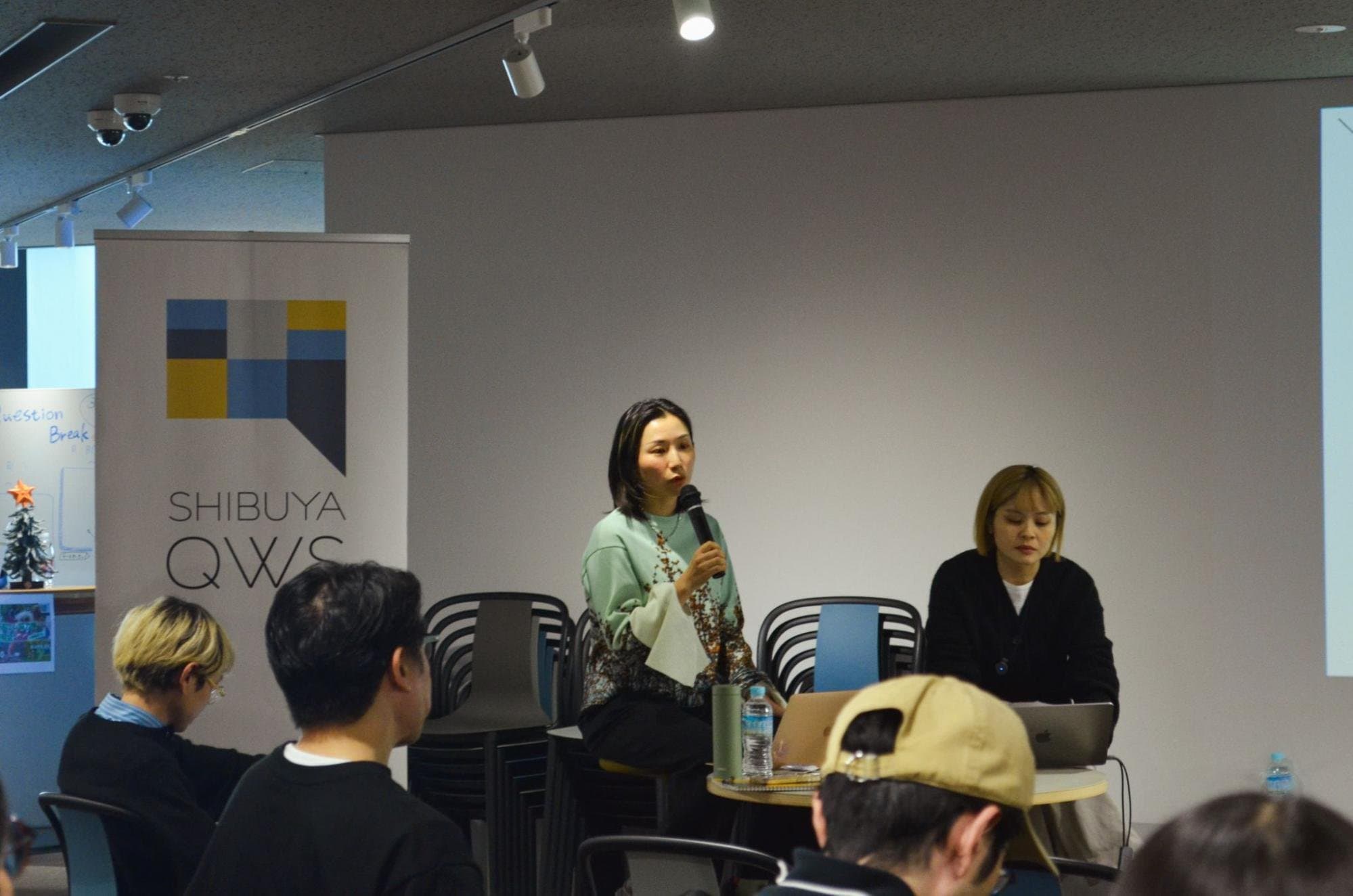
FIG.2
Takano: I see. I think the point you raised, Ishikawa-san—about the limitations of single-year contracts—is a particularly significant issue. When working on long-term initiatives with the public sector, such as local governments, what approaches do you all take to address the systemic issues themselves?
Kurimoto: Personally, while the common criticism that initiatives with the government end after a single fiscal year is half-true, I also see it as a matter of how the framework is structured.
As a prerequisite, some form of evaluation at the end of each fiscal year is necessary. On the other hand, unless it’s a purely “soft” project—such as one involving long-term debt obligations—it’s possible to structure a contract spanning five or ten years.Alternatively, if we can establish a comprehensive partnership agreement, while renewal at the end of each fiscal year is required, we can set a mission together with the local government to work toward medium- to long-term goals. If there is consensus—not just at the staff level but also among administrative leaders—that pursuing a major mission is what matters, then I believe the assumption that government operations are always limited to a single fiscal year is just that: an assumption.
Takano: That’s exactly it—what’s important is “working together to build a culture within the administration,” just as you, Mr. Ishizuka, have been doing through your work in the public sector and design.
Ishizuka: We, too, often proceed on a two- or three-year basis while renewing our contracts with local governments.We don’t really set goals that are meant to be completed in a single year; rather, we start by aligning our perspectives—saying, “That’s the North Star we’re aiming for; let’s first figure out how to get there.” I think we’re engaging in that kind of steady, step-by-step work across various projects.
Takano: I definitely think the term “North Star” is excellent, but to get straight to the point, where exactly is the North Star that each of you is looking toward?Also, when I spoke with Mr. Kurimoto beforehand, he mentioned he was curious about the three of you’s “Theory of Change”—that is, the roadmap for what needs to be changed and how, in order to reach that North Star. What are your thoughts on that point?
Ishikawa: We really focus on the individual and believe in the power of the individual.We’re working on identifying what kind of environment allows each person to unleash their creativity and how we can create those situations and environments, and I believe the results of that process are now becoming visible on various scales. To put it another way, we might not have the same kind of ambition as so-called social entrepreneurs who say, “We want to create this kind of world.”
Ishizuka: My worldview is similar to Mr. Ishikawa’s. I think many of our projects are more about enjoying a stroll rather than being driven by a determination to “absolutely climb this mountain.” However, while we also recognize the importance of an environment that fosters individual creativity, I feel that a society where that responsibility falls entirely on the individual can be a bit stifling.
In the city, all sorts of initiatives spring up and then fade away. The reasons behind this include situations where an initiative becomes the sole responsibility of a single individual, or, conversely, where the context of something started by an individual isn’t carried forward, and everyone just jumps on the bandwagon.If we can prevent such situations while giving these activities concrete form through systems and structures, they might even become government initiatives, and we could create a socially innovative environment where more people can engage in these activities on an ongoing basis. Our theme is: What should the government and institutional frameworks look like to make this happen?
Takano: So it starts with a simple walk, but in the end, we have to take it that far, right?
Ishizuka: Well, to us, it just feels like we’re taking a walk, though.
Takano: What about you, Kurimoto-san?
Kurimoto: In a nutshell, our fundamental mission is “how to transform democracy for the better.” For example, people currently engaged in research and practice in the field of democracy often don’t receive very good compensation. There are plenty of projects being carried out on a volunteer basis, but it’s all too common for them to never be implemented on a societal scale.
Even when looking at Japan as a whole, there are overwhelmingly fewer funds and foundations dedicated to the field of democracy compared to other countries, so how to allocate societal resources to this field is a major issue. This applies not only to money but also to people.Our most important mission is to figure out how to transform the current system and increase both the number of people committed to democracy and the financial resources dedicated to it. That is precisely why we are taking on the challenge of investing in the field of democracy, even if it means dipping into our own pockets.
To give another example, Article 1 of the “Local Autonomy Act,” which defines the role of local governments in Japan, states—in essence—that local governments should conduct efficient and democratic administration. There’s been a tremendous amount of talk about efficient administration—with terms like “administrative reform” and “administrative DX.”While discussions on how to improve efficiency and streamline operations have been quite active, my assessment is that the aspect of democratic administration hasn’t really been addressed much until now. How can local governments restore their democratic functions—or even strengthen them further? I feel that our activities are deeply committed to this very issue.
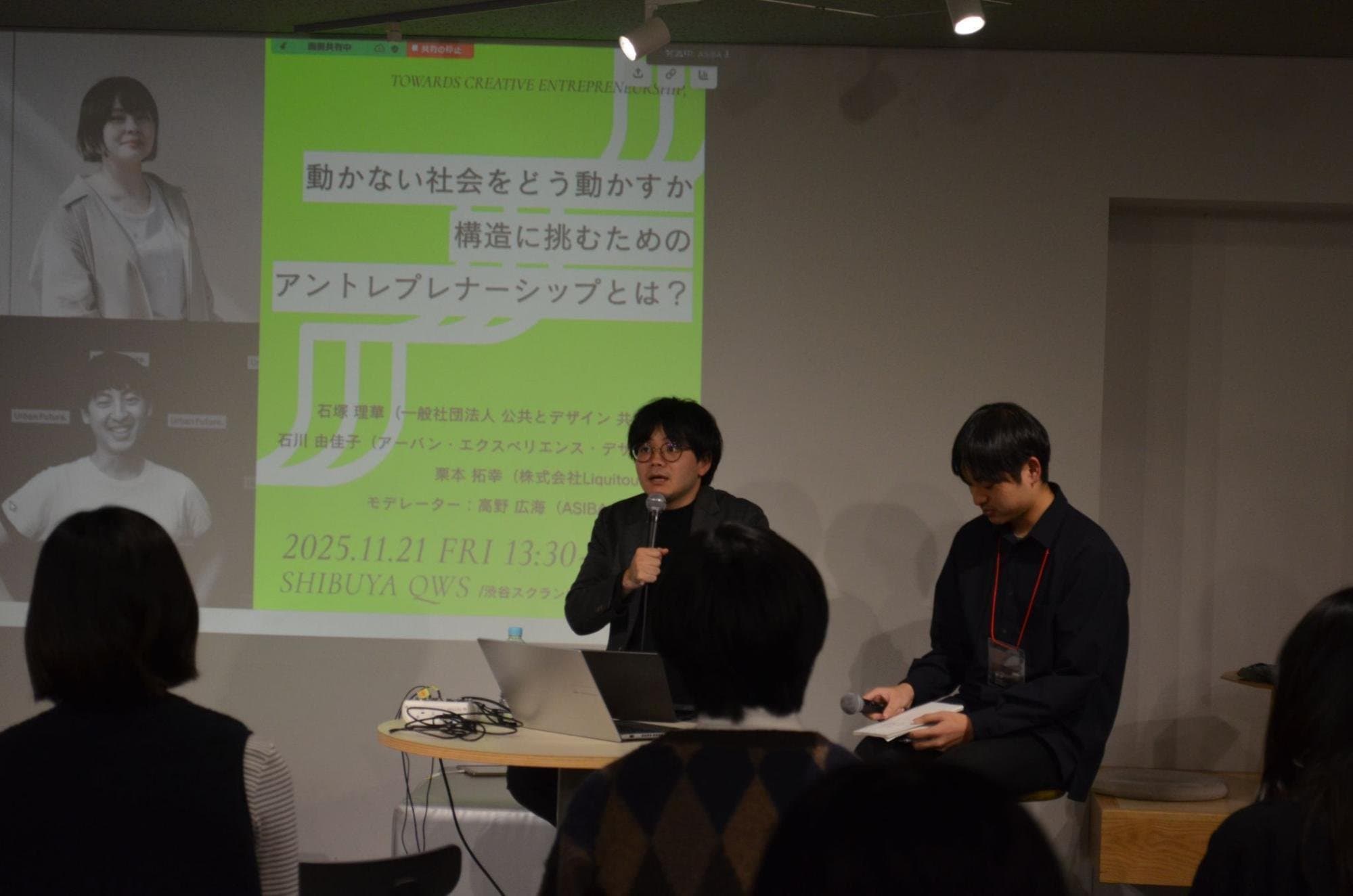
FIG.3
Takano: I wonder if the idea that deepening democracy itself doesn’t generate revenue applies to Mr. Ishizuka and Mr. Ishikawa’s fields as well. From your perspectives—as two people tackling various challenges in fields where there’s no market or no source of funding—how do you think this trend might change in the future, both in terms of your own initiatives and from a meta-perspective rather than just the industry as a whole?
Ishikawa: No matter where we go in the world, the second thing people ask us when we first meet is, “How do you guys make money?”I really feel that it’s becoming increasingly necessary to properly build the infrastructure and support systems needed to nurture the various activities initiated by citizens—which we either launch or support—in a sustainable way, while at the same time, we need to collaborate with these groups and build bridges to ensure their continuity.
In that sense, while I’m sure the three of us here today share a major common goal, our approaches and the systems we’ve put in place to achieve it differ. I believe it would be extremely meaningful if we could create a system that effectively combines these disparate fields.
Also, as things stand now, it’s by no means guaranteed that we can create something good just from “citizens’” ideas. I think we also need to cultivate their sense of style, aesthetic sensibility, and the very sensibility that drives them to envision the kind of scenery they want to see. In other words, this isn’t simply a matter of opening things up and letting people think freely. I believe the real challenge lies in determining what kind of citizens will actually respond when the process is made open.
Ishizuka: One question I have is whether it’s really a good idea for the number of people engaged in activities like ours to grow indefinitely. People in society are in all sorts of circumstances, and as a practical matter, they have to work to make a living. For example, I think it’s really difficult for busy parents to devote all their spare time to engaging with the city.
In this context, I see potential in the role of company employees. For example, a framework where people use their resources as employees to reconnect with their communities—moving back and forth between their corporate identities and local society—allowing them to express their “self as a citizen” while utilizing a small portion of their company’s resources to reengage with the community.Since this is part of what we call the “redistribution of care,” I believe that creating mechanisms to slightly redistribute the current social structure in this way could serve as a breakthrough to overcome the current situation, where such issues are treated solely as individual problems.
Kurimoto: I think this would vary completely depending on whether we’re talking about urban or rural areas. In urban areas, the power of the private sector is very strong even when considering public matters, so we need to discuss how to redistribute the resources held by the private sector toward public services. On the other hand, in rural areas, there are still many cases where the government operates on the largest scale.
In any case, the government bears overall responsibility for both the creation and delivery of “public services”—which are vital to everyone in the community—making it difficult for a diverse range of citizens to actively participate as stakeholders.I believe we need to consider how to effectively rebalance these rigid relationships while, at the same time, ensuring that the creative process is more inclusive of a diverse range of citizens and further improving the transparency of the process.
However, while creating new channels for funding in this way is important, I believe we must not turn a blind eye to the core issue—namely, how to review the use of tax revenue and the structure of existing programs. In an era where social needs and residents’ lifestyles are changing dramatically, we must first gradually make the government’s use of funds more flexible.
For example, suppose there is a budget of 1 million yen. Whereas in the past this might have been distributed as grants to 10 organizations with a proven track record, we could keep 500,000 yen as grants but allocate the remaining 500,000 yen as prize money—10,000 yen each to 50 young people. Just doing something like this can produce entirely different results.Even if we can’t change the total amount of money spent, I believe the perspective of looking for ways to adjust how it’s used will become increasingly important going forward.
Takano: Changing the subject slightly, I feel that deciding how much of the company’s resources to allocate toward research aimed at theorizing the initiatives you’re all undertaking or ensuring their reproducibility is a difficult issue.Precisely because we’re entrepreneurs venturing into new fields, I believe it’s very meaningful to share our knowledge with society—not just focus on individual projects. What are your thoughts on this?
Kurimoto: We’re actually putting a lot of effort into these kinds of research activities. For example, when we take on work commissioned by the government—since the funding comes from tax revenue—I believe it’s our fundamental responsibility to systematically organize the various insights we gain and give back to society.
Especially in Japan, there haven’t really been many academic footholds in the field of digital democracy until now. If we don’t invest funds here to set a precedent, no new players will emerge in the future.No matter how much we say, “Research is important,” there’s no point in it at all unless researchers are provided with adequate compensation and are able to fully explore the themes they wish to investigate. For that reason, while devising various strategies, we continue to allocate resources to these research and investigative activities on an ongoing basis.
Takano: Specifically, how much of your resources are you allocating to this?
Kurimoto: Roughly 30 to 40 percent of the company’s total resources, I’d say.The reason we allocate this much is partly because we have the resources for research and development, but it’s also because when we expand the company’s initiatives to other regions within Japan or overseas, we can use this data to explain, ‘We’ve been carrying out these kinds of initiatives in this context.’ Actually, I’ve recently come to realize that there are also benefits for the company’s sales activities in this regard.
Ishizuka: For me, this is exactly the area I’ve wanted to tackle but haven’t been able to yet. We’re conducting projects with Shibuya Ward and Kita Ward in the context of “Design for Policy,” but similarly, there aren’t many academic papers in Japan specifically about Design for Policy initiatives. In that sense, it’s definitely worth doing, and while I strongly feel I could actually write a paper on it, the reality is that I haven’t done so yet.
I’d also like to actively share toolkits we’ve developed in collaboration with local governments. For example, we worked with Kyoto Prefecture and Kameoka City to develop a toolkit aimed at addressing workplace challenges faced by female employees at small and medium-sized enterprises—specifically, issues like the lack of women’s restrooms and the difficulty of announcing maternity leave when you’re the only woman taking it.However, this is by no means an issue unique to Kameoka City; it’s knowledge that can be applied anywhere in the country, so I’d really like to share this kind of insight more widely.
In terms of theoretical refinement, when we undertake projects, we sometimes collaborate with universities and researchers to create new evaluation criteria and re-evaluate and re-examine our initiatives.And since the project itself—including the process—is so important, we always put a lot of effort into archiving it. We’re conscious of re-editing and presenting this information in the form of archive papers or booklets that a wide range of people will want to read, rather than in a rigid, formal format.
In the context of reproducibility, the cornerstone of our activities is the “forcities.org” data bank—a database designed to help us think about the local from a global perspective, based on the concept of sharing the insights and practical knowledge of various urbanists who cherish cities. We truly hope to ensure that the diverse practices of individuals can be reproduced within a broader context.
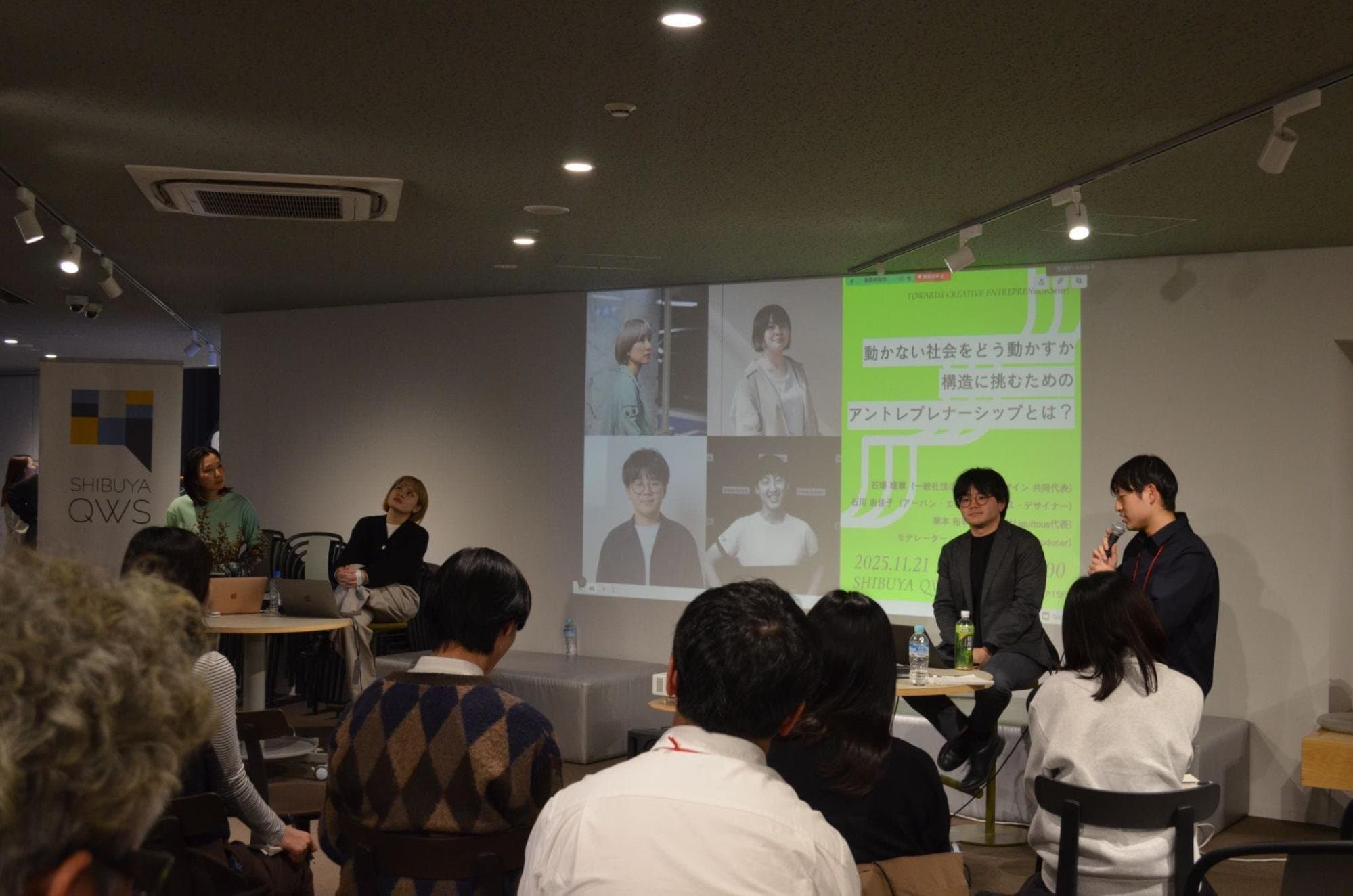
FIG.4
Takano: Thank you. Since we’re running out of time, I’d like to wrap up by asking everyone—in the style of a certain TV show—the question: “What does creative entrepreneurship mean to you?”
The reason is that, while we ourselves say creative entrepreneurship is important, we’re actually trying to create an image of it by writing the words down where nothing exists yet (laughs).This event is part of that effort. Please share with us—whether it’s a specific person you can think of who’s making an impact on society through creative solutions, or just a general image—whatever comes to mind.
Kurimoto: I believe that being creative is, in a sense, an exploration of “Being.”When people think of entrepreneurship in general, I think there’s a strong tendency to say, “The market size is about this big, and we can capture this much of the revenue share, so let’s start this kind of business.” I see this as being closer to identifying economic opportunities within existing structures, rather than reflecting on “Being”—that is, considering how we want to be or how we want society to be.
However, when it comes to creative entrepreneurship—and I suspect many of you feel the same way—I believe the desire to define who I want to be and what kind of society I want to see is much stronger.In exploring that “how I want to be,” we gather various elements beyond mere economic rationality—things that cannot be sustained by economic rationality alone. Depending on the situation, this might involve collaboration across sectors of civil society or even creating a movement.
In any case, it’s an approach of drawing on various elements from areas that are economically irrational to underpin the “Being” I want to create, and to shape that “Being” while defining its boundaries. In that sense, compared to general entrepreneurship, we must consider a wider range of strategies, including those within the civil society sector.At the same time, we must still achieve a certain level of economic viability. You might say this requires more thought and is more multifaceted, but I believe that exploring “Being” through these processes is precisely the kind of person the term “creative entrepreneurship” refers to.
Takano: That really captures the challenges ASIBA is grappling with, and we, too, would like to continue our efforts to overcome them. Next, what are your thoughts, Mr. Ishikawa?
Ishikawa: For me, creative entrepreneurship is like stoking a fire to keep the atmosphere warm.There’s a woman named Fiona—the head of a Dutch team called Cascoland—who is an urban planner I deeply respect. She’s always getting her hands dirty, adding firewood to keep the space warm so that the people who are there and the residents can feel comfortable.
Takano: Do you mean physically? (laughs)
Ishikawa: Physically, too. (Laughs)Rather than imposing some ideal vision and saying, “You guys, follow me,” she gently stokes the fire of what’s already emerging there, creating an environment where it can grow comfortably. Her example has really left a lasting impression on me. As we were talking today, it struck me once again that this approach might be exactly the kind of worldview I want to create and the way I want to bring things to life.
Takano: I can really picture that scene. It’s not about drawing a line between who is a creative entrepreneur and who isn’t. I felt that it would be wonderful if this concept could expand the circle in that way. Finally, what about you, Ishizuka-san?
Ishizuka: For me, a creative entrepreneur is a designer who acts as an “enabler.”“Enable” means to make something possible—in other words, an “enabler” is someone who makes things possible. It’s about helping the people around me, those involved in a project, or even those directly affected by certain issues in their daily lives or communities to envision their own potential—to see that they might be capable of more—and then taking small steps to make that vision a reality.I believe that image—of making things possible through what may seem like steady, groundwork—is close to what I envision as creative entrepreneurship.
Takano, thank you. Throughout this session, I think we were able to share the sense that, while there are various perspectives and approaches to a single term, the North Star we’re all aiming for is surely close. Once again, thank you all very much for joining us today.
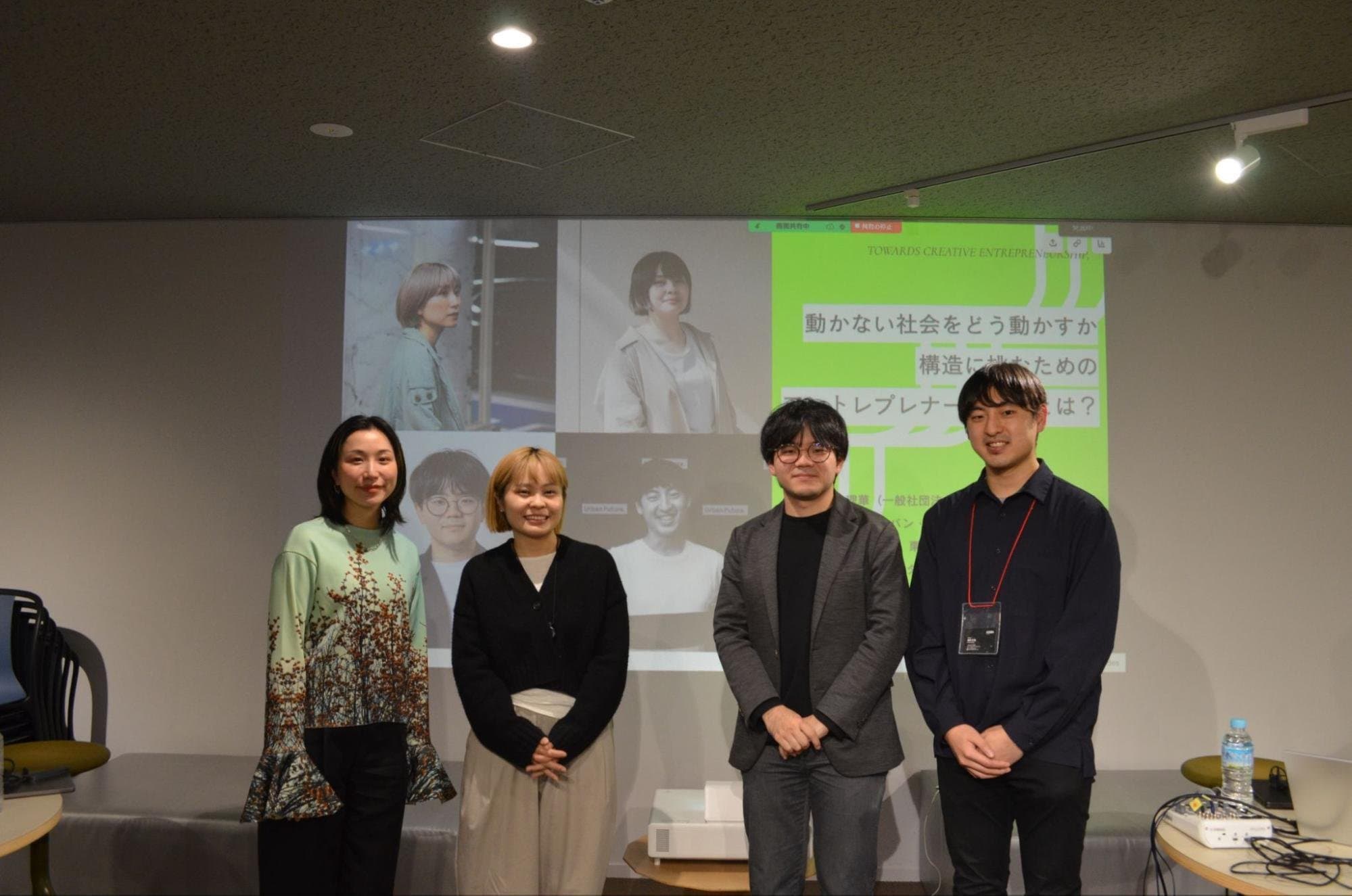
FIG.5
Credit
Related Works
Related Texts
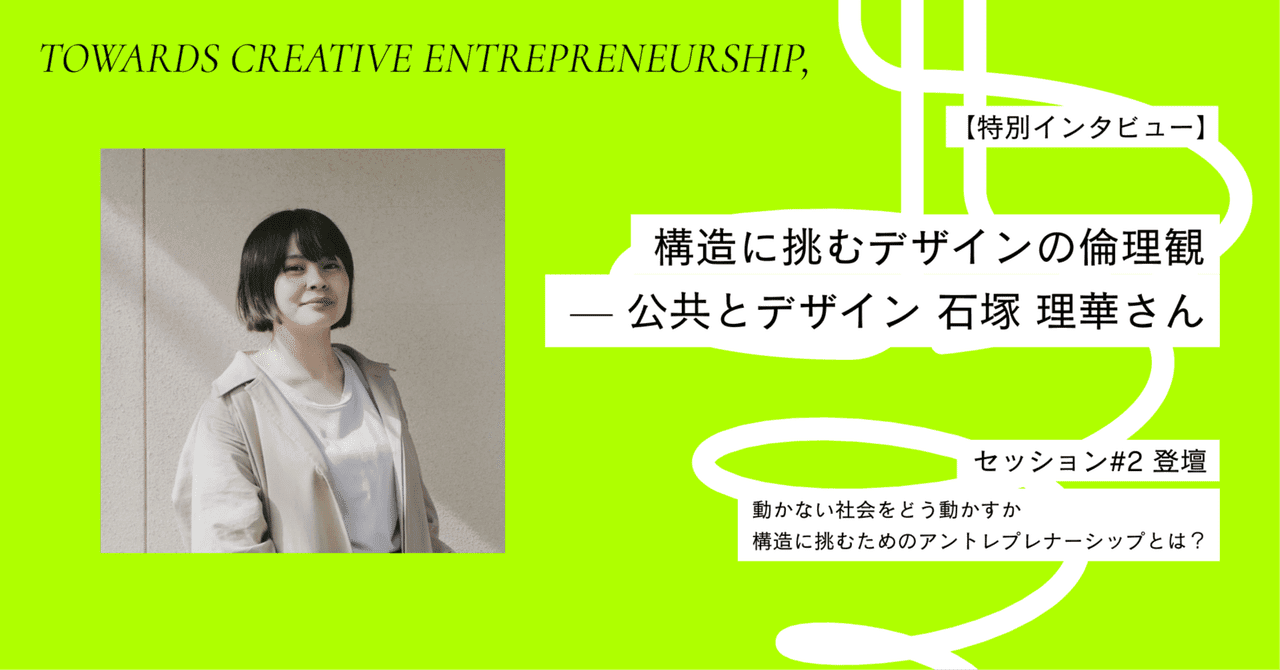
Special Interview: The Ethics of Design Challenging Structures - Public and Design with Rika Ishizuka
CREEN Conference Special Interview #5
INTERVIEW
2025.11.18.
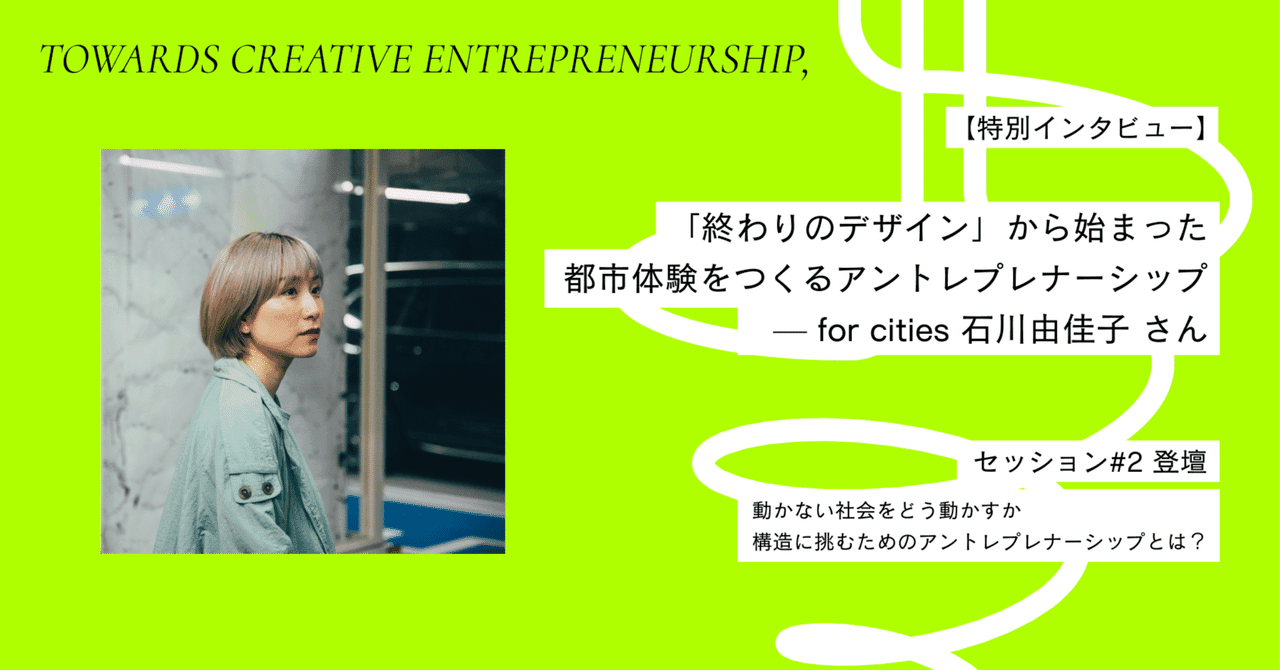
Special Interview: Entrepreneurship in Urban Experience Design Starting from 'Designing the End' — Yukako Ishikawa from for Cities
CREEN Conference Special Interview #4
INTERVIEW
2025.11.16.
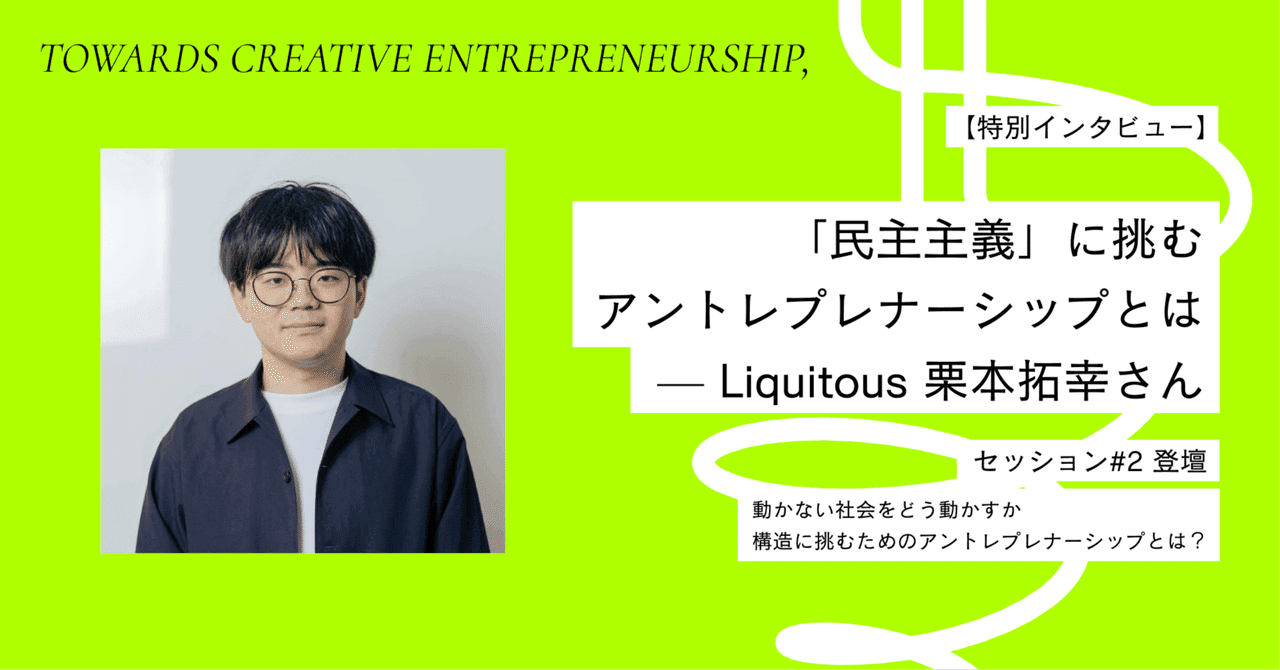
Special Interview: What is Entrepreneurship Challenging Democracy? - Takayuki Kurimoto from Liquitous
CREEN Conference Special Interview #3
INTERVIEW
2025.11.14.
Special Interview: How to Approach Impact Investment to Preserve Culture - Kanefumi Furuichi from SIIF
CREEN Conference Special Interview #2
INTERVIEW
2025.11.07.
Special Interview: What is the Finance System that Enables Creation? - Shunsuke Nakaji from ANRI
CREEN Conference Special Interview #1
INTERVIEW
2025.11.07.
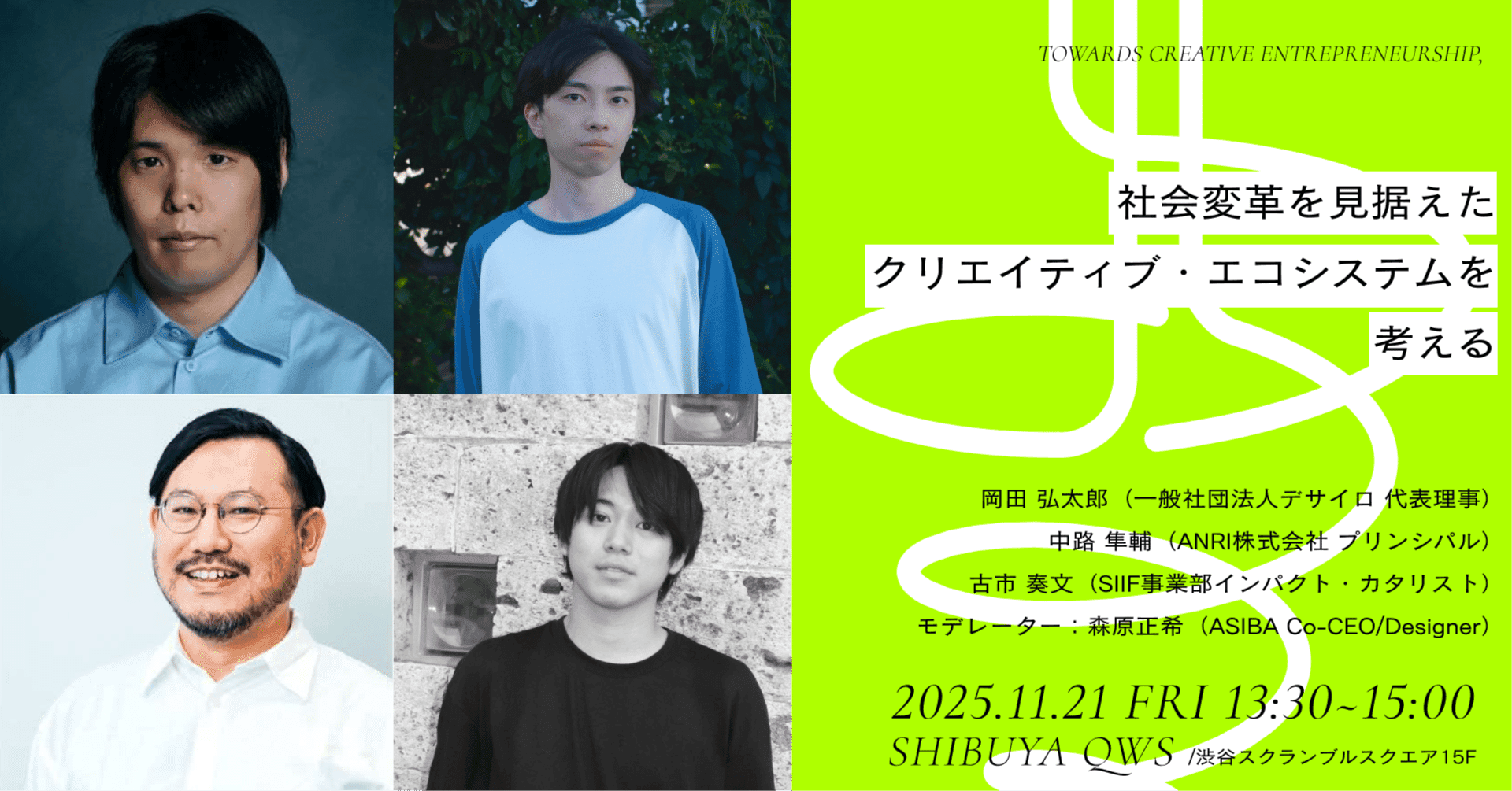
Special Session: Considering a New Creative Ecosystem in Light of Social Change
CREEN Conference Special Session #2
DIALOGUE
2025.12.26.