INC-2nd Cohort Roundtable #3
FIG.1
This is the second installment of a series of one-on-one and roundtable discussions featuring participants from ASIBA Phase 2, designed to explore their personalities and interests in greater depth. For this session, we invited two individuals who are advancing their projects with a focus on environmental issues and held a roundtable discussion with them and two moderators. On Saturday, July 6, at ASIBA FES 2024, we’ll host an in-person discussion with designer and engineer Mr. Kondo and Mr. Ishii from “Chicchai Tsujido” to delve even deeper into the topics covered in this article. We hope you’ll join us.
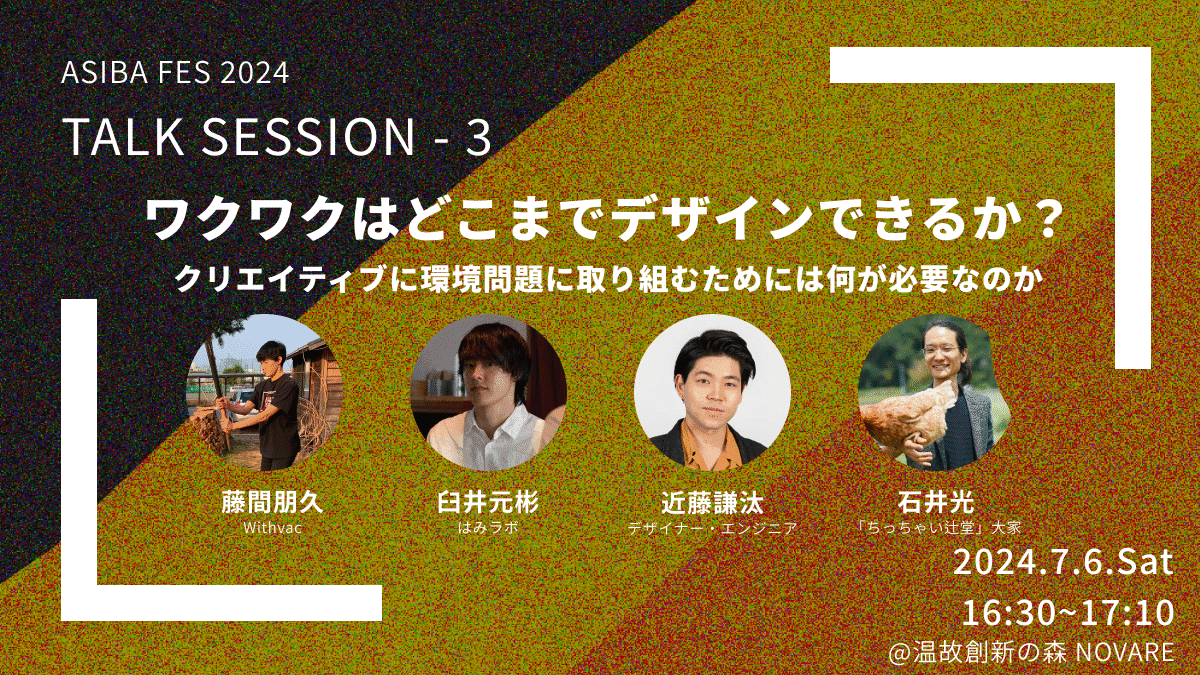
FIG.2
Morihara: First, let’s have them introduce the projects they’re working on. Fujima, could you briefly tell us what kind of project you’re working on and what you’re aiming to achieve?
Fujima: “WithVac” is a project that aims to reduce urban energy consumption by utilizing building systems data found in cities. Initially, WithVac was developed with the goal of improving the efficiency of building systems. This effort arose against the backdrop of a shortage of personnel to manage these systems and the fact that society as a whole has not kept pace with the aging of building infrastructure.We were moving forward with the goal of improving efficiency—for example, by using AI—and ultimately consolidating the systems’ data onto a platform to provide various services based on that data.
However, as we actually analyzed the data, new questions arose—or rather, we began to question the sole focus on improving the efficiency of building systems. We began to wonder: Is improving the efficiency of building systems really enough to enrich the lives of people—of urban dwellers? We intend to tackle that question.
Usui: “Delivering hidden value to enrich the world” is the overarching vision of our “Hami Lab.”We call things that inherently have value but are treated as worthless “outliers.” We believe that if we appropriately design a path for these outliers, their true value will be conveyed, and that value will feed back into our lives as a source of enrichment. Among these outliers, we are currently focusing our project on food waste. Since food waste was originally valuable food, it has the potential to be put to good use. However, the current reality is that because no clear path forward has been established for it, we have no choice but to dispose of it as trash.
One solution is composting, which turns food waste into compost. While composting is gradually becoming more widespread, its current form—simply a box or bucket—is valuable to environmentally conscious people but fails to excite those who aren’t. To bring this concept to society, there needs to be something that stirs emotions or piques interest. After all, emotions can be a driving force for people. Based on the hypothesis that it’s not enough for it to exist merely as a function, we’re moving forward with this project while emphasizing the importance of “how to design the experience that lies beyond the ‘outlier.’”
Morihara: Thank you. I think there are similarities between the two projects—are there any points where you find mutual resonance, or common ground that you’ve identified?
Fujima: When I first heard about Mr. Usui’s project, I thought, “Is this an initiative to promote composting?” But it’s not just that—you’re working with the philosophy of “finding value in things that would otherwise be discarded” and “redefining value,” aren’t you?
I felt that Mr. Usui’s unique approach to “finding value” isn’t an initiative that simply boils down to a straightforward goal of solving waste or environmental problems.Withvac, too, goes beyond simply seeking to optimize facility data; there’s the idea that a data platform could help building owners forge new collaborative relationships, and there’s also the philosophy of “making facilities more interesting.” While we might be grouped together as “environmental” initiatives, I think the common thread is that solving environmental problems isn’t our sole purpose.
Usui: I agree. Whether it’s food waste or building systems, these things are part of our daily lives, yet I worry that we often take the benefits they provide for granted. I feel like we’re both exploring the idea that there might be something out there that enriches our lives. I think building the Withvac platform will ultimately lead us to that very place.
Fujima: I think there’s something more to it than just features that enrich our lives.
Usui: That’s right. I think that by adding something to those functions, aspects of life that are usually hidden will come to the surface, and that might change how we engage with them. It’s just a hypothesis, though. Even though our methods differ—yours digital, mine analog—I think the broader vision we’re aiming for is similar.
Fujima: I think there’s a tendency to view both equipment and composting as merely tools for solving problems—or simply as functions. It’s just like how, at first, I saw Mr. Usui’s composting system as nothing more than a means to solve the trash problem.
Precisely because that happens, I think we share a common challenge: both composting and equipment need to be things that can inspire excitement in people and engage them on a deeper level.
Usui: That’s right. I think there are two kinds of that excitement. Whether you lean toward the “funny” side or the “interesting” side, the context changes completely. If you’re just looking for a simple, one-time impact, I think it’s fine to go for something funny and entertaining, but when you think about what comes next, you really have to explore the “interesting” direction that sparks genuine curiosity.If we want to sustain that excitement and integrate it into people’s daily lives, we need to pursue the kind of excitement that sparks genuine interest. We’re currently in the experimental phase of exploring this, using prototypes and other methods.
Fujima: I hadn’t even realized there were two types of excitement to begin with. Or rather, I probably hadn’t considered anything beyond the “funny” kind. To give an example involving building systems: things like the heat turning off if someone looks sleepy while working in the winter, or the systems talking nonstop. I think those are “funny.” But talking with Mr. Usui made me realize—it was a real eye-opener—that we need to think about how to sustain that.
Morihara: I think Withvac’s data platform is very easy to understand, but why do you have a vision that’s not focused on marketing?
Fujima: There are several reasons. I think there’s a lot of talk about smart cities and the like, but I sense a problem: people in today’s society seem to think that “the future equals smart and efficient.” I want to explore the possibilities beyond that—to show that “it’s not just about that.”
Morihara: Why do you place such importance on “excitement”?
Fujima: I think making things fun is one way to achieve that. I don’t think making things fun is the optimal solution, but I want to try making it fun at least once. A long time ago, I was part of an environmental issues community, and seeing everyone there with somewhat gloomy expressions, I thought, “Why not try making it fun for a change?”At the root of it all is simply that I want to feel excited myself. I felt that if I just kept talking about things like improving the efficiency of building systems, I’d end up asking myself, “Am I really happy just because things are more efficient?” So I think that’s also why I chose excitement as a means to an end.
Morihara: Even so-called environmentalists often talk this way—if you don’t start by envisioning “the kind of future we’d like to see,” the conversation basically just ends up being gloomy. I think we both share the feeling that we need to create that spark.
Usui: That’s right. I also think it stems from my belief that emotions are what drive people. Ultimately, when you start something new, I think it begins with an initial interest, a question, or the feeling that it seems interesting. I believe it’s important to help bring that out in people.We’re working on composting right now, but honestly, we could survive in the present moment even without it, and it doesn’t immediately make our lives any richer. If we were just living for the moment, we wouldn’t need it.
However, from a long-term perspective, we need to take action to halt the progression of environmental problems, and since composting is one of the ways to do that, it’s important.It would be easy if everyone could adopt that long-term perspective, but for the vast majority, that’s not the case—I feel they’re already struggling just to get by in the present. That’s why, even if I directly tell them, “Let’s solve environmental problems—to do that, each of us should compost our food waste and stop throwing it away,” the message doesn’t really get through, and they don’t take action.
I feel like we need to seamlessly integrate this into their lives as a new context, and when I think about actually doing that, I believe it’s quite important to spark their interest and create a sense of excitement right from the first impression.
Morihara: Mm-hmm. When you say “excitement,” what specific moments are you referring to?
Usui: When it comes to composting, I think the excitement lies in providing experiences like making compost together, or noticing that the trash has disappeared before you know it—or finding a handle that’s fun to turn, and as you keep turning it, realizing it’s connected to the compost bin and is actually helping to mix the soil inside.I hope this indirectly contributes to solving environmental issues. If we push environmental issues to the forefront, as Mr. Morihara mentioned earlier, the conversation tends to become a bit too gloomy. Rather than making solving environmental issues the primary goal, I think it’s easier for people to accept and incorporate into their daily lives if solving those issues is a natural byproduct of an enjoyable activity.
Abe: May I ask why you started composting in the first place?
Usui: It all started with a design project for my third year in college. The project focused on exploring the connection between the city and nature.The site we were given included mountains and farmland—a place where you could directly experience nature—and I was thinking about how to incorporate human activities into that environment. As I developed the design along those lines, I thought it would be wonderful if, while people enjoyed the richness of nature, they could also give something back to nature. That’s when I took notice of composting and proposed a plan that incorporated it.As time went on, through my involvement with ASIBA—where I listened to farmers who practice composting—I became fascinated by the idea that, even on a small scale, we can have a positive impact on nature. I was drawn to the fact that we could shift the incineration of food waste—which had previously only had a negative impact on nature—into a beneficial process of decomposition. I’ve always loved nature, too. I think at that time, my interest was what drove me.Although there was a lot of talk about solving the waste problem and tackling various environmental issues, I didn’t really feel a personal connection to it—I saw it as abstract theory that felt distant from my own life.When viewed within the broad framework of environmental issues, it feels incredibly distant from daily life, but when you focus on something as small as food waste, I realized that these kinds of “environmental activities” can actually be surprisingly accessible.
Fujima Abe, why did you start working in facilities management?
Fujima: Personally, I wasn’t really a fan of things like air conditioners—I love nature, and I used to think it would be better to live a life that relied as little as possible on air conditioners and other machines.However, as global warming has become more severe, we’ve ended up in a society where we can’t survive without such systems. Conversely, I started to feel that these systems are disconnecting us from nature, and I began to question the idea that humans can control the environment at will. I thought that by rethinking the role of these systems, we might be able to change the way people think as well.
Abe: What do you mean by “changing the nature of building systems”?
Fujima: I feel that today’s building systems are—well, perhaps too convenient. Air conditioners and HVAC systems, in particular, let you freely control the room temperature with the push of a button, but I wonder: is it really okay for humans to be able to control the environment so easily?So, for example, if you want to cool a room, you’d have to turn a knob really hard (instead of just pressing a button)—that way, you’d physically experience the effort required to artificially alter the environment. We’re thinking about ways to bridge the gap between humans and nature.
Abe: Why is it a problem for things to be convenient?
Fujima: I worry that because things have become too convenient—and the relationship between humans and nature has grown so tenuous—the fact that people can get by without thinking at all might actually cause even more problems. I know people often talk about technological advancements as a way to solve environmental issues, but I believe human mindsets need to change as well.
People in the past used to think more deeply and come up with solutions with their own hands, didn’t they? They could make their own snow geta or find ways to beat the heat. I’ve been wondering if our current state—where things are so convenient that we no longer need to do those things—is really a good thing.
I feel that the problem lies in the fact that, due to “convenience,” we’ve lost the ability to think ahead. In the Edo period, for example, people made things themselves, used them, and then either reused them or turned them into new products—a circular way of thinking that existed on a daily, personal scale.Now that times have changed, this way of life is attracting a lot of attention worldwide. However, in our pursuit of “convenience”—defined by efficiency and productivity—the scale of our lives has expanded far beyond the scope of our daily existence. As a result, I think today’s world has shifted from a circular system to a one-way process.
Production, consumption, and everything beyond are all disconnected, and for the vast majority of people, only the consumption phase is part of their daily lives. I think that’s probably what Fujima-kun means when he says that “too much convenience” isn’t a good thing.To solve environmental problems, we need to think in terms of cycles, but if we keep pursuing convenience, the scale just keeps getting bigger and bigger, gradually moving further and further away from the capacity of our own cycles—and it ends up looking like a one-sided pursuit of improving the value of human life. I think that’s the problem.That’s why I think Fujima-kun is considering making infrastructure more accessible. Perhaps by intentionally making the user interface (UI) less convenient, he wants to raise awareness that “infrastructure isn’t something we should take for granted.”
Morihara: Don’t you think that as things have become more convenient, we’ve started to think about all sorts of other things? Because we have air conditioning, we can do other work. Modern society was built on the leisure time this created, but how do you view the fact that this implies the technologies we’ve developed for the sake of convenience might ultimately be meaningless?
Fujima: I don’t think they’re meaningless, but I do wonder if this is really the direction we should keep heading in. Things are already so convenient as it is, but when we reach a level of “smartification”—where “humans don’t even need to control things”—I question whether we should just keep pursuing efficiency at all costs.
Abe: I see. I think you mentioned wanting to make the equipment “interesting”—but what exactly do you mean by “interesting equipment”?
Fujima: We need to think more deeply about who finds it interesting, but I think one aspect of “interesting” is the experience of feeling a direct connection between yourself and the environment—the realization that your own actions contribute to environmental issues.
Morihara: Regarding Mr. Usui’s project, I think composting has been around for a long time—but are there any perspectives that take a critical view of it? I’m interested in why he focused on composting in the first place, and what the fundamental issue he’s trying to solve actually is.
Usui: I do think awareness of composting is certainly growing, but it still seems like an initiative undertaken only by people who are involved in agriculture, love nature to begin with, or for whom nature is already an integral part of their daily lives.Awareness is low among people living in cities, who are inherently far removed from nature. Even though densely populated cities generate the most food waste, awareness is actually lower there, and initiatives using composting as a solution remain stagnant, limited to only certain circles. We want to bridge that gap.To do so, I believe the current approach to composting isn’t sufficient; we need to explore a new model that incorporates the specific context of urban settings—placing composting systems in cities and designing them for urban residents to use—and tailors them to the needs of those specific users.This is why I emphasize the importance of incorporating a sense of excitement into the project. I believe urban dwellers have a keen sense for trends—things that are fun or new—and I think it’s crucial to present and design ways for people to interact with composting that capitalize on that. From what I’ve researched, I don’t think there are many places that approach composting in this way.Recently, Tsubame Architects and others launched an initiative called “FARM SPOT” and unveiled unique compost bin designs, and I think our approach is somewhat similar to that. However, since we place great importance on being attuned to the specific location and the people there, I believe our direction differs slightly.
Morihara: There are quite a few efforts to reuse food waste and give it new value, but I often wonder why these practices haven’t become mainstream in society. Are there any hypotheses out there about how to revalue these materials and make them part of mainstream society?
Usui: I think there’s a current situation where tackling environmental issues has become a form of self-interest. Solving environmental problems can come across as corporate self-interest—as if companies are saying, “We’re doing this because it’s a social problem, so we’re in the right.” I suspect the reason this approach hasn’t become mainstream is that it’s treated merely as a tool to justify corporate initiatives.I think everyone resists having values or notions of “rightness” imposed on them. My personal hypothesis is that if we change the way we present these initiatives, a path toward broader adoption might become visible.
Abe: Finally, based on today’s discussion, I’d like to ask about your outlook for the future.
I believe that by rethinking the future role of Usui Compost in urban settings—and its design—we can change the way people interact with compost.Although each individual compost unit is just a small product, if many people engage with it in a fluid way, we can create a significant impact. I believe that by generating this impact in a decentralized manner, we can function as a large network—a kind of infrastructure. Keeping this perspective in mind, I want to design and operate each compost unit with care and flexibility.
Fujima: I realized that I want to make facilities feel more accessible to people. I even get the impression that today’s facilities are hidden from view in people’s daily lives. While it might be a stretch to call it “exciting,” I think it’s necessary for people and facilities to have a more interactive relationship.By “interactive relationship,” I mean that it’s not just people taking unilateral action toward the facilities—the facilities themselves should also actively engage with people in some way. I want to further explore what role facilities should play in people’s lives and how we can make them feel more accessible.
[ASIBA FES 2024] “Will That Gaze Transcend the ‘Now’?”
FIG.3
ASIBA FES brings together young people from the fields of architecture and urban planning who seek to envision the future. How do ASIBA members, who challenge the reality before them, perceive this world, and where do they hope to go?The 19 projects that participated in ASIBA’s second cohort will share the contours of the society they’ve discovered beyond the present—through their own words, objects, and experiences. Crossing generations, transcending organizations, and moving beyond today’s society, let’s journey together toward what lies beyond our gaze. Let’s meet at this gathering where multiple futures intersect.
Date & Time: Saturday, July 6, 12:00 PM–8:00 PM *Feel free to come and go as you please Location: NOVARE, Forest of Learning from the Past to Create the Future (https://maps.app.goo.gl/EwKcC26QUyZ7qLyx8) Program: Booth exhibits, workshops, final pitches, discussions with young professionals, NOVARE tour, and more
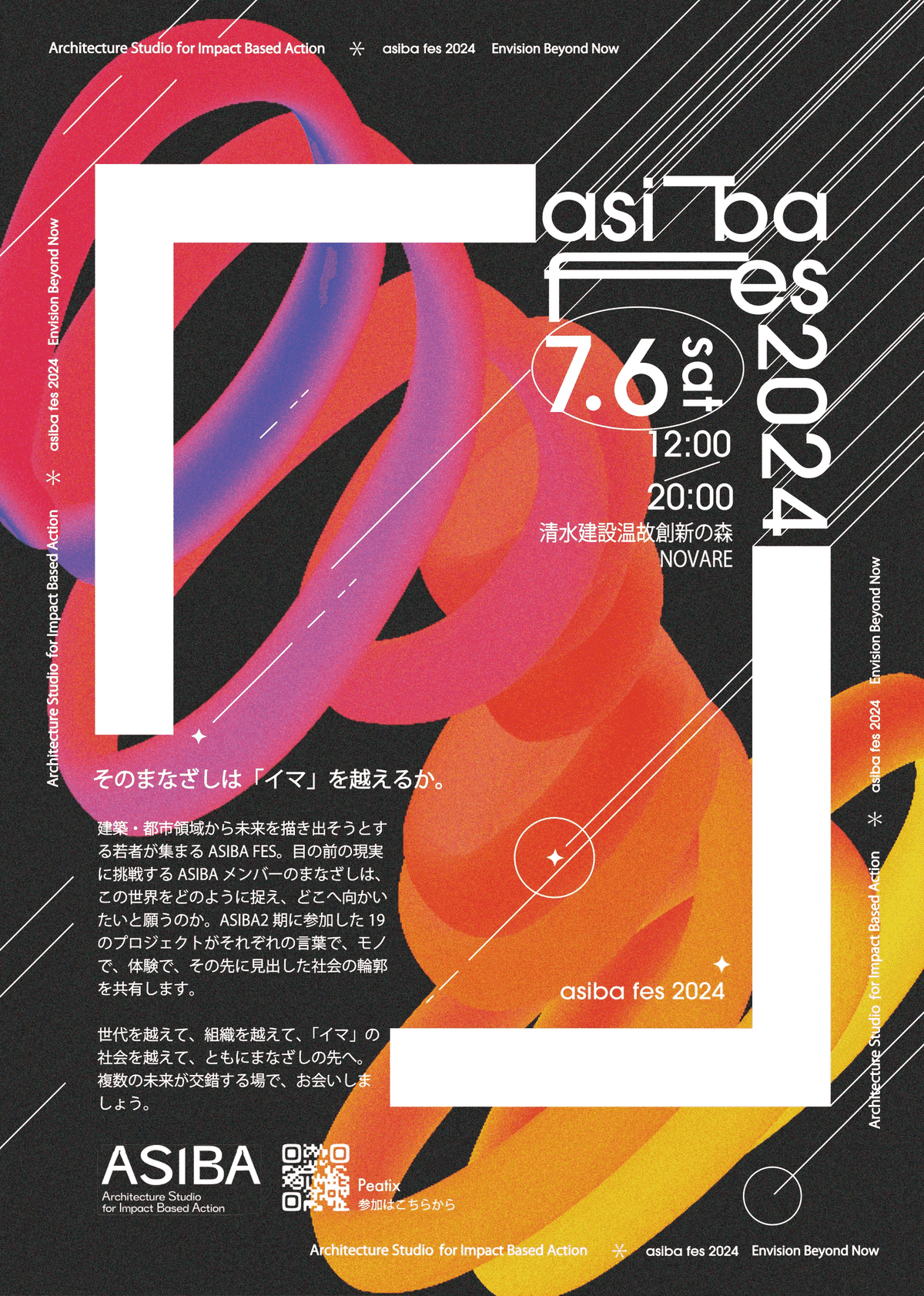
FIG.4
Credit
Related Works