Creators Forge a Space of Solidarity to Challenge the World Together

FIG.1
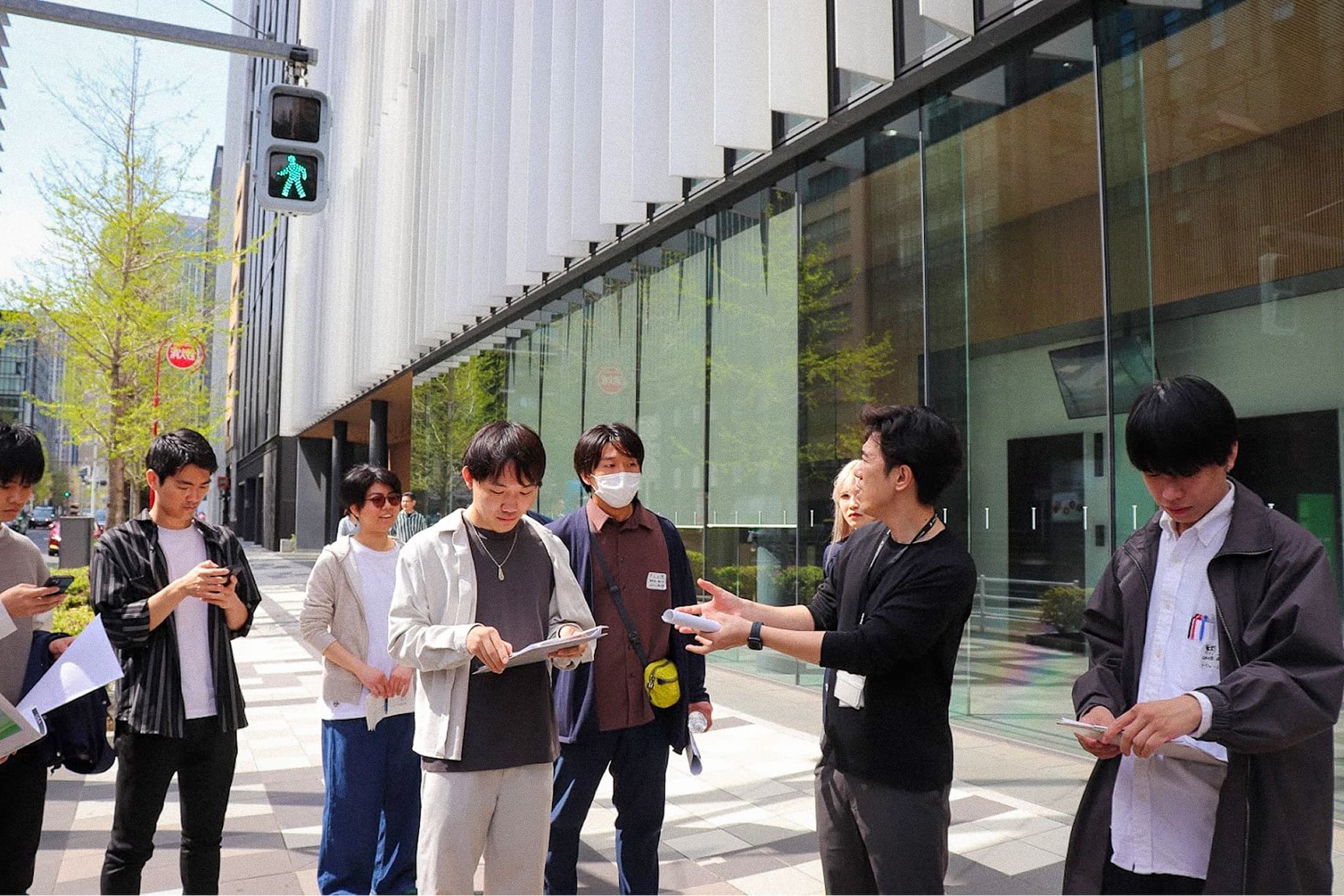
This program, which had been called “Incubation” for its first three sessions since its inception, has been renamed “League” as it enters its fourth session. To describe the first session in a single phrase, it was “the architecture version of the University of Tokyo Entrepreneurship Dojo ,” and it did indeed begin by drawing on the model of an “incubation”-style support program.It consisted of two months of repeated introductory business lectures and mentoring, culminating in a final presentation where participants pitched their ideas to investors and others. Successful startup founders were invited to serve as mentors, providing feedback on the business models under development.However, as the program’s content was updated nearly every year—taking into account the actual circumstances of the participants and the characteristics of the field—to steer it toward more productive outcomes, it began to exhibit features that clearly distinguished it from general “incubation” models. Here, I would like to discuss the limitations of the “incubation” format and the “League” model that emerged to overcome them.
Fundamentally, “incubation” in the startup context refers to a program in which investors—particularly venture capital (VC) firms—who are considering future investment provide support to pre-launch or early-stage entrepreneurs aiming to launch new businesses but who are still at the idea or prototype stage, leading up to the point of investment.Recently, this has merged with local government initiatives to support small and medium-sized enterprises (SMEs) and startups, leading to an increase in incubation programs that do not necessarily involve investment .
The differences between such general incubation programs and ASIBA’s program include the fact that it “does not provide mentoring,” “does not develop business plans,” “does not hold pitch sessions,” and “does not provide funding.”
What does incubation provide, and to whom? The more seriously we, as program providers, consider this question, the more we arrive at a major contradiction. Namely, people with the initiative to start their own businesses will seek out advisors and knowledge on their own if they need them; there is no particular need for us to provide them.Conversely, if we create such a passive environment, the number of participants who simply wait to be provided with things tends to increase, and this often leads us away from the ideal entrepreneur that incubation programs were originally intended to support.Of course, it is difficult for individuals to expand their networks on their own, and such programs serve as a crucial first stepping stone—allowing participants to meet people they wouldn’t normally have the opportunity to speak with—so they should be utilized effectively. However, I believe that a “provider-beneficiary” relationship, reminiscent of that found in educational institutions, harbors structural distortions separate from superficial practical benefits.
Furthermore, since many projects in the creative field have their own unique circumstances and niche contexts, they often must proceed based on intuitions only the individual can grasp or on logic that defies explanation. Moreover, rather than following a clear-cut path aimed at optimizing profits in an existing market, most of these projects involve exploring new possibilities in fields where no market yet exists.Rather than taking the vague advice of older mentors at face value and changing one’s course, wouldn’t developing the ability to tune out outside noise and listen to one’s own voice cultivate a more useful compass for navigating such paths where there are no clear-cut answers?
For these reasons, ASIBA emphasizes an attitude of “learning together” rather than “teaching and being taught,” and has established the role of “buddy” instead of “mentor.” We invite program alumni and peers active in the field to stand shoulder-to-shoulder with current participants as individuals who are taking their projects just one step further.They share questions and concerns together, and sometimes even move forward by drawing inspiration from the participants themselves. Within this cohesive group, participants, buddies, and organizers alike create an environment where they support one another while each advances their own projects.
A “business” is, after all, merely a means to an end. Of course, while commercialization is a fundamental premise of the Creative League, it is not the ultimate goal.Designers, researchers, artists, and architects—who have presented their own questions and perspectives on society in various forms—are now attempting to bring those ideas to life using media other than graphics, academic papers, artworks, or architecture. Specifically, they are striving to achieve this through “business”-like methods. This may be the only common thread among the diverse group of young people gathered in this program.
When we view “business” in this way, we realize that what is important to them is not the reproducibility of the plan, but rather the aspects that cannot be reproduced.Since they are attempting to give form to what falls through the cracks of numbers and plans, starting with a business plan would be putting the cart before the horse. Therefore, they likely continue experimenting tentatively until a form takes shape; only then, upon looking back—when the dots connect to form a line —can they translate it into a plan.
This isn’t to say that equity is bad or debt is good; it’s simply the obvious point that financing must be tailored to the nature of the business and the scale the founders are aiming for.However, when it comes to equity (as is often said), there is a significant information asymmetry between investors and entrepreneurs, and once funding is raised through equity, it becomes difficult to switch to other funding methods; therefore, as a general rule, we do not propose this option ourselves.Instead, we introduce various funding sources—sometimes including development grants from other acceleration programs—to ensure that their options are as broad as possible.
Over the past three years, the number of early-stage projects participating in the ASIBA program has exceeded 100. Furthermore, six of those projects have gone on to launch their own companies.While some members are raising funds and scaling their products like traditional startups, others are running client work alongside their own products, operating more like creative agencies. There have even been projects attempting a third path based on a unique sponsorship system; it’s fair to say that each is designing a funding model that suits them best.
Furthermore, for several projects, ASIBA continues to provide ongoing support even after the program ends through joint commercialization efforts. By stepping in as producers or designers and launching collaborative projects with partner companies and cooperating local governments, ASIBA creates opportunities and initiatives that a single project could not achieve on its own.Rather than simply providing funding or space as an incubator or investor, ASIBA gets directly involved and takes risks alongside the projects, thereby ensuring the quality and originality of the final products.
“League” refers to “solidarity” in English. As you can see from what has been discussed so far, simple dynamics such as “teaching–learning,” “supporting–being supported,” or “managing–participating” no longer exist at ASIBA.Transcending the boundaries of individual programs, participants within the ASIBA ecosystem engage in diverse forms of mutual learning and support. It should already be clear that this is not done merely to reduce educational or operational costs. To navigate a path with no single “right answer,” we have no choice but to pool our experiences, networks, and passion to discover the right answers for ourselves.
Now that three years have passed since we began, I’m once again struck by just how diverse our members are. Initially, perhaps influenced by entrepreneurship education, there was a sense that starting a business or becoming self-employed was an absolute good. But looking back, I believe what’s truly important is having a diverse range of lifestyle choices—and that these choices are open to everyone.Sometimes, members who joined with the goal of starting a business return to the ASIBA community as designers a few years later, while others who joined as researchers go on to work independently a few years down the line. I believe that as each person engages with “solidarity” in their own time—joining, stepping away, and returning—the potential to sow the seeds of a new society will emerge from these organic connections.
Credit
Related Works